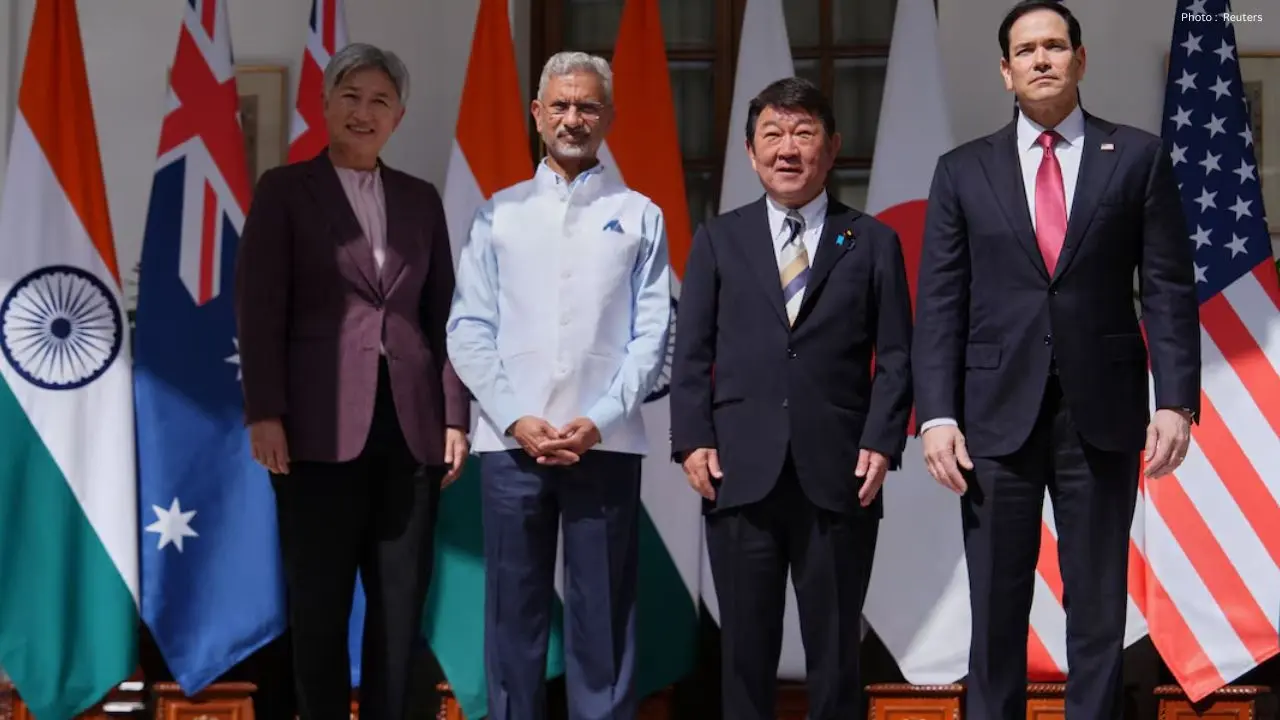
In a significant meeting, foreign ministers from India, the United States, Japan, and Australia convened in New Delhi, aimed at reinforcing regional security, economic collaboration, and the evolving dynamics of the Indo-Pacific region.
This gathering spotlighted the Quad alliance amid ongoing geopolitical rivalries, maritime security dilemmas, and economic pressures shaping international relations within Asia and beyond.
The Quadrilateral Security Dialogue—known as the Quad—unites four democratic nations striving to address matters related to regional stability, trade, technology, infrastructure, and defense partnerships.
While not a formal military alliance, the Quad has emerged as a vital strategic platform facing heightened tensions in the Indo-Pacific.
During the discussions in New Delhi, the ministers focused on various cooperative initiatives encompassing maritime security, resilience in supply chains, disaster response, technological alliances, and economic growth.
The meeting echoed rising concerns regarding China’s influence across the Indo-Pacific. Although officials refrained from direct confrontations in their public remarks, the dialogue included essential regional security topics.
China has often criticized the Quad, perceiving it as a relic of Cold War strategies aimed at curbing its influence in Asia. Nevertheless, Quad members assert their consolidated efforts aim at fostering a free, open, and stable Indo-Pacific.
India’s strategic position, economic expansion, and diplomatic reach in Asia have made its involvement in the Quad increasingly significant. The decision to host the meeting in New Delhi also underlines India's growing diplomatic stature.
The United States regards the Indo-Pacific as a key focus of its foreign policy, enhancing cooperation with regional allies amid rising competition with China across sectors such as trade, technology, and military influence.
Japan and Australia remain deeply integrated into regional security strategies due to concerns about maritime conflicts, vulnerabilities in supply chains, and geopolitical fluctuations.
Experts suggest that the Quad aims to fortify its relevance by broadening its focus beyond solely military matters. The alliance is now also emphasizing infrastructure, emerging technologies, climate collaboration, healthcare partnerships, and economic resilience.
This wider focus may bolster regional ties while allowing the Quad to position itself as a constructive force for long-term development rather than merely a vehicle for strategic rivalry.
The New Delhi meeting occurs against a backdrop of significant geopolitical transformations around the globe. Conflicts in Europe, turbulence in the Middle East, and trade tensions elevate the urgency for nations to enhance their diplomatic and strategic partnerships.
For India, juggling relations with Western powers and regional players poses a notable diplomatic challenge. New Delhi has persistently sought strategic autonomy while broadening its cooperation with various global partners.
The Quad illustrates shifting security dynamics throughout Asia. Key maritime pathways in the Indo-Pacific hold tremendous significance for international trade, energy flow, and economic stability, with any disruption potentially impacting global markets.
Consequently, regional powers increasingly emphasize naval partnerships, infrastructure investments, and technological collaborations to foster enduring stability.
Analysts note that the Quad’s success hinges on member nations’ ability to uphold unity despite differing economic priorities and diplomatic agendas.
Each nation’s individual relationship with China complicates strategic coordination. However, the escalating concern over regional security continues to drive the four countries toward deeper collaboration.
The meeting also sends a crucial diplomatic message about the escalating relevance of multilateral alliances in contemporary global politics. Nations increasingly depend on collaborative platforms to tackle security, economic, and technological challenges.
For smaller states in the Indo-Pacific, the Quad’s initiatives are scrutinized closely, as regional partnerships could shape trade prospects, infrastructure initiatives, and geopolitical stability.
Yet, experts warn that growing competition among major global powers might intensify tensions if diplomatic communication declines.
Thus, the New Delhi meeting signifies both an ambition to enhance regional cooperation and a reflection of broader geopolitical rivalries influencing the current global landscape.
As the Indo-Pacific ascends as a strategically pivotal area worldwide, the Quad’s role is set to retain high international prominence in the years ahead.