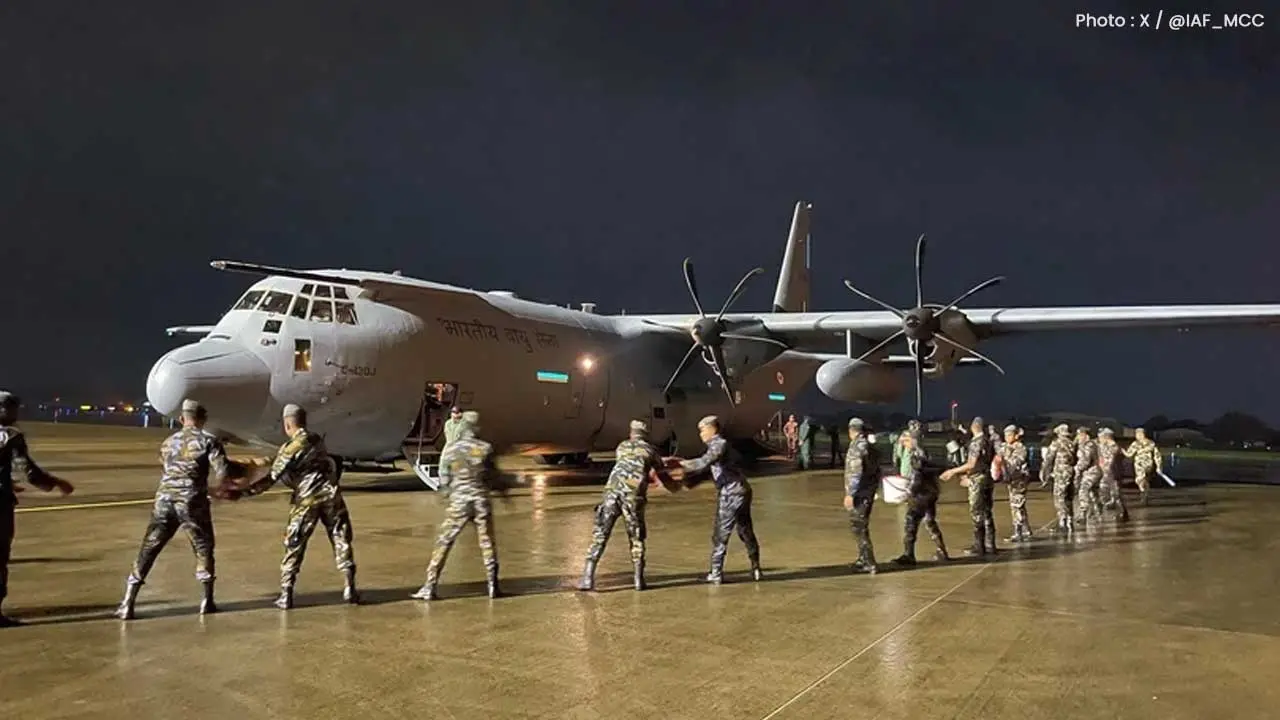
Cyclone Ditwah has wreaked havoc in Sri Lanka, leading to significant flooding that has severed ground communications. In a noteworthy act of technologically-enabled humanitarian assistance, the Indian Army has implemented satellite internet to revive essential communication channels in affected areas. This initiative, utilizing Eutelsat's OneWeb Low Earth Orbit (LEO) satellite network alongside Airtel, underscores the critical role of satellite connectivity in disaster relief operations.
The flooding from Cyclone Ditwah paralyzed terrestrial communication systems, isolating entire communities and complicating rescue and relief efforts. As part of Operation Sagar Bandhu, India’s extensive Humanitarian Assistance and Disaster Relief initiative, the Indian Army employed OneWeb satellite terminals to restore secure, high-speed internet connections. This setup allowed for ongoing telemedicine consultations with doctors based in India, providing urgent guidance for treating the injured and at-risk individuals. Furthermore, this connectivity facilitated coordination among rescue teams, improved logistics, and provided real-time situational updates, proving vital for a successful disaster response.
This deployment serves as a vital example of leveraging satellite internet for disaster resilience. Conventional communication networks tend to collapse during emergencies such as floods and cyclones. In contrast, LEO satellites provide quick deployment, extensive coverage, and low latency, effectively bridging critical communication gaps during crises. Neha Idnani, Eutelsat's Regional Vice President for APAC, highlighted the necessity of reliable communications amid crises, stating that secure connectivity is essential for preserving lives and facilitating vital services.
Even with the success of this initiative, widespread adoption of satellite internet in India encounters regulatory hurdles. At present, Eutelsat functions under a limited testing license, while other international providers, including SpaceX’s Starlink, await regulatory clearance to enter the Indian market. Experts view the large-scale introduction of satellite broadband as a transformative opportunity for enhancing connectivity in remote regions, border areas, and zones affected by disasters; however, challenges surrounding spectrum allocation, licensing, and security persist. The collaboration between the Indian Army, Eutelsat, and Airtel exemplifies the transformative potential of satellite connectivity within humanitarian efforts.
Initiated on November 28, Operation Sagar Bandhu illustrates India’s role as a proactive first responder in the region. Over 53 tons of aid have been dispatched, NDRF search-and-rescue teams have been deployed, and naval and air force assets have successfully evacuated stranded individuals, including foreign citizens. More than 2,000 Indians have been airlifted to safety, reaffirming India’s strategic position in the Indian Ocean under its Neighbourhood First doctrine and the Vision MAHASAGAR initiative.
As climate-induced disasters become more frequent and severe, resilient communication networks will be paramount for effective disaster responses. Satellite internet, whether from OneWeb, Starlink, or other future systems, provides critical support when conventional infrastructures fail. For India, the task lies in developing a regulatory framework that balances security concerns with technological advancements, unlocking the complete potential of space-based broadband for humanitarian, civil, and strategic uses.
This groundbreaking deployment during Sri Lanka’s Cyclone Ditwah exemplifies how innovation, strategic foresight, and global collaboration can save lives and support communities during crises, establishing a benchmark for future relief operations.