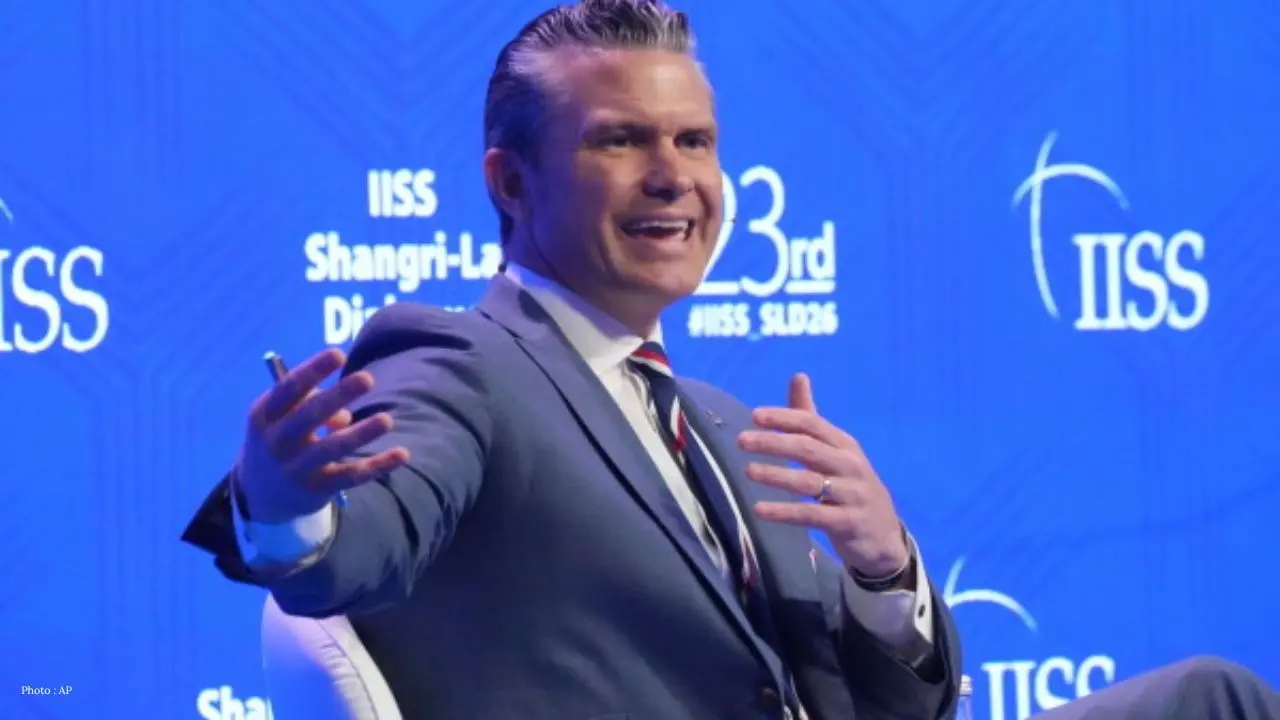
US Defense Secretary Pete Hegseth used his speech at the Shangri-La Dialogue security summit in Singapore to deliver one of the clearest messages yet about the foreign policy direction of President Donald Trump’s administration. His remarks focused on military strength, stronger alliances, and growing concerns about China’s expanding influence in the Indo-Pacific region. The speech offered important clues about how the United States plans to deal with global security challenges in the coming years.
Speaking before defense leaders, military officials, and policymakers from across the world, Hegseth warned that China’s rapid military expansion is creating serious concerns for regional stability. He said the United States wants to maintain a balance of power in the Indo-Pacific and prevent any single country from dominating the region. While he avoided some of the stronger language used in previous years, he made it clear that Washington remains deeply concerned about Beijing’s military activities and strategic ambitions.
One of the strongest themes of Hegseth’s speech was the idea that American allies should take greater responsibility for their own defense. He argued that the United States can no longer carry the security burden alone and that wealthy partner nations must invest more money and resources into their military capabilities. According to Hegseth, strong alliances should be based on equal contributions rather than relying heavily on American military power. This reflects a major principle of the Trump administration’s foreign policy approach, which emphasizes burden-sharing among allies.
Hegseth also praised several Indo-Pacific partners, including India, Australia, Japan, and South Korea, for increasing defense spending and strengthening military cooperation with the United States. He described India as a key strategic partner and an important force in maintaining regional balance. He highlighted growing defense cooperation, military modernization efforts, and plans for joint defense production between Washington and New Delhi. These comments show that the United States sees India as an increasingly important partner in its long-term Indo-Pacific strategy.
Another major takeaway from the speech was the administration’s focus on military preparedness. Hegseth repeatedly emphasized that peace can only be maintained through strength. He said the United States is investing heavily in its defense industry, expanding weapons production, and rebuilding military capabilities to deter potential threats. This approach reflects the administration’s belief that strong military power is necessary to maintain stability and prevent conflict.
Despite his warnings about China, Hegseth also stressed the importance of maintaining communication with Beijing. He noted that military-to-military talks between the two countries have increased and described these contacts as important for reducing misunderstandings and avoiding accidental conflicts. His comments suggested that the United States is trying to balance competition with China while keeping diplomatic channels open. Analysts viewed this as a softer tone compared to previous speeches, especially after recent meetings between President Trump and Chinese President Xi Jinping.
The speech also highlighted Washington’s broader vision for the Indo-Pacific region. Hegseth said the United States wants a network of strong and self-reliant partners that can work together to maintain regional security. Rather than creating new alliances or expanding diplomatic forums, he argued that countries should focus on building real military capabilities and practical defense cooperation. This reflects a more realistic and security-focused foreign policy strategy.
Political analysts say the Shangri-La Dialogue speech provides a clear picture of how the Trump administration views global affairs. The administration appears committed to maintaining a strong military presence in Asia, strengthening partnerships with regional allies, and countering China’s growing influence. At the same time, it expects allies to contribute more to collective security and reduce dependence on American resources.
Overall, Hegseth’s remarks revealed a foreign policy centered on military strength, strategic competition with China, stronger defense partnerships, and increased responsibility for allied nations. The speech signaled that the United States plans to remain deeply involved in Indo-Pacific security while pushing partners to play a larger role in protecting regional stability. As tensions continue to shape global politics, these policies are likely to influence America’s relationships with allies and rivals for years to come.