Director Babak Anvari, known for his distinctive psychological storytelling, returns with a haunting new film, “Hallow Road,” which releases in theaters this Friday. Written by William Gillies, the 80-minute thriller abandons traditional jump scares and elaborate horror setups for something far more unsettling — a minimalistic narrative built entirely on tension, ambiguity, and the terrifying power of imagination.
Unlike conventional horror films that thrive on visual shocks and grotesque imagery, “Hallow Road” focuses on atmosphere and psychological unease. Anvari, who gained recognition for films such as Under the Shadow and Wounds, uses silence, confined spaces, and emotional intensity to create a sense of dread that lingers long after the credits roll.
The story begins in the dead of night. At 2 a.m., the camera pans across a forest floor covered in leaves, revealing a bloodied sneaker — a quiet but disturbing sign of violence. The next shot cuts to an empty family home, where a dinner table remains set, glass is shattered, and the remnants of an interrupted evening suggest something terrible has occurred. These images, lasting nearly six minutes before any dialogue is spoken, immediately establish the tone: mysterious, tense, and deeply uncomfortable.
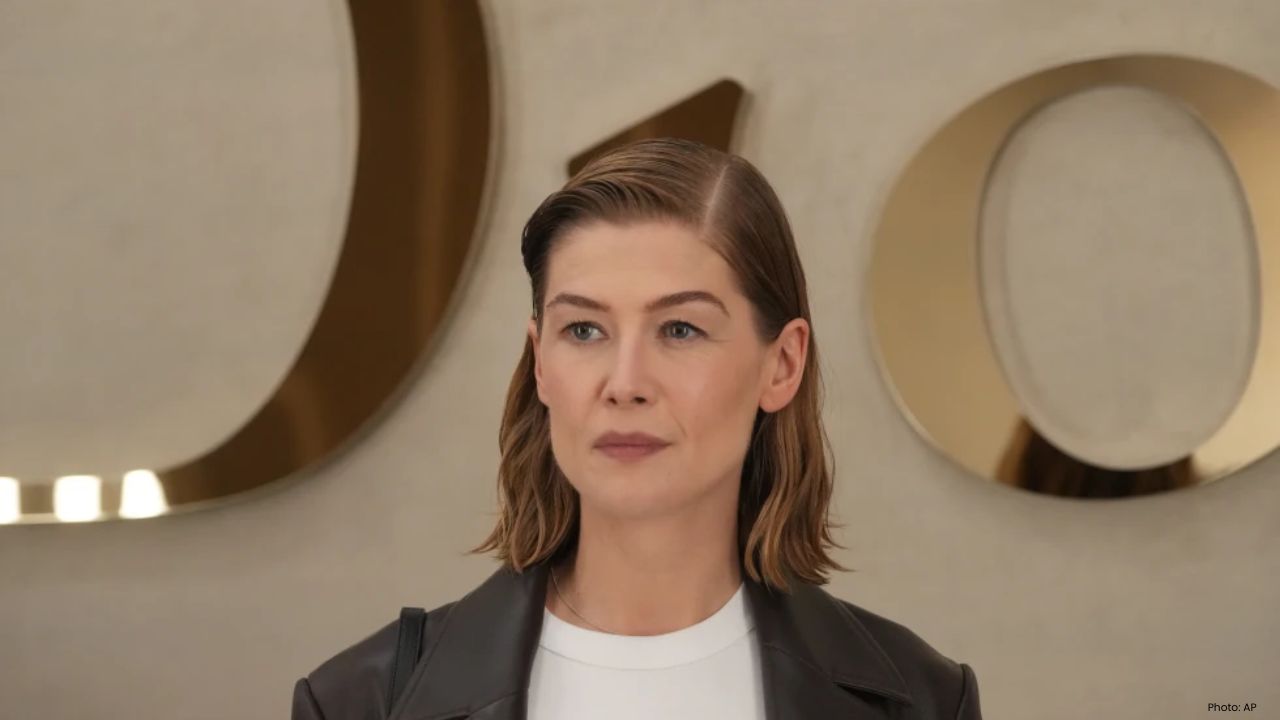
The film then shifts to its central characters — Maddie, played by Rosamund Pike, and her husband Frank, portrayed by Matthew Rhys. The couple’s strained family dynamic comes to light when Maddie receives a late-night phone call from their daughter Alice, played by Megan McDonnell, a university student who has stormed out of the house after an argument. The tension builds quickly when Alice, using her father’s car, gets into a serious accident on a remote forest road. Another person may be injured or dead.
As Maddie and Frank rush to the scene, the film unfolds almost entirely in real time, capturing the claustrophobia of being trapped in a moving car with limited information and mounting fear. Much of the story takes place through fragmented phone conversations, with Maddie trying to calm her panicked daughter and instructing her on how to perform CPR while waiting for help to arrive. The audience, hearing the same broken calls and snippets of information, experiences the same helplessness as the parents.
Anvari’s approach turns a simple premise into a tense, emotionally charged experience. The confined setting recalls the one-location storytelling of Steven Knight’s Locke (2013), yet Hallow Road trades that film’s sleek visuals for raw immediacy. The shaky camera work, muted lighting, and natural sound design create a chilling sense of realism.
Beyond the thriller elements, the film delves into the emotional turmoil of parenthood — the fear of losing a child, the guilt of past mistakes, and the desperate instinct to protect at all costs. As the night progresses, it becomes clear that Maddie and Frank’s marital and parental conflicts are as central to the story as the unfolding mystery. Both parents have differing views on how to help their daughter — one advocating calm rationality, the other overt control — mirroring the complex dynamics many families face under stress.
Adding to the unease is a faint hint of folklore or supernatural suggestion woven into the plot, leaving audiences unsure whether the events are purely real or touched by something beyond understanding. Anvari and screenwriter Gillies use ambiguity as their greatest weapon, letting viewers project their own fears into the void left by what the film refuses to show.
Performances play a crucial role in sustaining the intensity. Rosamund Pike delivers a controlled yet deeply emotional portrayal of a mother torn between composure and panic. Matthew Rhys complements her performance with quiet frustration and suppressed fear, creating a believable and heartbreaking dynamic. Megan McDonnell, though heard more than seen, brings raw authenticity to Alice’s terrified voice, making her off-screen presence feel immediate and real.
Cinematographer Anna Valdez captures the eerie darkness of rural roads and shadowy interiors with minimal lighting, while composer Martin Phipps’s sparse score amplifies every breath and silence. The production design, too, mirrors the emotional decay within the family, using ordinary settings — a car, a home, a forest — to reflect psychological confinement.
At just 80 minutes, Hallow Road moves with precision, never overstaying its welcome. Its strength lies in what it withholds rather than what it shows, trusting viewers to fill in the blanks. The result is a film that lingers — not for its shocks, but for its haunting quiet and the relatable terror of uncertainty.
As Halloween approaches, Hallow Road stands apart from the usual gore-heavy releases. It’s an intimate horror experience — one that captures the true essence of fear: not knowing what’s out there, and realizing that sometimes the real horror lies within.