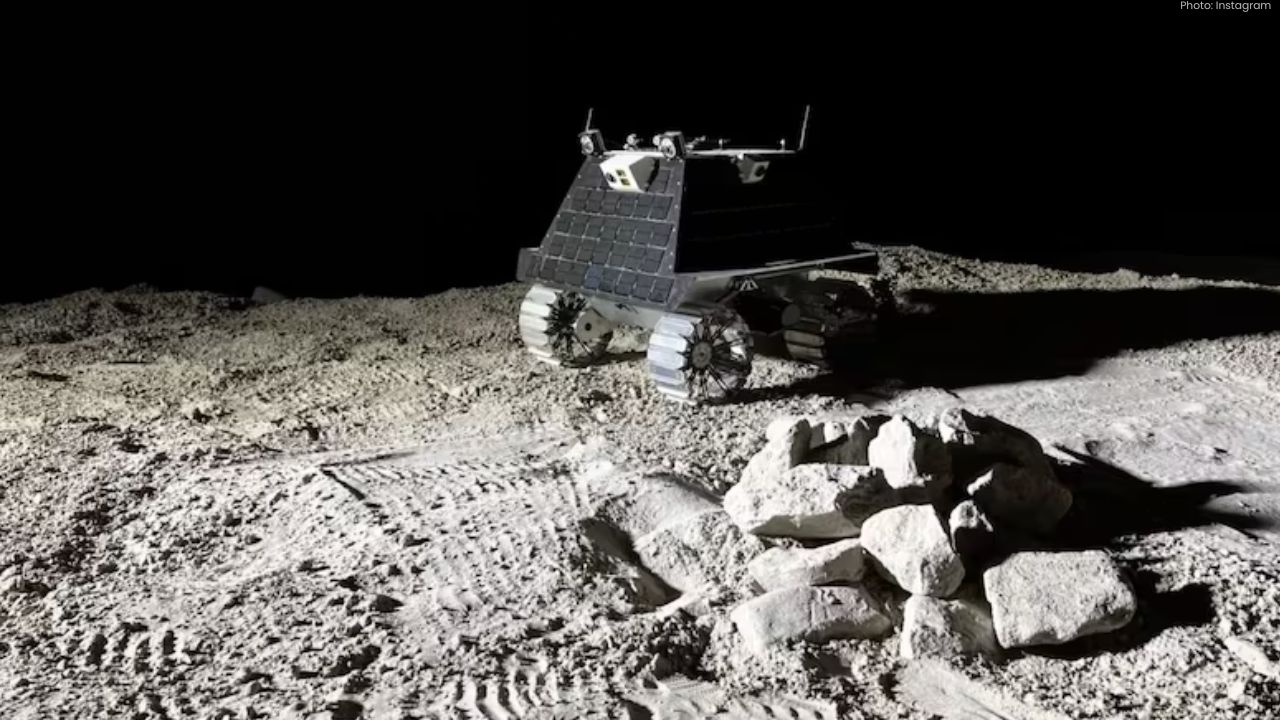
A short drive from Toronto, in a quiet shopping plaza between a day spa and a shawarma restaurant, sits a two-storey building with shiny blue-tinted windows that reflect the summer sun. This unassuming office is the headquarters of Canadensys Aerospace, the Canadian company tasked with an extraordinary mission: sending the first Canadian-built rover to the Moon.
This mission will mark Canada’s first ever-led planetary exploration. While Canada has contributed to space programs in the past, such as designing the Canadarm for the Space Shuttle and the International Space Station, this project represents the first time Canada is taking the lead in exploring another celestial body.
Canadensys: A Hub of Space Innovation
Inside Canadensys, the walls are decorated with maps of the Moon, models of spacecraft, and posters of galaxies far away. Engineers in anti-static white coats work carefully on machines that look unlike anything found on Earth.
Dr Christian Sallaberger, the president and CEO of Canadensys, told the BBC that sending this rover is part of the company’s larger vision to move humanity beyond Earth. "Learning about the Moon is the logical first step," he said, emphasizing that while people are inspired by science fiction movies like Star Wars or Star Trek, this is a real, tangible mission.
Prototypes of the rover sit on tables in the lab, one painted white and another grey, with the Canadian flag proudly displayed in the background.
A Canadian Rover for NASA’s Artemis Programme
The rover is part of NASA’s Artemis Programme, a major international initiative to establish a sustainable human presence on the Moon. Canadensys’ rover has a clear set of objectives: it will look for water, measure radiation, and test technology that could support future manned lunar missions.
The vehicle must survive multiple lunar nights, which last about 14 Earth days, facing extreme temperature swings. Daytime on the Moon can reach a scorching 100°C (212°F), while nighttime drops to a freezing -200°C (-328°F). Designing a rover to withstand such conditions is one of the mission’s biggest engineering challenges, according to Dr. Sallaberger.
Another challenge is the Moon’s surface itself. Covered in a jagged layer of rock and dust called regolith, the lunar soil is nothing like Earth’s round and smooth dirt. Dr. Sallaberger compared it to Velcro, noting that it can easily jam mechanisms if not designed properly.
The Importance of Lunar Water
The search for water on the Moon is one of the most exciting parts of the mission. For decades, scientists thought the Moon was completely dry. That view changed in 2008 when researchers re-analyzed samples collected during the Apollo missions and discovered tiny particles of water.
Dr Gordon Osinski, the mission’s chief scientist and a professor at Western University in London, Ontario, explained that while water has been detected from orbit, it has yet to be confirmed on the ground. The exact amount and location remain unknown. It could be small grains mixed with lunar soil or larger patches of ice, possibly in craters at the Moon’s south pole.
Water is a crucial resource for long-term lunar exploration. It could supply drinking water for astronauts or be split into hydrogen and oxygen for rocket fuel. In Dr. Osinski’s vision, the Moon could one day serve as a refuelling station for spacecraft, turning science fiction ideas into reality.
Canadensys’ Journey
Canada has dreamed of building a lunar rover for decades. Talks began in the early 2000s, but concrete plans only appeared in 2019. Canadensys, founded in 2013, won a C$43 million contract in 2022 to build the rover. The company has already contributed more than 20 instruments to various space missions, showing its expertise in aerospace engineering.
The rover, which weighs 35 kilograms, is planned to launch at the earliest in 2029. Its landing site will be the Moon’s south polar region, one of the harshest environments on the lunar surface.
Challenges of Lunar Landing
Landing on the Moon is never easy. Recent attempts by other companies have ended in failure. In March, Intuitive Machines’ spacecraft tipped over during landing, ending the mission. A few months later, Japan’s iSpace Resilience lost contact with Earth while landing.
Dr. Sallaberger emphasized the risks involved, saying, "Things do go wrong, and we try to do the best we can to mitigate that." Despite these risks, the mission continues, demonstrating Canadensys’ commitment to advancing space technology.
A New Era of International Collaboration
Space exploration has traditionally been collaborative, with countries like the United States, Russia, and Canada working together on the International Space Station. However, as missions aim for permanent Moon bases, questions about ownership and resources are emerging.
In 2021, the US passed a law protecting the Apollo landing sites, concerned that other countries might disturb them. Dr. Osinski noted that the Artemis Accords, signed by over 50 countries, promote peaceful and sustainable exploration, showing that international cooperation is still possible.
Private companies are also opening up space. SpaceX, Blue Origin, and others are offering commercial space flights, allowing wealthy individuals like Jeff Bezos and even celebrities to briefly experience space. But the Moon remains the ultimate goal, offering opportunities for scientific discovery and human expansion.
The Future of Canadensys and Lunar Exploration
Canadensys is already thinking beyond the rover. Future projects include lunar greenhouses to grow food on the Moon. While these ideas are still years away, the rover represents the first step toward a long-term human presence on the Moon.
Dr. Sallaberger explained, "If you design something that can survive on the lunar surface long-term, you’re pretty bulletproof anywhere else in the solar system."
In addition, the Canadian Space Agency held a contest to name the rover, reflecting public interest and pride in the project. While a name has not yet been announced, the mission itself is a source of inspiration for the next generation of scientists and engineers in Canada.