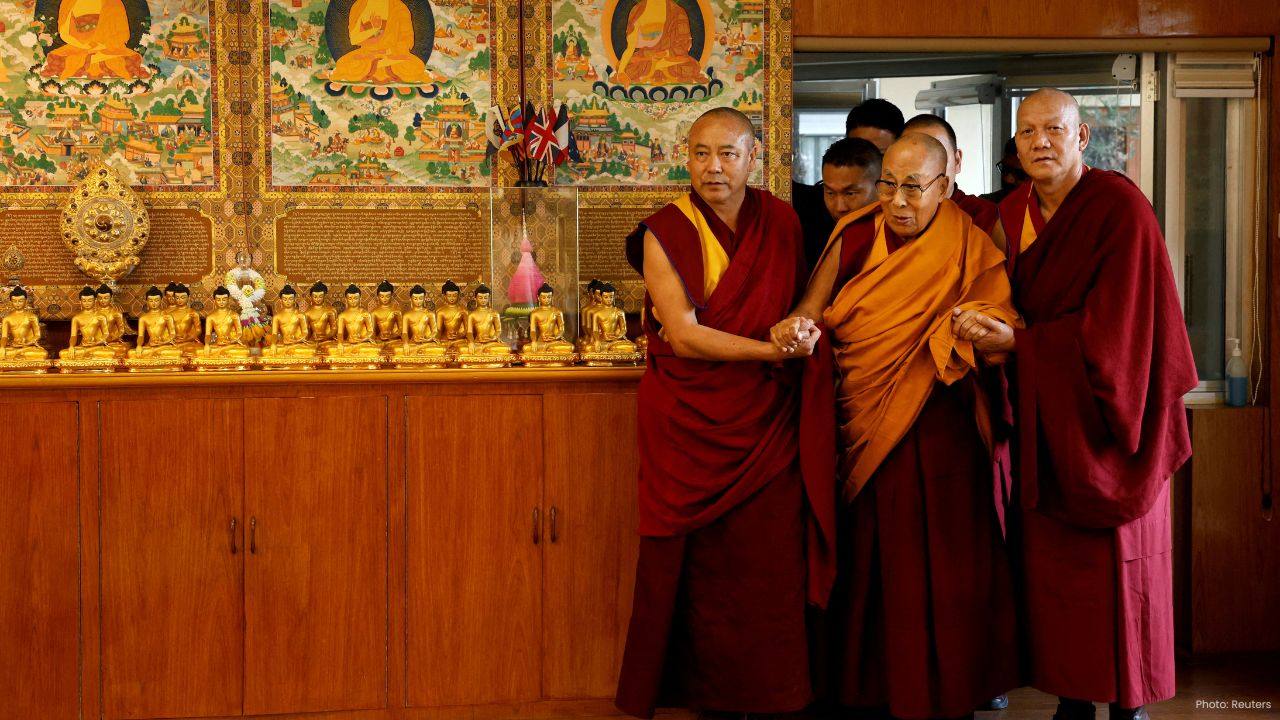
The Tibetan government-in-exile is calling on Canada to back its authority over the succession of the Dalai Lama, challenging China’s claim to control the selection of the next spiritual leader.
Appeal to Canada Amid China Ties
Penpa Tsering, head of the Central Tibetan Administration (CTA), currently based in India, is visiting Ottawa this week to request Canadian support. China, which has governed Tibet since 1950, insists that it alone has the power to approve the Dalai Lama’s reincarnation.
“We need support from as many free and democratic countries as possible to express their opinion on religious freedom,” Tsering said. “In Tibet, that includes freedom to choose our own reincarnation.”
The appeal comes as Prime Minister Mark Carney seeks to repair diplomatic ties with Beijing, strained after a rupture in 2018.
Dalai Lama Sets His Own Succession Rules
In July, the 90-year-old Dalai Lama stated that a non-profit institution he established will have sole authority to identify his successor. He emphasized that the next spiritual leader can be of any gender and may be born outside of Tibet. Beijing, however, views the Dalai Lama as a separatist and has threatened to assert control over his succession.
International Support for Tibetan Autonomy
Tsering noted the reluctance of many governments to confront China due to economic interests, but pointed to growing global awareness of Beijing’s authoritarian actions, including its crackdown in Hong Kong, threats to Taiwan, and repression of Uyghurs in Xinjiang.
The U.S. Congress passed a law in 2020 affirming that the selection of Tibetan Buddhist leaders, including the Dalai Lama, is a religious matter free from Chinese interference. Several European Union countries, including France, the United Kingdom, and Germany, issued a joint statement this summer rejecting state-led interference in the Dalai Lama’s succession.
Calls for Recognition of Tibet and Criticism of Chinese Policies
The CTA also urges Canada to recognize Tibet’s historical status as an independent state with a distinct culture and political identity. Tsering highlighted the plight of Tibetan children in Chinese-run boarding schools, which he described as “forced assimilation” aimed at erasing Tibetan identity.
“You are taught only in Mandarin, indoctrinated with Communist Party ideology, and some schools conduct military drills for children,” he said. “Children are taken away from their families, their culture, and their religion.”
Background on the Tibetan Government-in-Exile
Since fleeing Tibet in 1959 after a failed uprising, the Dalai Lama and the CTA have operated out of Dharamshala, India. The government-in-exile advocates for Tibetan autonomy but lacks formal recognition as a sovereign state.
The Department of Global Affairs Canada has not yet commented on its position regarding the Dalai Lama’s succession. Mr. Tsering’s visit signals ongoing international efforts to protect Tibetan cultural and religious autonomy in the face of Chinese authority.