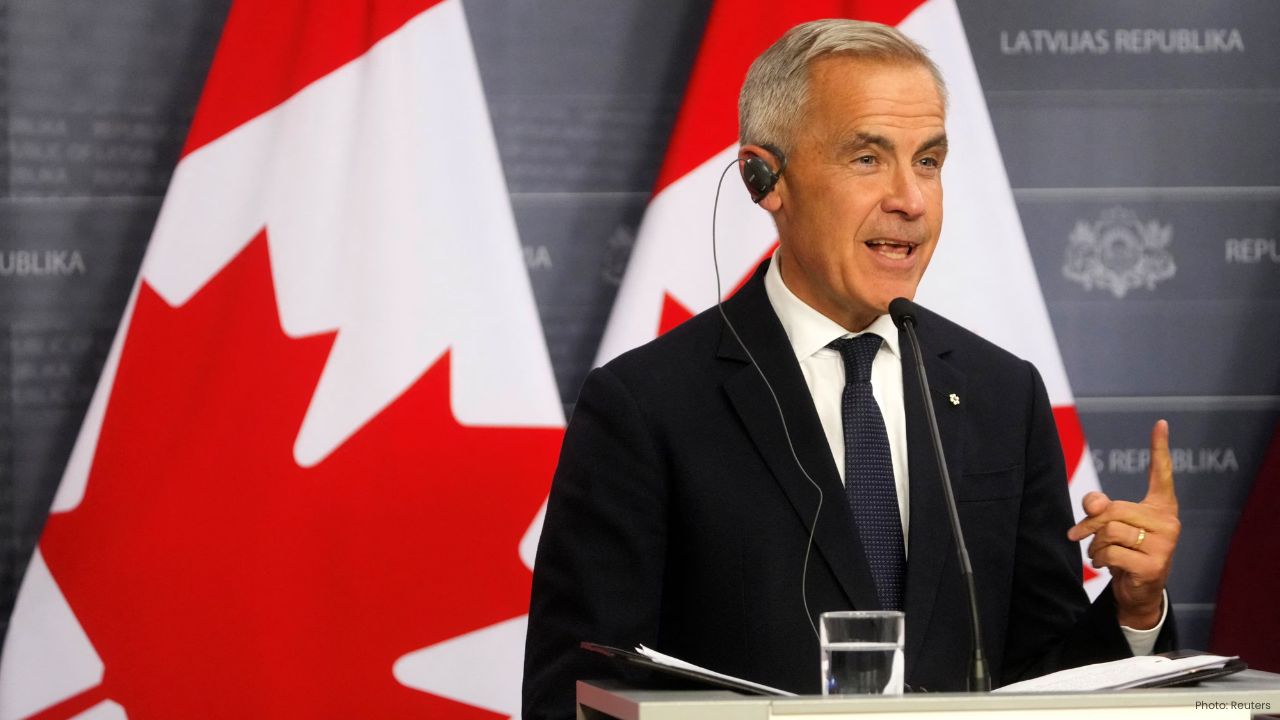
Prime Minister Mark Carney announced a comprehensive set of measures on Friday aimed at transforming Canada’s economy into a stronger and more resilient force capable of withstanding trade disruptions caused by the United States under President Donald Trump. The government’s new economic strategy targets the support of workers and businesses most affected by tariffs and other trade uncertainties.
“If you look back at our country’s history, we have always turned challenges into opportunities,” Carney said in Mississauga, Ontario. “Now, at this moment of profound change, we must carry the same responsibilities and embrace the same ambitions as those who came before us.”
Carney emphasized the need to act immediately. “We know we need to act now. Invest now. Precisely when it’s hard. We are charting an economic strategy to move Canada from reliance to resilience, from uncertainty to prosperity.”
Pausing the Electric Vehicle Mandate
A significant part of the government’s plan includes pausing the electric vehicle (EV) mandate. This mandate originally required new zero-emission vehicles (ZEVs) to reach 20 percent of new vehicle sales by next year, 60 percent by 2030, and 100 percent by 2035 to help Canada achieve its emission reduction targets.
Under the new plan, the EV mandate will be waived for the 2026 model year, giving the auto industry more flexibility. Additionally, the government will launch a 60-day review of the policy to assess its long-term effectiveness.
Carney stated that the government is focused on boosting “climate competitiveness” across the economy while restructuring key sectors, including automotive manufacturing. He also noted that it is too early to say whether tariffs on Chinese EVs will be lifted.
A government release highlighted that pausing the mandate and implementing other measures will allow workers to gain new skills, help businesses retool, and increase domestic demand across sectors.
Supporting Workers with Reskilling and Job Programs
To assist workers affected by trade shocks, the government will introduce a new “reskilling package” aimed at helping up to 50,000 Canadians upgrade their skills. Training can be accessed through employers or recruitment companies.
Additionally, new employment insurance (EI) claimants will be automatically enrolled in a job-matching program. The government will also introduce a “skills-to-job” platform, designed to make job searches easier and connect people quickly with training, career counseling, and new employment opportunities.
For laid-off workers, the government is extending EI benefits from the current 45 weeks to 65 weeks for long-tenured employees. Carney also announced that the one-week waiting period for receiving benefits will be waived for up to 700,000 workers.
Introducing a $5-Billion Strategic Response Fund
To support Canadian businesses in adapting to trade disruptions, the government is launching a $5-billion strategic response fund. This fund aims to help companies develop new products, access new markets, and maintain competitiveness.
“The fund will be open to all sectors given that tariff impacts are wide-ranging and touch nearly every industry in Canada,” Carney explained.
The measures form part of a wider government strategy combining loans, training, policy updates, and market development programs. By helping workers, supporting businesses, and investing in domestic demand, Canada hopes to reduce reliance on external trade conditions and build a more resilient economy.
This strategy marks a proactive step by Canada to safeguard its economy amid growing global uncertainty. With a mix of reskilling programs, financial support for businesses, and a careful review of environmental policies like the EV mandate, the government aims to ensure that both workers and industries can thrive despite external challenges.
Prime Minister Carney concluded, “Canada has always turned challenges into opportunities. Today, we continue that tradition by investing in our people, our industries, and our future. Resilience is our path to prosperity.”