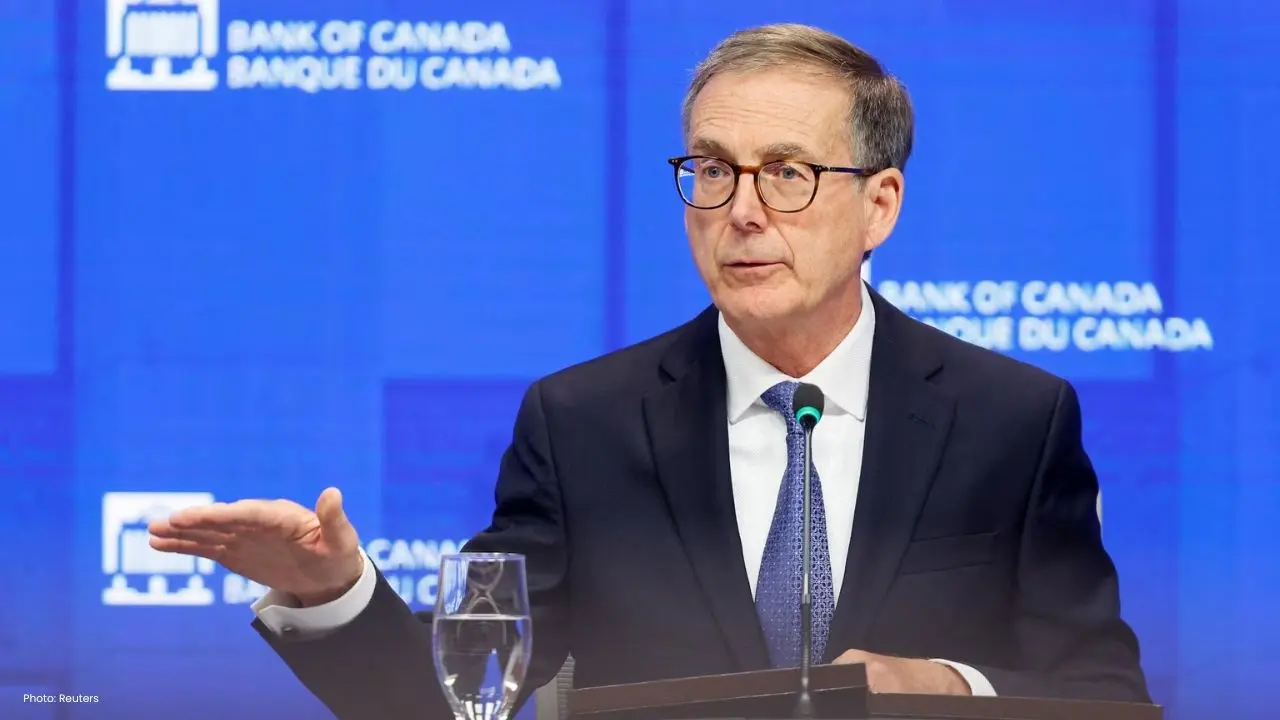
The Bank of Canada is expected to keep its benchmark interest rate unchanged this week, ending the year on the sidelines after multiple unexpected signs of economic resilience.
The central bank last reduced its policy rate in October to 2.25 per cent. At the time, officials suggested that would likely mark the end of a year-and-a-half easing cycle. Since then, incoming data on inflation, output and employment have surprised analysts, showing the economy has weathered U.S. tariffs better than anticipated.
Four rate cuts were delivered in 2025, adding to nine reductions since mid-2024. Market expectations now point to the bank holding rates steady for most of 2026, with the probability of a rate hike now greater than another cut.
In contrast, the U.S. Federal Reserve is expected to lower its benchmark by a quarter point this week, bringing the fed funds rate to 3.5 per cent from 3.75 per cent. Economists describe the Fed stance as still restrictive, given weakening U.S. labour conditions.
Recent Fed member comments have pointed to a cut, despite inflation remaining above the 2 per cent target and data delays linked to the U.S. government shutdown.
Looking ahead, uncertainty surrounds who will lead the U.S. central bank next year. Kevin Hassett, a close ally of President Donald Trump, is seen as the frontrunner and is expected to favour lower borrowing costs.
Conditions in Canada appear clearer. Bank of Canada Governor Tiff Macklem said in October that rates were “at about the right level” to keep inflation near target while helping the economy adjust. Any further easing, he added, would require a material deterioration in the outlook.
Recent numbers support that wait-and-watch approach. Annual CPI inflation stood at 2.2 per cent in October, and core measures remain near 3 per cent. Labour market data point to gradual improvement, with 54,000 jobs added in November and unemployment falling to 6.5 per cent.
Economic output also firmed in the third quarter, avoiding a technical recession. Although much of the 2.6 per cent annualized growth came from lower imports, the figure exceeded forecasts. Historical revisions to GDP for 2022 to 2024 indicate stronger momentum than previously believed.
Analysts say the firmer trend helps explain stickier-than-expected core inflation and raises questions about whether the central bank would have eased as aggressively had it known earlier.
Looking to 2026, risks remain, including the review of the USMCA trade agreement. However, policymakers emphasize that monetary policy is not the right tool to counter trade disruptions, noting the limits of interest rates in helping specific sectors adjust.
The central bank’s focus, they argue, is on preventing spillovers and supporting broader economic adjustment rather than responding directly to tariffs or trade uncertainty.