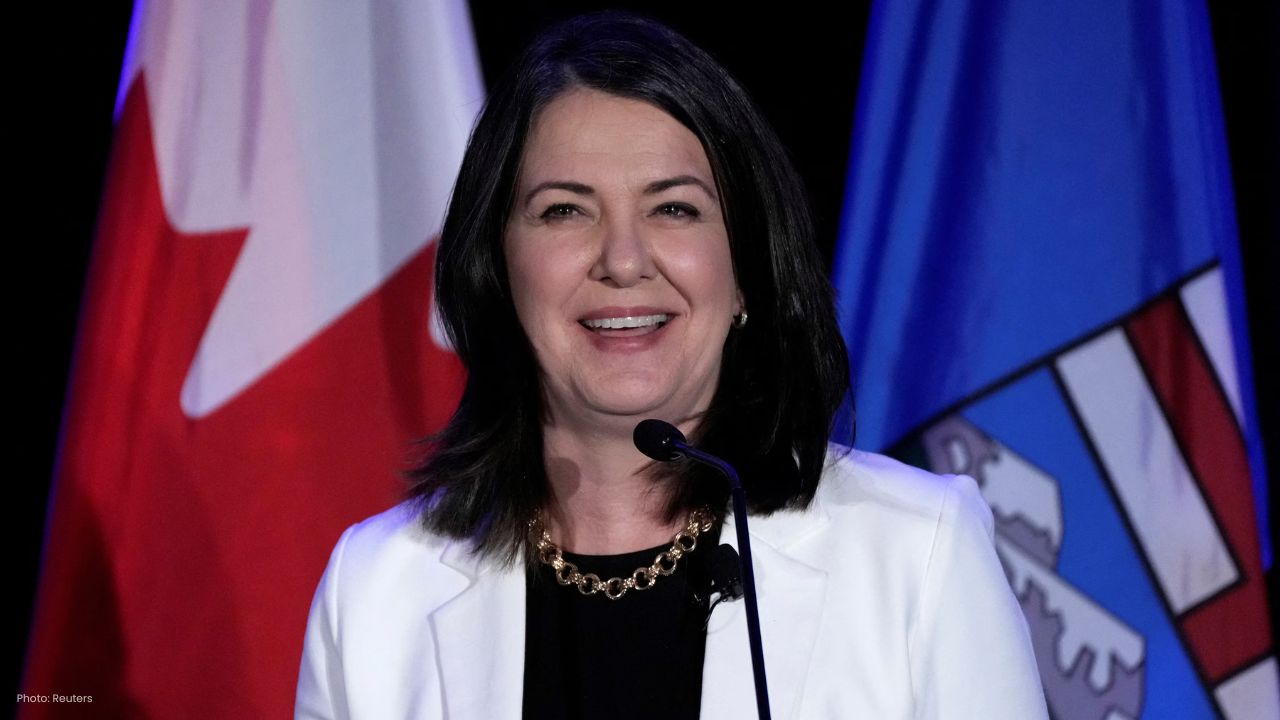
Alberta Premier Danielle Smith has expressed her support for Prime Minister Mark Carney’s second batch of key major projects being considered for fast-track approval. Carney announced Thursday that seven additional initiatives, primarily in the energy and infrastructure sectors, are being referred to the federal government’s Major Projects Office for review. This follows an initial list of five projects unveiled in September.
The second list includes a nickel mine in northern Ontario, a hydroelectric project in Iqaluit, a transmission line, and a liquefied natural gas (LNG) project in northwest British Columbia. Two additional mineral mining projects, located in Quebec and New Brunswick, were also selected.
Notably absent from the list is a bitumen pipeline that Smith and her government have been actively advocating for. Smith stated that negotiations with the federal government on the pipeline are ongoing. “Currently, we are working on an agreement with the federal government that includes the removal, carve out, or overhaul of several damaging laws chasing away private investment in our energy sector, and an agreement to work towards ultimate approval of a bitumen pipeline to Asian markets,” Smith said in a statement.
Smith emphasized that discussions are approaching a critical stage, with a decision expected soon on whether Carney’s government will support Alberta’s energy objectives or adhere to regulatory frameworks established under former Prime Minister Justin Trudeau. Smith had hoped to finalize an agreement ahead of this weekend’s Canadian Football League Grey Cup, but Carney noted Thursday that further discussions are needed over the coming weeks despite what he described as a productive “meeting of minds.”
“This is a very important process for the province, for the country,” Carney said. “We want to make sure we’re doing it right.”
Carney highlighted the federal government’s expectations for Alberta, calling on the province to make strategic investments to position its oil and gas industry for the energy future. “The future of energy, clean and conventional, is low risk, it’s low cost, and it’s low carbon,” he said. He also emphasized the importance of reducing the emissions intensity of Alberta’s oil and gas sector, noting that the trend is already moving in that direction. In addition, Carney wants Alberta’s carbon market and regulatory framework to provide greater certainty for future investments, though specific details were not provided.
Meanwhile, B.C. Premier David Eby voiced frustration over the continued focus on Smith’s proposed west coast pipeline. “There is no route, there is no proponent, there is no project,” Eby said. “It is a figment of a communication person’s mind in Alberta. If it goes ahead, it will only be because it is fully funded by taxpayers to the tune of $40 to $50 billion.”
None of the projects referred to the Major Projects Office have yet received a national interest designation. Such a designation would give a project special treatment, including potential exemptions from certain environmental laws, helping it advance more quickly. The Major Projects Office is responsible for reviewing submitted projects and providing recommendations, with the federal government holding the final authority to grant the national interest status.
Carney’s second batch of projects and ongoing negotiations with Alberta underscore the federal government’s effort to balance energy development with regulatory oversight, while provincial leaders like Smith continue to push for faster approval processes for key energy infrastructure.