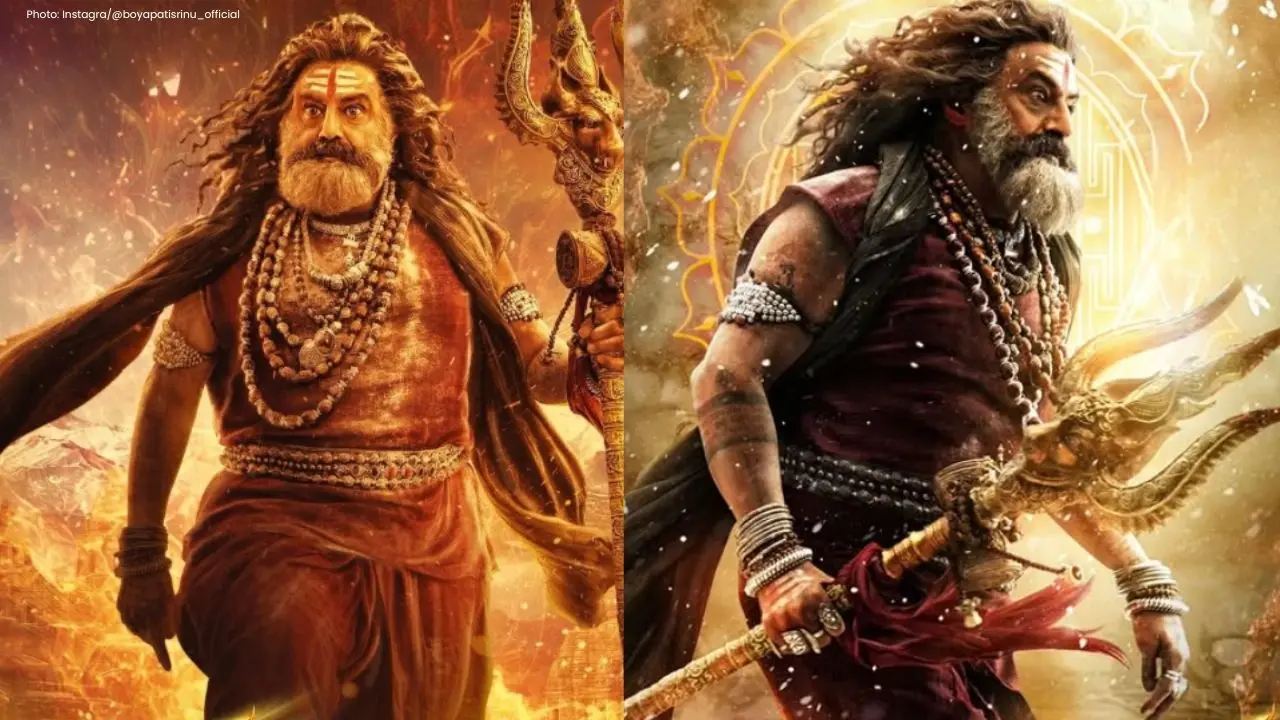
Boyapati Sreenu’s latest film, Akhanda 2: Thaandavam, opens with the director’s signature declaration that instantly signals what follows: logic is dismissed at the entrance and physics is nowhere in sight. With complete confidence and unapologetic exaggeration, Boyapati brings back his larger-than-life universe, led once again by Balakrishna in full mythic form.
The story centres on a neighbouring country that plans to destabilise India by attacking what it believes is the country's spiritual foundation, Sanatana Dharma. Their operation unfolds through an ambitious biowarfare attack aimed at the Maha Kumbh Mela. As the situation spirals, DRDO works on an antidote, and the crucial responsibility unexpectedly falls on Janani, a 16-year-old prodigy with an IQ of 266. She succeeds in creating the vaccine but becomes the primary target of the enemy forces.
Akhanda, her uncle who once vowed to appear whenever she needed him, returns with divine intensity to protect her and stop the looming biowar. What follows is a storm of supernatural action, ritual symbolism, black-magic detours, geopolitical showdowns, and Boyapati’s trademark one-man-army moments where Balakrishna’s character destroys entire battalions using only a trishul.
In typical Boyapati fashion, every character speaks in full-blown mass dialogue, turning even simple conversations into grand declarations. The film carries all the familiar elements — cultural references, festival backdrops, temple ambience, slow-motion reactions, exaggerated stunts, and long monologues. Comedy is absent, but a few self-aware lines manage to land effectively.
Action remains the film’s main attraction. Guns become stabbing weapons, helicopter blades are stopped mid-air, and enemies are sent flying with a single punch. Snow chases unfold with villains missing shots with near-comical creativity. Within each action block, Boyapati throws a dozen ideas at once — some ridiculous, some inventive, all carried by sheer conviction.
Despite this spectacle, the film’s seriousness often clashes with its writing. Themes like Sanatana Dharma, faith, geopolitics, and biowarfare are treated with dramatic weight but lack emotional grounding. The narrative relies on mass-myth logic rather than storytelling depth, making several moments feel convenient instead of impactful.
The geopolitical segments resemble a fusion of patriotic action and superhero fantasy — except here, national agencies, the Prime Minister, the police and RAW step aside because Akhanda alone is deemed enough to resolve the crisis. DRDO labs appear more like bright study centres, and complex threats are explained through divine lectures delivered to military officials.
Unintended humour emerges throughout, especially with melodramatic villains and exaggerated dialogues. A particularly amusing moment arrives when a general learns his son was killed “with one punch from an Indian soldier,” delivered with complete seriousness.
What prevents the film from collapsing under its scale is Thaman’s music. His pounding rhythms, ritual chants, and mass elevation soundscapes transform several scenes into larger-than-life moments. Without his score, much of the film’s impact would be significantly reduced.
Balakrishna anchors the film with complete conviction, dominating every frame with his presence and dialogue delivery. Harshaali Malhotra brings sincerity to her role as Janani, though the character warrants more depth. Aadhi Pinisetty is striking despite limited screen time, and Samyuktha experiments with a brief yet different role.
Technically, the film is competent, supported by decent cinematography, solid production values, and slightly uneven editing. The storyline remains thin, several characters are underutilised, and certain beats mirror the first film, often without the same dramatic precision.
Yet, despite its flaws, excesses, and accidental comedy, Akhanda 2 succeeds in delivering the wild, addictive Boyapati–Balakrishna energy that fans expect. This is not a film meant for logic; it is a spectacle designed for surrender. For viewers seeking loud action, divine elevation, explosive sequences, and a hero taking on an entire army with a trishul, the film delivers exactly what it promises.