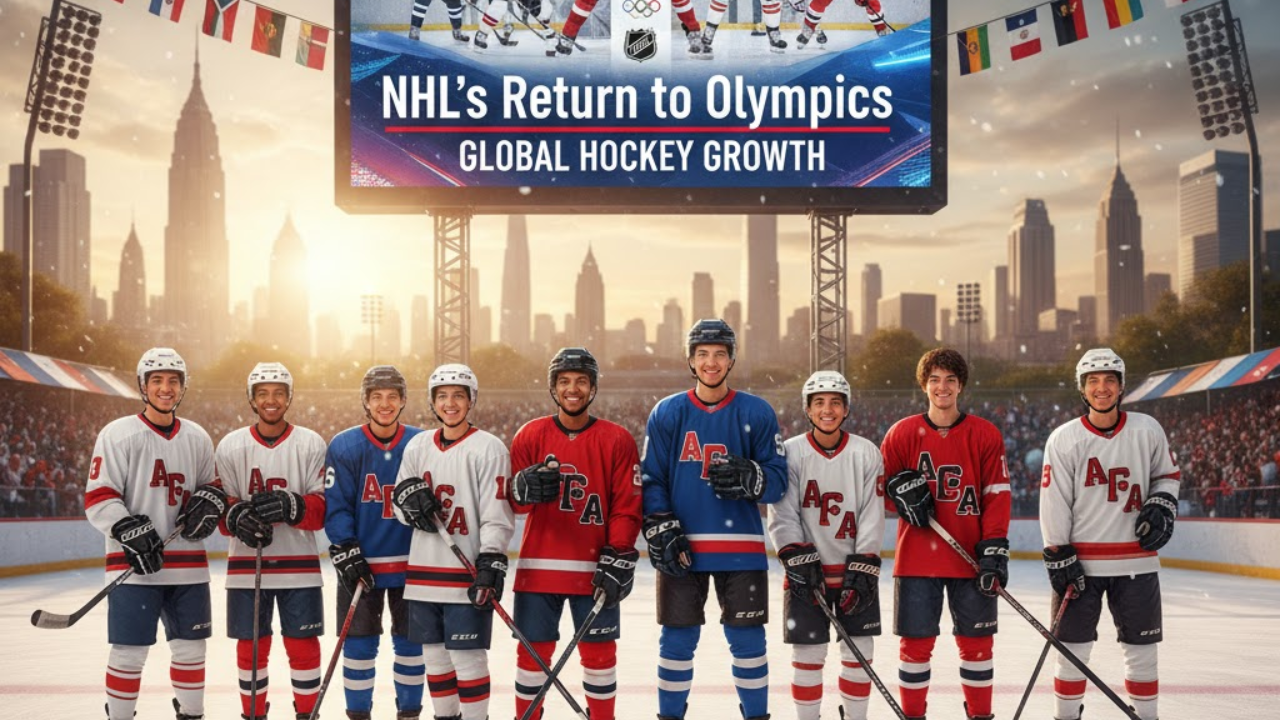
In October 2025, NHL Commissioner Gary Bettman confirmed that the league is doubling down on international competition as a central strategy to cultivate global talent and expand hockey’s footprint worldwide. This shift involves rejoining the Winter Olympics in 2026, reimagining marquee events like the 4 Nations Face-Off, and launching new tournaments such as the revived World Cup of Hockey. The move represents a prominent pivot from a North American-centric model toward a more globally integrated future.
For Canadian hockey stakeholders — fans, development programs, and national federations — this renewed emphasis promises both opportunity and renewed pressure to stay competitive at the world level.
The Strategic Shift: Why the NHL Is Going Global
Expanding Beyond Borders
The NHL has long dominated in North America, but its global influence has remained limited compared to leagues like the NBA or English Premier League. Bettman’s announcement highlights a fundamental shift in focus — from a regional league to a global sporting brand.
He emphasized that the league’s growth depends on engaging fans worldwide, particularly in emerging hockey markets across Europe and Asia. International competition, according to Bettman, is not just about fan interest; it’s about cultivating the next generation of players.
Today, nearly one-third of all active NHL players hail from outside the U.S. and Canada — a clear sign that hockey’s future depends on international development. By giving players more opportunities to represent their nations under the NHL banner, the league aims to strengthen global connections and attract new audiences.
Return to the Winter Olympics
A Long-Awaited Comeback
After missing consecutive Winter Games in 2018 and 2022, the NHL has confirmed its players will participate in the Milano-Cortina 2026 Winter Olympics. It will be the league’s first Olympic appearance in twelve years, since Sochi 2014.
Bettman acknowledged that pausing the NHL season for the Olympics presents scheduling and financial challenges. However, he stressed that the exposure and pride associated with the Olympics outweigh those concerns. For players, the opportunity to represent their country on the world stage remains one of the highest honors.
The decision also aligns with the league’s global ambitions. Olympic participation provides unmatched visibility — especially in Europe and Asia, where the NHL hopes to expand its influence. For fans in Canada, this announcement rekindles national excitement for best-on-best hockey after a decade-long absence.
The Rise of the 4 Nations Face-Off
A Successful Experiment
Earlier in 2025, the NHL replaced its All-Star Weekend with the 4 Nations Face-Off, a high-intensity international tournament featuring teams from Canada, the United States, Finland, and Sweden. The event proved to be an overwhelming success — both in competition and viewership.
The championship game between Canada and the United States drew record television ratings across North America. Fans embraced the concept of national teams composed entirely of NHL players, playing under professional league rules.
The format reintroduced the energy of best-on-best competition that fans have missed since the early 2000s, while allowing the NHL to maintain control over scheduling and player safety.
Encouraged by this response, Bettman confirmed that the 4 Nations format would become a recurring fixture — possibly replacing traditional All-Star weekends in future seasons.
The Roadmap Ahead: From the World Cup to Global Series
The World Cup of Hockey Returns
The NHL has officially confirmed plans to revive the World Cup of Hockey in 2028. Unlike the Olympics, which are governed by the International Ice Hockey Federation (IIHF), this tournament will be entirely controlled by the NHL and its Players Association.
Hosting the World Cup every four years ensures fans can witness top-level international play regularly, alternating with Olympic years. It also allows the league to tailor formats, broadcast schedules, and sponsorships to its liking, ensuring financial stability while maintaining player safety.
Global Series and Exhibition Matches
In addition to tournaments, the NHL’s Global Series will continue to bring regular-season games to international cities. Past matchups in Sweden, Finland, Germany, and even Australia have proven highly successful.
These games not only build local excitement but also showcase the NHL’s top talent to audiences that may never have seen a live professional game before. By strategically staging matches in key markets, the league aims to inspire young athletes and broaden hockey’s reach beyond its traditional strongholds.
What It Means for Canadian Hockey
Strengthening a Proud Tradition
Canada remains the heartbeat of world hockey. Every new international initiative, whether it’s the Olympics, 4 Nations Face-Off, or World Cup, only enhances the visibility of Canadian excellence in the sport.
Participation in these events gives Canadian players the chance to uphold their nation’s long-standing dominance while representing the NHL’s best. The country’s development programs and coaching infrastructure will likely benefit from the raised standards and global exposure that come with such tournaments.
The Challenge of Competition
However, as the NHL works to globalize the sport, Canada faces new challenges. European hockey systems — particularly in Finland, Sweden, and Germany — are rapidly improving. As player development becomes more international, Canada’s advantage may shrink.
For Hockey Canada, the focus now shifts toward innovation, player support, and staying ahead of emerging nations eager to claim their share of glory.
The Global Impact: Building a Truly International Sport
Elevating Worldwide Talent
The NHL’s global outreach aims to ensure that hockey talent emerges from every corner of the world. Countries like Switzerland, Germany, Denmark, and the Czech Republic already contribute elite players to the league. As more nations invest in hockey infrastructure, the overall quality of global competition rises.
For young players abroad, these initiatives offer pathways to the NHL that previously didn’t exist. More tournaments mean more scouting opportunities, exposure, and chances to compete against elite opposition.
Expanding the Fan Base
By embracing global events, the NHL is also appealing to new audiences. Fans in nontraditional markets such as China, Japan, and Australia are gaining access to live NHL broadcasts and exhibition games. This exposure fuels interest in youth programs and merchandise, expanding the league’s global economic footprint.
The strategy mirrors what the NBA and FIFA have accomplished: turning regional sports into global brands.
The Challenges Ahead
Player Fatigue and Scheduling
Balancing international tournaments with the rigorous 82-game NHL season remains a major challenge. Teams worry about injuries, while players risk burnout. The league must find a delicate balance between expanding global competition and maintaining the quality of domestic play.
Coordination with IIHF
The NHL’s decision to run independent tournaments like the World Cup of Hockey could strain relations with the International Ice Hockey Federation. Collaboration will be essential to ensure scheduling, officiating standards, and player availability align smoothly across leagues.
Market Sustainability
While global expansion creates buzz, sustaining interest in non-traditional markets requires long-term investment in youth development, coaching, and facilities. Without that foundation, the excitement may fade once marquee events end.
The Bigger Picture: NHL as a Global Brand
Gary Bettman’s vision is about more than tournaments — it’s about transforming the NHL into a global entertainment powerhouse. Expanding into new territories gives the league access to new audiences, sponsors, and revenue streams.
The NHL’s focus on international partnerships, digital broadcasting, and fan engagement reflects a broader evolution across professional sports: a recognition that global exposure is the key to long-term survival and growth.
As hockey enters this new era, the NHL has the opportunity to shape its narrative as a sport that unites nations rather than separates them.
The Canadian Perspective
For Canadians, this evolution feels personal. The NHL’s global growth highlights how deeply the country’s hockey culture has influenced the sport worldwide. Yet it also presents a wake-up call: Canada must continue leading innovation, development, and values within the global game.
As new players from Europe and Asia enter the NHL, competition for roster spots will intensify. Canadian development systems must adapt, ensuring homegrown players remain prepared to meet global standards.
At the same time, representing Canada internationally remains a matter of immense pride. The upcoming Olympic return promises to reignite one of the most cherished rivalries in sports — Canada versus the United States — while reaffirming hockey’s place in Canadian identity.
What Lies Ahead
Looking forward, the NHL’s global expansion is expected to unfold in three main phases:
-
2026 Olympics Participation – Reintegration of NHL players and heightened global viewership.
-
2028 World Cup of Hockey – The league’s proprietary best-on-best event, strengthening its international influence.
-
2029–2030 Global Series Expansion – Regular-season and exhibition games staged across Europe, Asia, and potentially South America.
If successful, this blueprint will make hockey one of the most globally recognized professional sports — a goal that seemed distant only a decade ago.
Disclaimer
This article is based on credible reporting and verified statements from NHL executives as of October 2025. It is intended for informational and analytical purposes only and does not represent official positions of the NHL, its teams, or governing bodies.