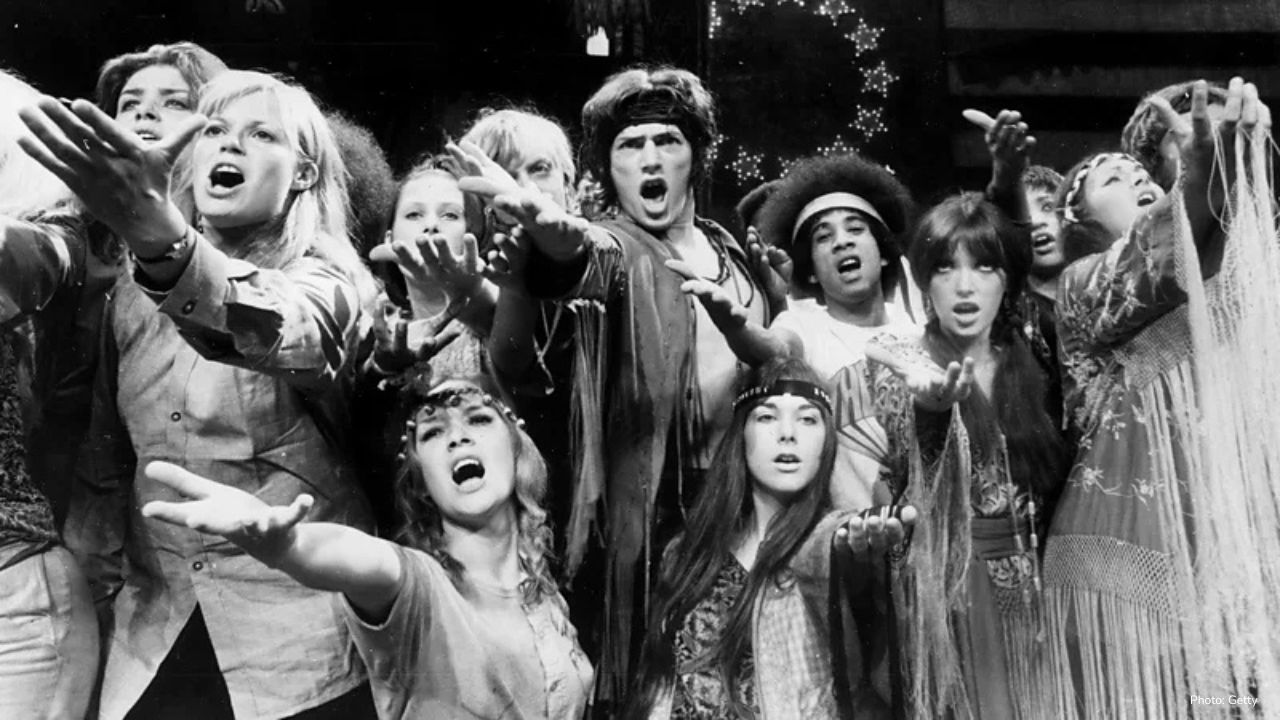
Fifty-seven years ago, London audiences saw something they had never seen before: a stage full of naked actors performing a musical. This historic moment came with the opening of Hair at the Shaftesbury Theatre on 26 September 1968, the day after the UK passed a new law ending strict theatre censorship.
For more than 200 years, no new play could be performed in Britain unless it was approved by the Lord Chamberlain, a senior officer of the Royal Household. The Lord Chamberlain had the power to ban or modify any play that was considered inappropriate. Nudity, strong language, and controversial political content were not allowed. But the new Theatres Act of 1968 ended this control, allowing more freedom for theatre creators.
Hair was a US “Love-Rock Musical” created by James Rado and Gerome Ragni, two actors inspired by young hippies they had seen in New York. The musical celebrated freedom, youth culture, and rebellion against authority. It dealt openly with topics like sex, drugs, the Vietnam War, and anti-establishment attitudes. Galt MacDermot, a jazz musician, added music to Rado and Ragni’s lyrics, and the show opened off Broadway in October 1967. It moved to Broadway in April 1968 after some changes, including new songs, new actors, and a new director, Tom O’Horgan.
O’Horgan explained to the BBC that the famous nude scene at the end of Act One was not the most important part of the show. While the scene did attract attention and sell tickets, the real message was political and moral. The actors’ naked bodies represented young people being sent to war in Vietnam, dressed in uniforms and harmed by bombs and bullets. The scene was not sexual, and actors were not forced to fully disrobe if they did not want to.
The musical also broke many other rules of theatre. It included strong language, explicit sexual content, drug references, and rock music, which was new to Broadway. According to Scott Miller in Rebels with Applause: Broadway's Groundbreaking Musicals, Hair rejected traditional story structures, music rules, and conventions of the American musical. Songs like “Sodomy” and “Hashish” discussed taboo subjects, while “Black Boys and White Boys” celebrated inter-racial relationships.
When Hair came to London, the nude scene had been “greatly over-emphasized” in public discussions, O’Horgan said. Even without it, the show would have been controversial under the Lord Chamberlain’s rules because of its frank treatment of politics, language, and social issues.
The Lord Chamberlain’s censorship dated back to 1737. The office was created to prevent plays from scandalizing the public or criticizing the government. Over time, it caused many problems. Plays mocking Adolf Hitler were rejected in the 1930s, and in the 1950s and 1960s, theatres often clashed with censors over new, provocative works.
The passing of the Theatres Act in 1968 marked a turning point. For the first time, playwrights and producers could stage works without fearing government censorship. Hair’s London debut was perfectly timed to celebrate this new freedom. The musical shocked audiences with its bold political messages, innovative music, and energetic performances. Critics were divided, but the show was a success and symbolized a new era of theatre in Britain.
Annabel Leventon, a member of the original London cast, said in 2017 that the show was revolutionary. “We danced in the aisles, sat on the audience’s laps, and frightened them,” she said. “By the end, everyone was singing along. Hair changed the world of theatre forever.”
In simple words, Hair was more than just a musical with a nude scene. It broke old rules, challenged traditions, and showed that theatre could discuss real-life issues openly. Its opening in London marked the start of a freer, more exciting era for British theatre.