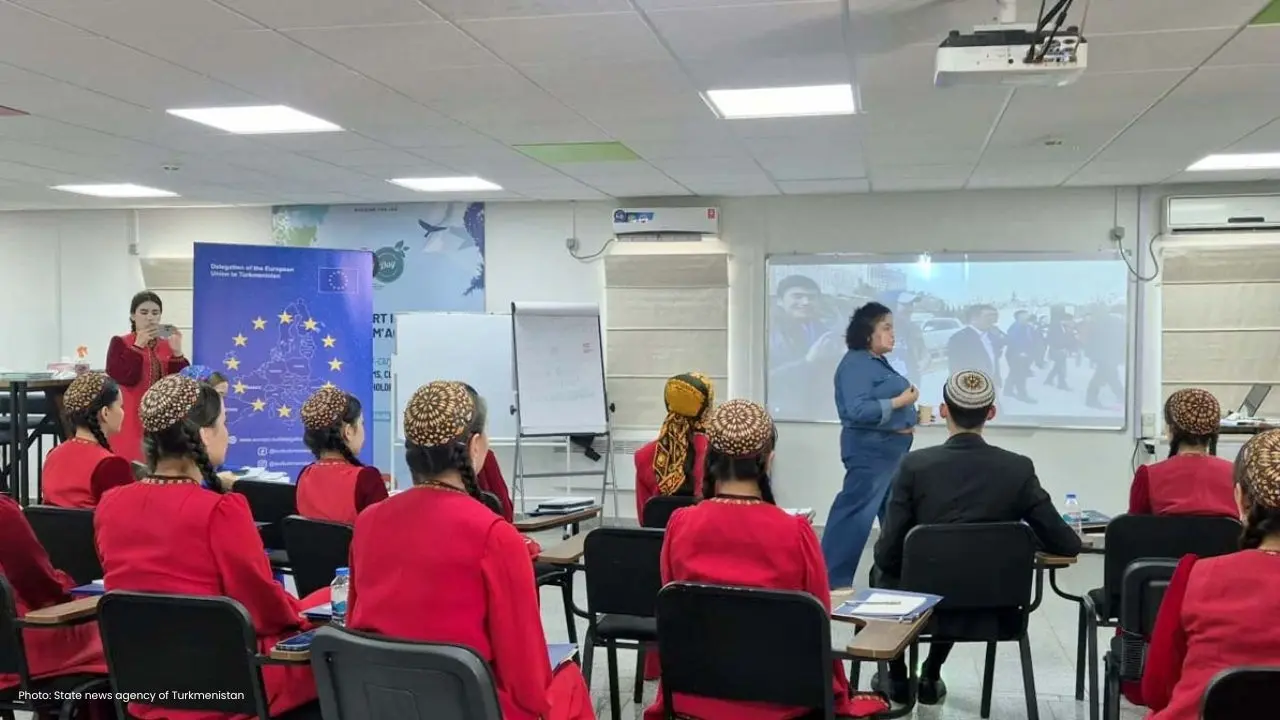
In an effort to bolster media education and professional development in Turkmenistan, the European Union Delegation has conducted a series of workshops dedicated to digital journalism and artificial intelligence. Held from April 29 to May 6, 2026, at Bouygues Turkmen's training center, these sessions attracted a diverse group including journalists, university educators, and students from across the nation.
Supported by Turkmenistan's Ministry of Foreign Affairs, the European Union, and the CARAVAN media initiative, the workshops were hailed as a pivotal educational effort. They aimed to enhance media literacy and digital communication skills while assisting media practitioners to adapt to the evolving landscape shaped by technological advancements and AI.
Maciej Madalinski, the Deputy Head of the EU Delegation to Turkmenistan, opened the workshop series by underscoring the essential role of media development and information literacy. He explained that these components are central to the EU's collaborative strategies with Turkmenistan and other Central Asian nations.
Madalinski noted that the rise of digital technologies and AI is dramatically reshaping the methods by which information is generated, disseminated, and absorbed globally. Social media algorithms are increasingly critical in determining audience engagement, blurring the lines between professional journalism and user-generated content. He remarked that such changes bring forth both opportunities and responsibilities for journalists and content creators.
The workshops aimed to address these contemporary issues and refine participants' skills in digital media production. Focus areas included practical content creation techniques, responsible AI usage, media ethics, digital storytelling, and the influence of technology on modern journalism. Attendees were also introduced to innovative digital tools designed to enhance editorial productivity and communication strategies.
Media experts from Kazakhstan, including Gulim Amirkhanova and Aiganym Amirbekova, led the training sessions, delivering their insights through interactive discussions and real-world media applications. Organizers expressed intent to foster innovation while promoting responsible journalism and critical thinking in the digital age.
This initiative marked the second phase of CARAVAN's activities in Ashgabat. The project previously offered training in autumn 2025, focusing on media literacy and the incorporation of AI in journalism and communication.
Feedback from attendees, including university and media representatives, was overwhelmingly positive, with many emphasizing the workshops' significance for professional advancement. Understanding digital media and AI is increasingly crucial for educators, journalists, and students navigating today’s communication landscape.
The EU remains committed to educational and digital transformation initiatives across Central Asia, part of its expansive regional cooperation plan. Officials assert that enhancing media literacy and nurturing responsible journalism will lead to a more informed public and equip media professionals to tackle the rapid changes in the digital realm.