A Unique Solar Phenomenon Emerges
In January 2026, Earth faced one of the most formidable space weather phenomena in recent times. A massive solar radiation storm, designated as S4 (Severe) on NOAA's Space Weather Scale — not witnessed since 2003 — unleashed a flood of high-energy particles that impacted our planet's magnetic field and triggered significant atmospheric responses.
Solar radiation storms result from the Sun's emission of charged particles, predominantly protons, at elevated velocities. When these particles penetrate Earth's magnetic shield, they can resonate with its magnetic field and atmosphere, elevating radiation levels in near-space. The storm in January 2026 was catalyzed by a powerful X-class solar flare and an accompanying coronal mass ejection (CME), which hurled a vast cloud of plasma and magnetic fields into space.
This event stands out not just for its intensity but for its broad visibility and potential ramifications. Space weather experts and global monitoring agencies like NOAA and ESA are diligently observing the storm as it interacts with Earth's environment.
What Initiated This Storm?
The Role of Solar Flares and CMEs
The foundation of the January 2026 space weather event was a notable X1.9 solar flare from an active region on the Sun. X-class flares embody the most potent category of solar flares, releasing vast amounts of energy and ejecting particles into space. Following the flare's eruption, a swift coronal mass ejection (CME) was emitted, dispersing a considerable amount of solar material.
These CMEs traverse the solar system and can interact with Earth's magnetic field if directed our way. In this instance, the CME arrived with impressive speed, catalyzing intense geomagnetic activity and raising solar radiation levels in near-Earth space. The synergy of solar eruptions has created a landscape conducive to severe radiation storms.
The combination of an X-class flare and a CME is a recognized catalyst for major space weather incidents. When the charged particles from a CME reach Earth’s magnetic field, they can incite disturbances in the magnetosphere, which serves as Earth's protective shield, resulting in geomagnetic storms. Strong interactions can generate breathtaking visual displays and challenge technological systems.
Grasping the Levels of Solar Radiation Storms
Solar radiation storms are rated from S1 (minor) to S5 (extreme) based on the intensity of energetic particle fluxes. An S4 (Severe) classification indicates a highly intense event with elevated radiation levels that can affect satellites, spacecraft, and aviation operations. The ongoing storm — classified as S4 — is the most potent seen since similar events in 2003.
The storm's gravity is crucial because it signifies real-time increases in energetic particles traversing near-Earth space. Elevated radiation levels can have direct implications for humans and systems beyond Earth's atmospheric shield, notably in low-Earth orbit or on high-latitude flight paths.
Spectacular Auroras Around the Globe
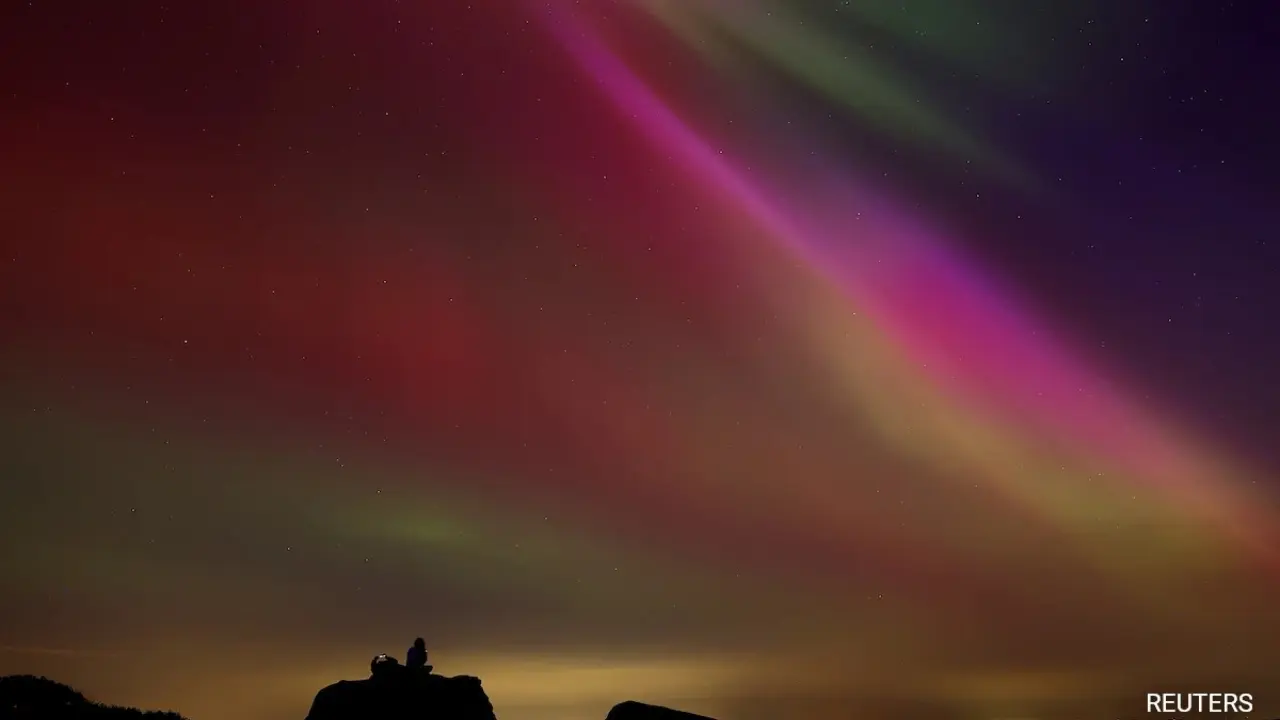
One of the most captivating outcomes of the solar radiation storm was the wide-scale emergence of auroras — both Northern and Southern Lights — at latitudes much lower than their typical range. Usually limited to high polar regions, mesmerizing auroras illuminated vast areas of the United States, Europe, and even stretched into mid-latitude zones.
In North America, residents were treated to stunning green, red, and pink auroral displays in locations as far south as California, Texas, and Alabama, where such views are infrequent. Europe witnessed similarly magnificent scenes, while regions like Ireland experienced vibrant auroras labeled by officials as historic and potentially once-in-a-lifetime occurrences.
Meanwhile, in the Southern Hemisphere, the aurora australis (southern lights) made rare appearances in areas of Australia and New Zealand that are not typically known for such activity.
This broad auroral activity happens when solar particles travel along Earth's magnetic field lines toward the poles, colliding with atmospheric atoms and molecules to produce light. During intense geomagnetic disturbances, the auroral oval — where auroras can be seen — can extend to lower latitudes, providing spectacular views across the globe.
Impacts on Space and Technology
Risks to Satellites and Spacecraft
While the visual aspects of the storm have been breathtaking, increased radiation also brings challenges for technological systems. Satellites orbiting Earth are particularly susceptible to heightened energetic particles, which can disrupt onboard electronics, impair solar panels, and interfere with navigation and communication systems.
Space agencies and satellite operators are closely monitoring these impacts. Precautionary steps, such as placing satellites into safe modes or altering operational settings, are being taken to minimize potential disruptions. For instance, GPS navigation systems may temporarily suffer accuracy issues during heightened space weather conditions.
Aviation and Polar Flight Routes
This storm also poses challenges for aviation, particularly for flights operating over polar routes. In high latitude regions, heightened solar radiation may increase exposure for both passengers and crew. It can also disrupt high-frequency (HF) radio communications, crucial in remote polar areas where other communication methods may be unreliable.
Airlines and aviation regulators have been urged to review flight paths and communication strategies to maintain safety and functionality. Although the risks do not directly compromise flight safety, they can affect operational efficiency and require meticulous management during severe space weather episodes.
Reflecting on the Rarity of This Event
Past Solar Storm Comparisons
Solar storms of this magnitude are uncommon but not unheard of. The Halloween storms of 2003 are often referenced in parallel to this event, having caused significant geomagnetic activity, power disruptions, and striking auroras at lower latitudes.
Historical events have seen even more extreme incidents, like the Carrington Event of 1859, which surged auroras worldwide and ignited issues with telegraph systems. While the January 2026 storm may not be as intense as the Carrington Event, it highlights the risks of substantial space weather phenomena during periods of peak solar activity.
Current analyses of solar activity suggest we are in the midst of Solar Cycle 25, a phase marked by increasing sunspot and flare activity. Such cycles, lasting about 11 years, naturally lead to heightened frequencies and intensities of solar eruptions.
Monitoring and Scientific Insights
Scientists and space weather organizations are leveraging a combination of satellites and terrestrial instruments to follow and assess the solar storm's changes and effects. Equipment aboard NOAA's GOES satellites records solar wind characteristics, particle flows, and magnetic field interactions, offering crucial real-time data for forecasters.
Collaboration among global agencies, including the European Space Agency (ESA), ensures holistic data informs both scientific discovery and operational preparedness. Ongoing monitoring aids in identifying potential hazards, forecasting auroral events, and advising critical infrastructure operators on possible impacts.
Looking Ahead
As the storm develops further, scientists will monitor several key indicators:
-
Whether solar wind conditions stay high and fuel geomagnetic activity.
-
The duration of enhanced auroral visibility at lower latitudes.
-
Any subsequent solar flares or CME events that might extend or amplify space weather impacts.
Geomagnetic storms typically diminish over several days as Earth's magnetic field normalizes and solar wind conditions ease. However, residual effects can linger, especially with potential further solar activity. Continuous monitoring is imperative to assess both ongoing impacts and possible risks.
Disclaimer: This article draws from scientific observations and reports available at the writing time. Space weather events are dynamic by nature, and conditions can evolve swiftly. For the latest updates, refer to official space weather prediction centers and scientific organizations.