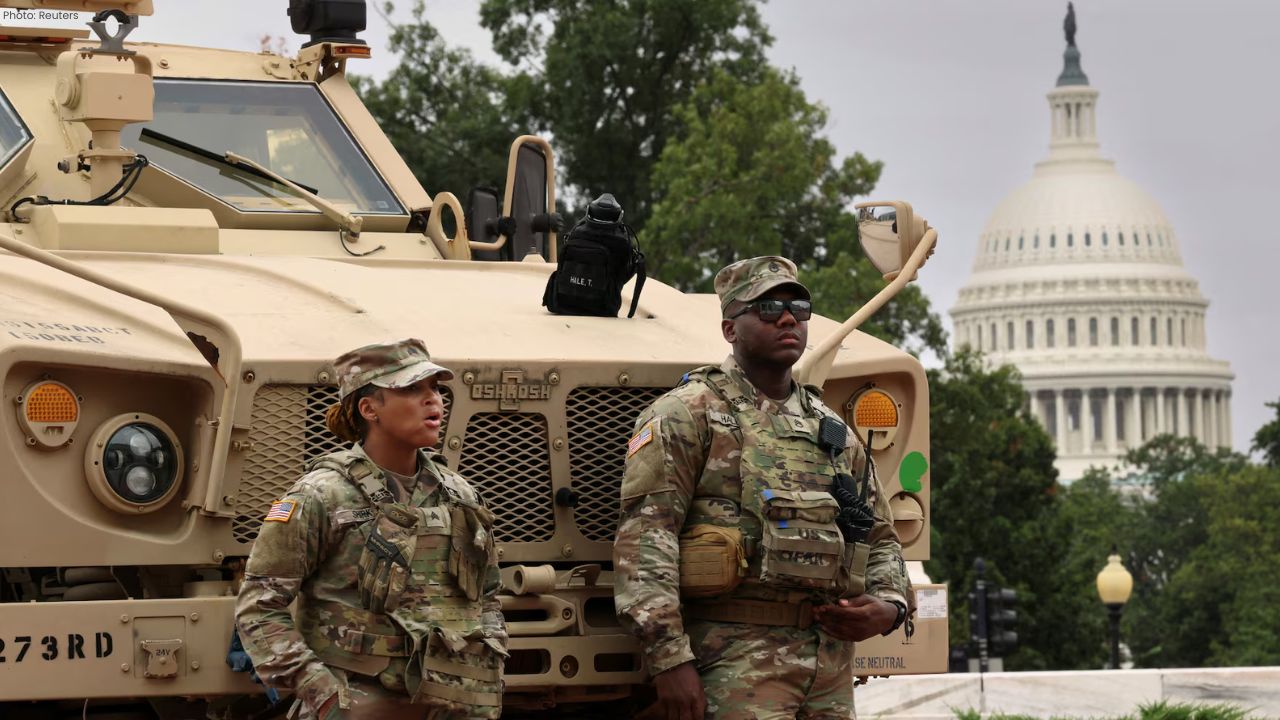
President Donald Trump’s recent deployment of National Guard troops in several U.S. cities has triggered legal challenges from state and local officials. The president has argued that federal troops are necessary to curb violence, address crime, and support deportation efforts. Democratic governors, however, insist the deployments are unnecessary and could escalate tensions.
Illinois filed a lawsuit on Monday seeking to block National Guard deployment in Chicago. Meanwhile, a federal judge temporarily blocked the transfer of troops from Texas and California to Portland, Oregon, over the weekend.
What is the National Guard, and Who Oversees It?
The National Guard primarily consists of state-based troops that respond to emergencies such as natural disasters or large-scale protests. Each U.S. state, the District of Columbia, and territories like Guam and Puerto Rico maintain their own National Guard units. These troops can also be deployed abroad, and some specialize in wildfire response or border security.
Although the National Guard ultimately reports to the Department of Defense, the president can federalize units under certain circumstances. Typically, the governor of a state must request National Guard support during emergencies and can seek additional federal assistance.
National Guard troops have limited authority—they do not make arrests or conduct searches—and the Posse Comitatus Act restricts the federal government from using military forces for domestic law enforcement.
Trump’s Attempts to Use the National Guard in Cities
President Trump has sought to bypass the usual deployment process several times.
-
California, June 2025: Trump took control of the California National Guard to respond to protests against immigration raids, despite Governor Gavin Newsom’s objections. Legal challenges followed, with mixed results: one appeals court ruled in favor of Trump, while a federal judge found certain actions violated the Posse Comitatus Act.
-
Washington, D.C.: Hundreds of National Guard troops were sent in response to what Trump described as a “situation of complete and total lawlessness,” citing homelessness and crime concerns.
-
Chicago: Trump authorized 300 National Guard troops amid immigration-related protests outside detention facilities. Governor J.B. Pritzker accused the president of “manufacturing a crisis” and filed a lawsuit.
-
Portland, Oregon: Trump attempted to deploy troops following protests at an ICE facility, but a federal judge temporarily blocked the deployment.
Legal Basis for Trump’s Action
Trump relies on 10 U.S. Code § 12406, a little-known law that allows the president to federalize National Guard troops if the U.S. is “invaded” or facing a “rebellion.” This law has rarely been used by previous presidents.
-
In June, Trump invoked it to federalize 2,000 National Guard troops to support ICE missions.
-
Defense Secretary Pete Hegseth cited the same law to deploy 200 Oregon National Guard members in late September.
-
The White House maintains strong confidence in the president’s legal authority and expects to prevail in court.
Why the Focus on Portland?
The Trump administration’s push to send National Guard troops to Portland stems from demonstrations near an ICE building over the weekend. Clashes occurred between federal officers and protesters opposing deportation policies.
Authorities reported arrests, aggressive behavior, and use of bear spray and other weapons. Trump described the city as “burning down,” while Oregon Governor Tina Kotek refuted claims of any insurrection or national security threat.
Judge Karin Immergut, appointed by Trump, temporarily blocked both the federalization of the Oregon National Guard and the deployment of California troops to the city, emphasizing constitutional limits over martial law. The administration is expected to appeal.