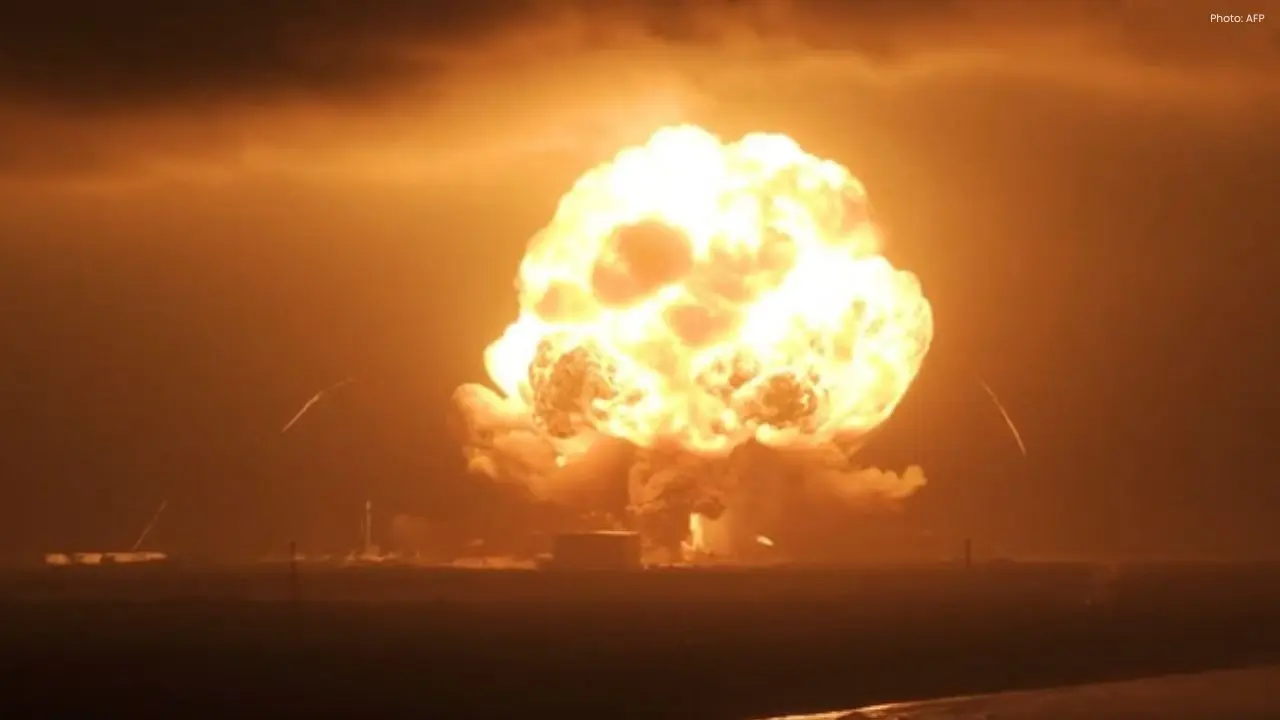
Blue Origin has faced a major setback as its New Glenn rocket erupted during a static fire test in Cape Canaveral, Florida, resulting in extensive damage to the launch pad and raising alarms about upcoming missions tied to NASA's lunar exploration efforts.
The explosion occurred Thursday night while engineers prepared the towering 321-foot (98-meter) rocket for its scheduled satellite launch next week. The rocket was fully fueled and undergoing routine engine ignition testing when a roaring blast sent a massive fireball skyward, visible and felt over a wide area.
Initial inspections revealed that Launch Complex 36, Blue Origin's key launch site in Florida, suffered severe destruction. Aerial footage taken the following day depicted widespread havoc, with twisted metal fragments scattered across the launch site; only one tower and a nearby water tank remained unaffected.
Fortunately, authorities confirmed that there were no fatalities or injuries as a result of the explosion. Emergency management officials have advised locals to stay clear of debris that could potentially wash ashore and to report any findings to the authorities.
This explosion presents yet another hurdle for Blue Origin's New Glenn initiative. Just weeks prior, operations involving the rocket were halted after a previous upper-stage engine malfunction caused a satellite to land in an incorrect orbit. This latest incident is expected to push back future launches while the cause of the explosion is thoroughly investigated.
Named after astronaut John Glenn, the first American in orbit, the New Glenn rocket plays a crucial role in Blue Origin's vision for commercial spaceflight and lunar exploration. This heavy-lift launch vehicle, set to carry satellites and lunar landers, is equipped with seven first-stage engines that utilize liquid oxygen and liquefied natural gas (methane) and is among the largest rockets capable of launching into orbit.
Furthermore, the rocket is integral to NASA's Artemis program, which aims to create a sustained human presence near the Moon's south pole. Earlier this week, NASA awarded Blue Origin a contract worth hundreds of millions to aid in lunar missions.
At the time of the incident, there was no payload on board the rocket. The mission was set to deploy a series of Amazon's Project Kuiper satellites, part of a larger initiative to deliver worldwide internet coverage and rival SpaceX's Starlink. Thankfully, the 48 satellites were not aboard during the test, averting further losses.
While Blue Origin navigates the uncertainty of recovery, nearby launch operations remain unimpeded. On Friday morning, SpaceX successfully launched a new group of Starlink satellites from Florida, and that evening, United Launch Alliance launched additional Amazon internet satellites using an Atlas V rocket from Cape Canaveral Space Force Station.
Launch Complex 36 carries historical significance within the American space program. Established in the 1960s, it facilitated multiple NASA missions, including those of Mariner, Pioneer, Ranger, and Surveyor spacecraft. Blue Origin began leasing the site in 2015 and has invested over $1 billion to modernize it for New Glenn functionality.
In addition, Blue Origin operates the smaller New Shepard spacecraft from Texas, conducting suborbital flights carrying tourists and scientific payloads. These flights had been paused earlier this year as resources shifted towards developing New Glenn and preparing for lunar missions.
NASA officials are currently analyzing how this launch pad damage may impact the schedule of Artemis-related projects. Leading up to the explosion, Blue Origin was gearing up to launch a prototype lunar lander later this year on a New Glenn rocket, with additional testing missions planned over the coming years in preparation for future crewed lunar landings.
According to NASA's present roadmap, a lunar landing mission is slated for as early as 2028, with astronauts expected to reach the Moon on either Blue Origin's Blue Moon lander or SpaceX's Starship system, influenced by which vehicle achieves development readiness sooner.
The investigation following Thursday night's explosion is anticipated to clarify the damage extent, pinpoint the explosion's cause, and set a timetable for resuming Blue Origin's launch operations. Until further notice, one of the company's pivotal projects is paused.