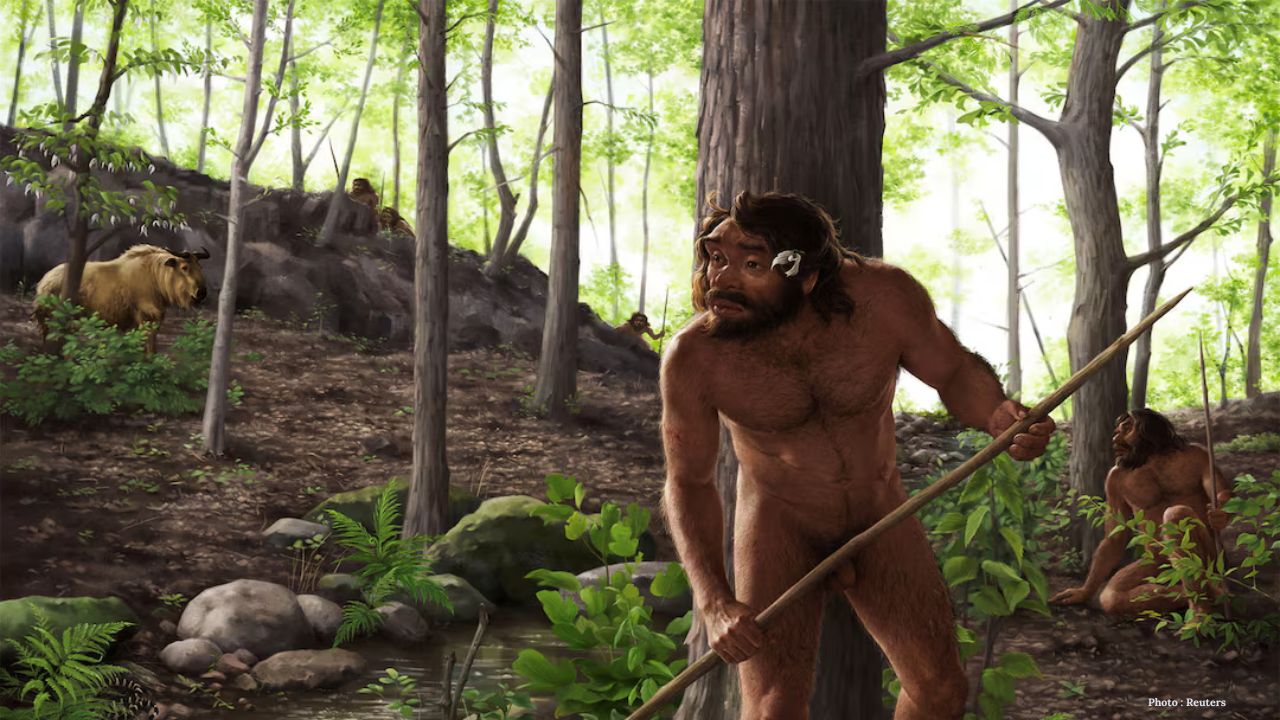
A fossil discovered more than 30 years ago in China may now rewrite the story of human evolution. The ancient skull, found in 1990 in Hubei Province, was heavily damaged during fossilization, making it hard for scientists to study it. Recent research using modern scanning and digital reconstruction techniques has revealed surprising details about this nearly one-million-year-old skull.
The skull, named Yunxian 2, is estimated to be between 940,000 and 1.1 million years old. Scientists believe it belonged to a man likely between 30 and 40 years old. Using digital reconstruction, researchers restored its original shape and compared it with over 100 other human fossils. They discovered that this skull does not belong to the previously assumed species Homo erectus. Instead, it is part of a distinct early human lineage closely related to the Denisovans, a mysterious group of archaic humans that once lived across Asia and later interbred with modern humans, Homo sapiens.
Professor Xijun Ni of Fudan University and the Institute of Vertebrate Paleontology and Paleoanthropology, Chinese Academy of Sciences, led the study published in Science on Thursday. The analysis showed that Yunxian 2 had a long, low skull with a receding forehead, a strong brow ridge, a large nose, and flat forward-facing cheekbones. Its estimated brain size is the largest recorded for any hominin of that age. Chris Stringer, an anthropologist at the Natural History Museum in London, said the skull lacks the midfacial prominence seen in Neanderthals.
The fossil had been partially crushed and deformed over time due to pressure from the ground. Despite this, the study concluded that Yunxian 2 fits into an Asia-centered human lineage that includes Homo longi—a species known from a skull found near Harbin—and the Denisovans. Key shared features include a broad roof of the mouth, low cheekbones, an expanded back of the head, and certain ear structures.
This discovery could change how scientists understand the human family tree, especially in Asia. It shows that multiple human lineages coexisted and interacted over hundreds of thousands of years, some of which eventually mixed with modern humans. According to the researchers, studying these ancient fossils helps scientists understand where we come from and how diverse human evolution was across different regions.