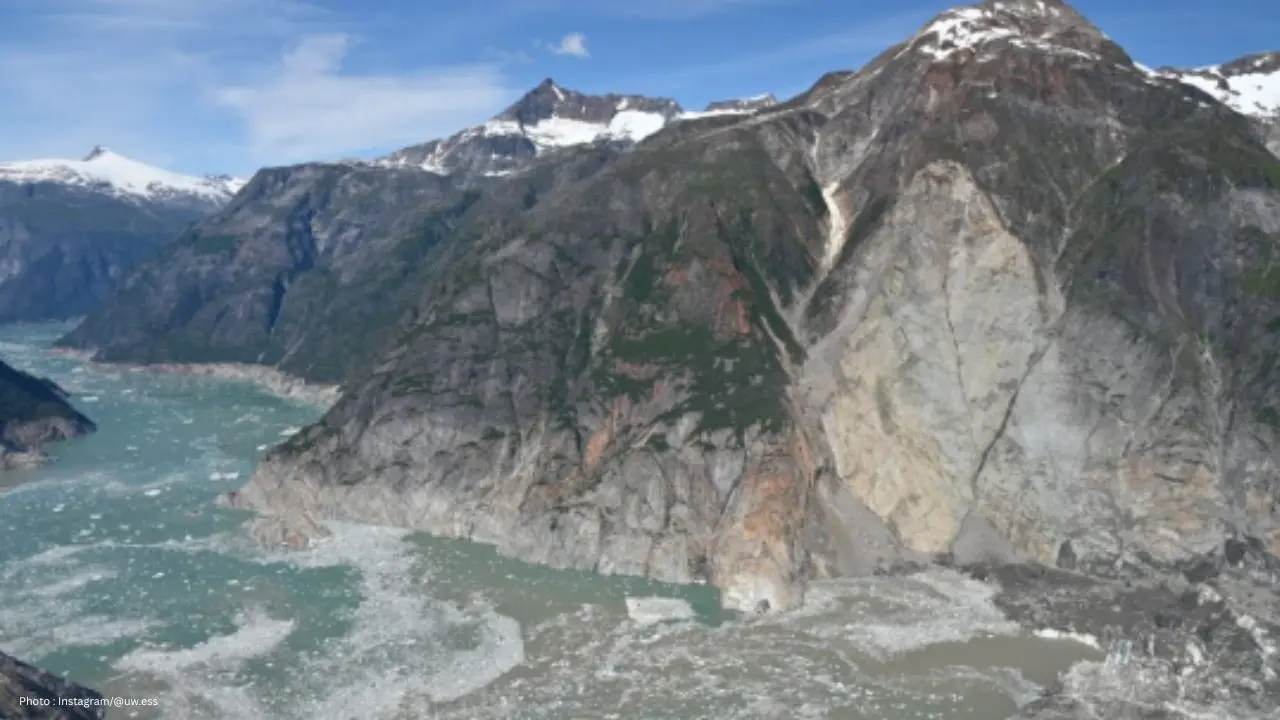
Scientists say satellites have captured one of the largest tsunamis ever recorded after a massive mountain collapse in Alaska sent enormous waves crashing through a remote fjord. Researchers described the event as the second largest tsunami in recorded history, with waves estimated to have reached heights of nearly 200 meters after millions of tons of rock suddenly fell into the water.
The tsunami happened in Dickson Fjord in eastern Greenland after the collapse of a mountainside linked to melting glaciers and unstable terrain in the Arctic region. Although the landslide occurred in a remote area far from major population centers, scientists said the force of the event was so powerful that seismic sensors around the world detected vibrations from the collapse. The tsunami continued moving back and forth inside the narrow fjord for several days.
According to international researchers, Earth-observing satellites were able to capture detailed images and radar measurements showing how the giant waves traveled through the fjord after the collapse. Scientists explained that satellite technology played an important role in helping experts understand the scale and movement of the tsunami in an area difficult for humans to access directly.
Researchers said the disaster began when warming temperatures weakened the mountain structure over time. Melting glaciers beneath the rock mass reduced support along the slope, eventually causing millions of cubic meters of rock and ice to break free and crash into the fjord below. The sudden impact displaced huge amounts of water and created what scientists call a “mega-tsunami.”
Experts noted that mega-tsunamis are different from traditional ocean tsunamis usually caused by earthquakes. Instead, these giant waves are often triggered by landslides, volcanic collapses, or large rockfalls entering enclosed bodies of water at high speed. Because the water is trapped inside narrow fjords or bays, the waves can become extremely tall and destructive.
The event has renewed scientific concerns about climate change and its impact on Arctic landscapes. Researchers warned that rising global temperatures are increasing glacier melt and destabilizing mountain slopes in polar regions, potentially making similar disasters more likely in the future. Scientists say remote Arctic areas are changing rapidly as ice loss continues accelerating.
Although no deaths were reported because of the isolated location, experts said the tsunami demonstrates how powerful climate-related geological events can become. Researchers are continuing to study the collapse to better understand how future landslides and mega-tsunamis may develop in vulnerable regions around the world.
Satellite agencies and climate scientists are now using the data collected from the event to improve tsunami detection systems and risk modeling. Officials believe advanced satellite monitoring could help provide earlier warnings for remote coastal communities facing possible landslide-driven tsunamis in the future.
Scientists described the event as one of the clearest examples yet of how modern satellite technology can capture extreme natural disasters in real time. The findings are expected to contribute to future research on climate change, Arctic geology, and global tsunami risks as scientists continue examining the long-term effects of warming temperatures on unstable mountain environments.