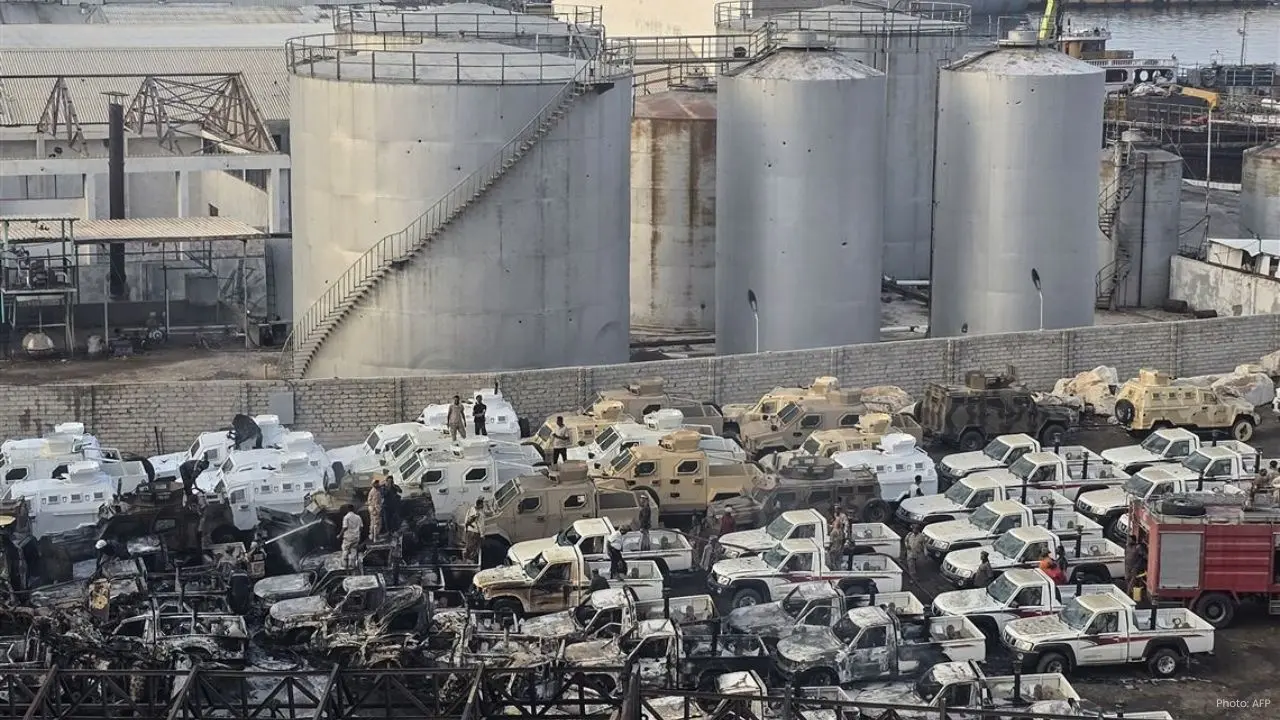
Recent Saudi coalition airstrikes on Yemen's Mukalla port have heightened friction between Saudi Arabia and the United Arab Emirates (UAE), compelling Abu Dhabi to announce the withdrawal of its forces from the region.
Details Released by Saudi Coalition
Major General Turki al-Maliki, a spokesperson for the coalition, revealed images of the early morning strike, asserting that intelligence indicated the presence of two ships loaded with vehicles, weapons, and ammunition in the port.
Saudi officials noted that the cargo was relocated to the al-Rayyan military base, involving Emirati personnel, without prior agreement with Riyadh. Al-Maliki affirmed that the strike adhered to engagement rules and did not result in civilian injuries.
UAE's Decision to Withdraw Forces
In the wake of the airstrike, the UAE declared its decision to conclude its counterterrorism mission in Yemen and pull out remaining personnel. This move came after escalating demands from Yemen’s recognized government for Emirati forces to exit within 24 hours, a request Saudi Arabia openly supported.
The UAE Ministry of Defence indicated that it had thoroughly evaluated the circumstances before deciding to terminate its mission to ensure the safety and effectiveness of its forces.
Rising Tensions Over Support for Separatists
The airstrike has revealed rifts within the Saudi-led coalition, which was established in 2015 to combat Yemen’s Houthi insurgents. Saudi Arabia accused Abu Dhabi of backing the Southern Transitional Council (STC), a separatist group pushing for autonomy in southern Yemen.
The STC, previously allied with the Saudi-supported government, has intensified military operations, gaining control over key areas in the Hadramout and Mahara provinces, critical regions bordering Saudi Arabia. Riyadh perceives these events as a direct threat to national security.
Cancellation of UAE Defence Agreement by Yemen
Post-strike, Yemen’s Presidential Leadership Council chairman Rashad al-Alimi annulled a defense pact with the UAE, enforcing the withdrawal of Emirati forces. He accused the UAE of endorsing STC's military actions against the Yemeni state.
Saudi Arabia supported this decision, urging the UAE to cease military or financial backing for local factions in Yemen.
UAE Refutes Saudi Claims
The UAE denied allegations regarding weapon shipments for the STC, asserting that the cargo was designated exclusively for Emirati forces. Abu Dhabi continues to affirm its commitment to regional security and seeks a resolution to prevent further escalation.
Regional and Global Responses
Qatar expressed approval of statements from both Saudi Arabia and the UAE, reflecting a shared commitment to regional stability and Gulf Cooperation Council (GCC) principles. Meanwhile, Saudi Foreign Minister Prince Faisal bin Farhan engaged in discussions with high-ranking officials from the United States and Pakistan regarding the situation.
Experts Caution on Broader Consequences
Analysts warn that divisions within the anti-Houthi coalition may undermine efforts to stabilize Yemen. Scholar Hesham Alghannam pointed out that eastern Yemen is crucial for Riyadh’s national security due to its strategic significance and resources.
He cautioned that any incomplete withdrawal could potentially benefit the Houthis, as fragmented factions may further deepen their divisions.