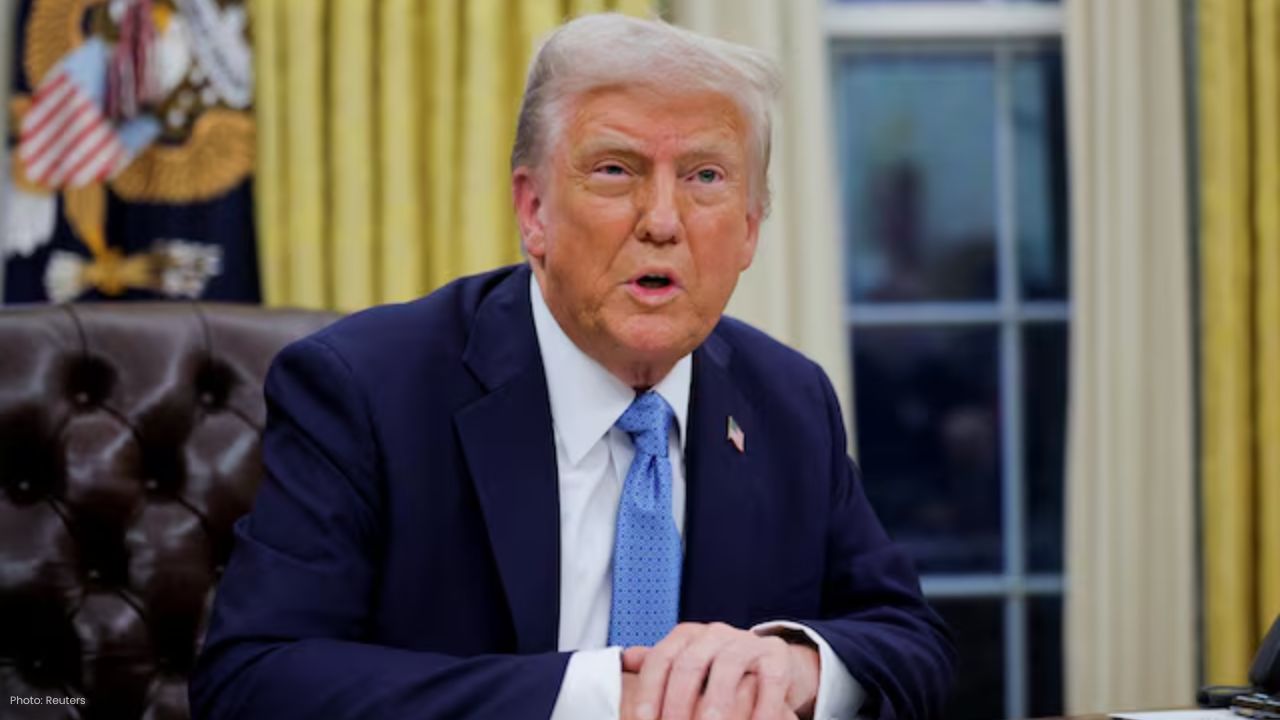
Former U.S. President Donald Trump’s abrupt announcement of steep tariffs on Chinese imports once again rattled global markets, underscoring how political maneuvering can unsettle investors even more than economic fundamentals. The episode highlighted both the fragility of market sentiment and China’s growing leverage in the ongoing technology and trade confrontation.
A Sudden Move That Rattled Investors
On Friday morning, optimism reigned across Wall Street as the S&P 500 Index was poised to notch another record high. That changed swiftly when Trump declared plans to impose a 100% tariff on Chinese goods, reigniting fears of a full-blown trade war between the world’s two largest economies.
The market reaction was swift and brutal. The Nasdaq Composite Index, heavily weighted with technology stocks, plunged 3.6% by the close of trading. The so-called “fear gauge,” the CBOE Volatility Index (VIX), surged more than 30%, marking one of its sharpest jumps this year.
By Sunday, the Trump administration had softened its tone, signaling a willingness to negotiate with Chinese President Xi Jinping. The rapid reversal helped calm global markets before Asian exchanges reopened, but not before a weekend of turmoil for traders.
China’s Calm and Controlled Response
When trading resumed on Monday, Chinese markets were notably restrained. The Hang Seng Index dipped only 1.7%, a relatively mild reaction compared to the 13.1% one-day plunge seen on April 7, when Trump’s earlier “Liberation Day” tariffs shocked investors. Back then, Beijing’s state-backed “national team” of institutional investors had to step in to stabilize markets.
This time, Chinese investors appeared less reactive, perhaps recognizing that Trump’s rhetoric may not always translate into sustained policy. In contrast, U.S. investors bore the brunt of the anxiety, reflecting concerns that political unpredictability at home could undercut economic resilience.
Rising Risks for U.S. Technology and Crypto Markets
The renewed trade jitters hit U.S. technology stocks especially hard. Companies with exposure to Chinese supply chains, including semiconductor giants and electronics manufacturers, faced sharp selloffs. Nvidia Corp. shares dropped 4.9% on Friday, as investors grew wary of potential disruptions to the global chip ecosystem.
Even the cryptocurrency market, often seen as detached from traditional finance, wasn’t spared. Traders who had supported Trump’s economic policies found themselves navigating one of the most volatile weekends in months as crypto prices fell alongside equities.
China’s Strategic Grip on Critical Materials
Beneath the market noise lies a deeper structural issue: China’s dominant position in the supply of rare earth elements critical to modern technologies, including AI chips, electric vehicles, and renewable energy systems. Beijing’s recent export controls on rare earths have heightened concerns in the U.S. over potential disruptions to semiconductor manufacturing.
Companies like ASML Holding NV, Taiwan Semiconductor Manufacturing Co. (TSMC), and Samsung Electronics rely on high-precision lasers and magnets that use these rare materials. TSMC alone depends on China for roughly 30% of its materials used in advanced chip production at the 7-nanometer level and below.
Despite U.S. investments in rare-earth mining and processing, China’s control of the supply chain gives it significant leverage — a fact increasingly recognized by investors and policymakers alike.
Beijing’s Push for Technological Self-Reliance
Amid rising tension, China appears more determined than ever to reduce its dependence on U.S. technology. The government has reportedly instructed domestic firms to stop purchasing Nvidia’s H20 AI chips, designed specifically for the Chinese market. Authorities have also tightened customs enforcement to curb the smuggling of advanced semiconductors, a stark contrast to their previously lenient stance.
These moves reflect President Xi Jinping’s long-term goal of achieving full technological sovereignty. By developing its own AI models and hardware infrastructure, Beijing aims to redraw a supply chain historically dominated by U.S. firms.
A Market Caught Between Politics and Economics
The sequence of events surrounding Trump’s tariff threat reveals the widening gap between political signaling and economic consequences. Traders once profited from what was jokingly called the “TACO trade” — buying stocks after a tariff-induced selloff and selling after Trump’s inevitable reversal. But as the former president’s policy swings become increasingly rapid, markets no longer have time to adjust or recover in predictable cycles.