President Donald Trump has retracted his earlier threats to impose tariffs on European allies over Greenland, marking a significant shift following escalating tensions. This decision was made after Trump and NATO leaders discussed a potential agreement centered on Arctic security, alleviating concerns of a significant discord between the U.S. and Europe.
Initially, Trump had threatened Denmark and several European nations with tariffs if they did not engage in discussions that could lead to U.S. sovereignty over Greenland. The proposed tariffs were slated to commence at 10 percent next month and increase to 25 percent by June. Many European leaders vehemently opposed this stance, asserting that Greenland is an integral part of the Kingdom of Denmark.
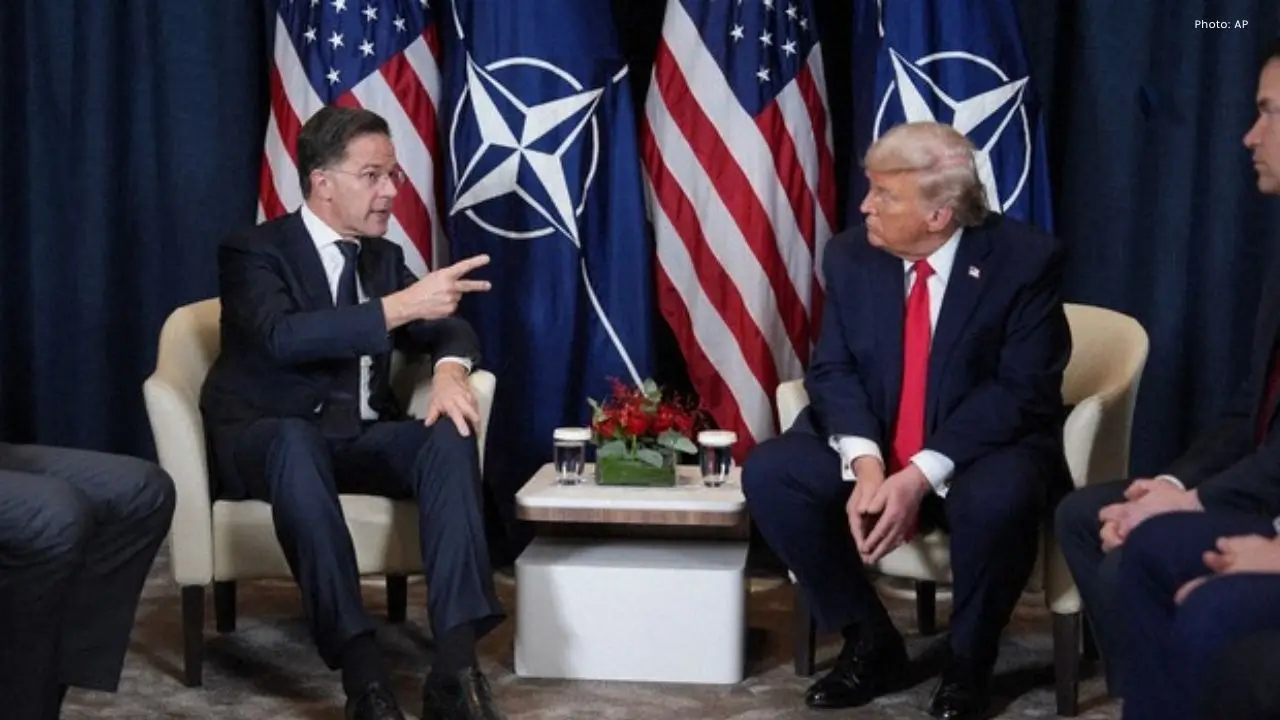
Trump announced his change of course via social media, noting that he and NATO's secretary general had established a framework for ongoing collaboration in the Arctic. Although he provided few specifics, he mentioned that talks included a new U.S. missile defense initiative dubbed the Golden Dome, which would deploy American weapons in space for the first time, anticipated to cost around $175 billion.
Among the ideas shared by NATO officials is a proposal for the U.S. to bolster its military footprint in Greenland by constructing additional bases. Currently, Greenland is home to a significant U.S. military base, with American officials asserting the island’s strategic importance in monitoring threats from Russia and China in the Arctic. Whether this proposal aligns with the framework Trump referenced remains uncertain.
Trump is known for his pattern of issuing tariff threats before retreating. Earlier this year, he proposed broad import taxes on various nations but softened his stance following sharp market reactions. This situation, however, raised deeper concerns as it seemed to challenge NATO, one of the world's foremost military alliances.
During the World Economic Forum in Davos, Switzerland, Trump conveyed that the U.S. had offered far more assistance to Europe over the years, deeming control over Greenland a minor request in exchange. He asserted he would not resort to force to seize the island but cautioned that the U.S. would remember those who didn't cooperate. Such comments alarmed European leaders, igniting fears of a severe rift within NATO.
NATO Secretary General Mark Rutte reaffirmed the alliance's commitment to support the U.S. in the event of an attack. Following this reassurance, Trump announced the tariff cancellation, a move welcomed by Denmark’s foreign minister who described it as a positive indication that Trump dismissed the notion of forcibly acquiring Greenland and temporarily suspended what he termed a trade war with Europe.
Trump claims that his interest in Greenland is rooted in national security, asserting that overseeing the island is vital as global powers amplify their activities in the Arctic. Nonetheless, Denmark and other NATO allies have stressed that Danish sovereignty over Greenland is a non-negotiable limit.
Locally, the situation in Greenland has stirred feelings of concern. The regional government urged residents to prepare for potential emergencies, advising them to stockpile food, water, and other supplies for five days. Some locals perceived Trump's remarks as threatening, even if they deemed it unlikely he would act. Numerous individuals expressed that his statements disrespected the Greenlandic populace.
Financial markets responded positively to Trump's decision to cancel the tariff threats, recovering from earlier downturns. U.S. officials also expressed relief, fearing that the conflict could jeopardize broader foreign policy objectives and weaken alliances.
While Trump aimed to address economic issues during his Davos speech, Greenland overshadowed his comments. He even mistakenly referred to Greenland as Iceland multiple times, which drew criticism and confusion. Despite the tariff reversal, the incident underscores how swiftly global tensions can escalate when trade disputes intersect with security issues.
For the time being, Trump's decision has alleviated immediate tensions in U.S.-European relations. Nevertheless, uncertainty persists regarding future negotiations on Arctic security and the extent of U.S. ambitions in the area. This episode highlights the delicate balance between diplomacy, national security, and alliance trust in an evolving geopolitical landscape.