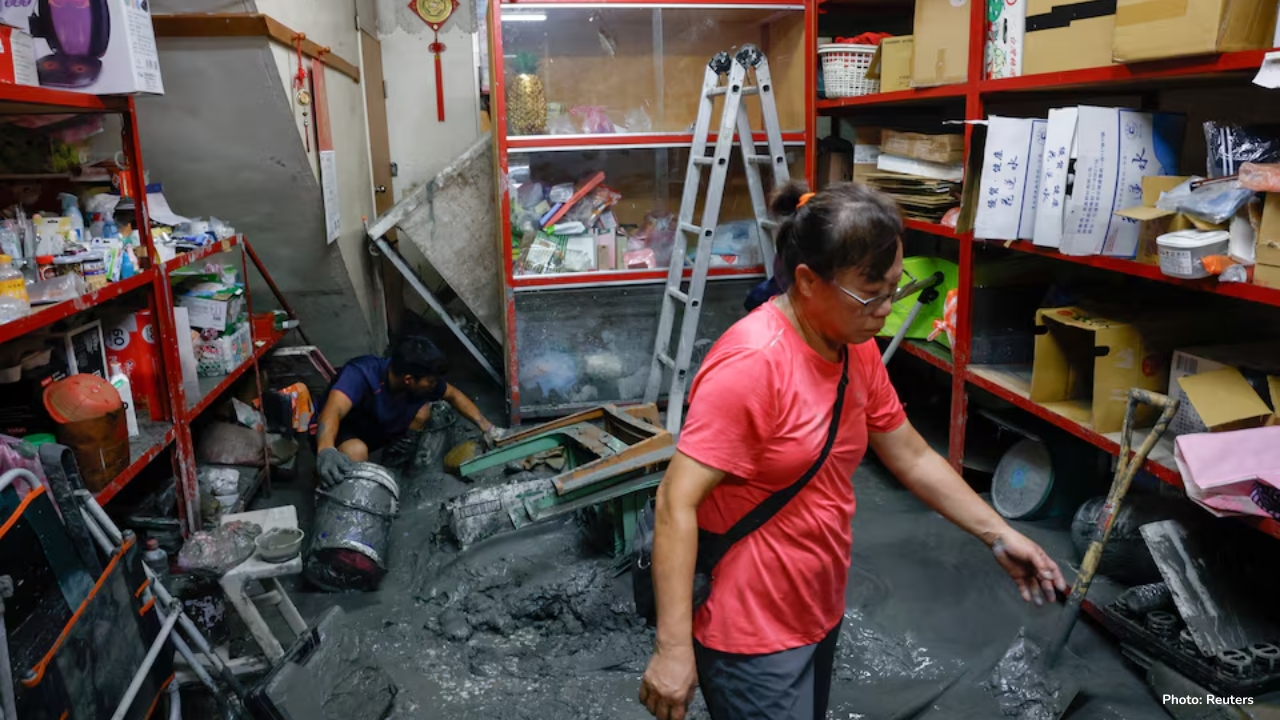
When Super Typhoon Ragasa struck Taiwan, it left behind not only broken homes and damaged roads but also a heartbreaking search for people still missing. In the small town of Guangfu, located in Hualien County on Taiwan’s eastern side, rescuers are facing some of the hardest conditions they have ever worked in.
They are wading through thick, waist-deep mud, searching destroyed houses, and listening carefully for any signs of life. Families wait in fear and hope, wondering if their loved ones will be found.
So far, at least 14 people have been confirmed dead, but 11 others are still missing. The rescue operation is racing against time, and every hour makes survival less likely. Still, the teams continue their work because each missing person represents a family waiting for answers.
How the Disaster Happened
The cause of this sudden flood and mud disaster was not only the typhoon’s heavy rain but also something known as a barrier lake. A barrier lake forms when landslides, falling rocks, or soil block a river’s path, creating a temporary dam. Behind this dam, water gathers quickly. At first, it looks like a normal lake, but because the dam is made of loose soil and rock, it is unstable. Once the water becomes too heavy, the dam can collapse without warning, sending a wall of water and mud rushing downstream.
This is exactly what happened in Guangfu. After Ragasa’s rains poured onto the mountains, a barrier lake formed upstream. Within hours, it grew large and dangerous. When it finally burst, the water rushed down the slopes carrying mud, rocks, and tree trunks. The flood hit Guangfu like a wave, destroying homes, blocking roads, and burying entire neighborhoods under heavy mud.
The Scene in Guangfu
When the floodwaters began to recede, what was left behind was not a typical flood scene. Instead of standing water, Guangfu was covered in dark grey mud that reached as high as people’s waists. Streets were no longer recognizable. Cars were half-buried, doorways were blocked, and in some places, only the rooftops of houses could be seen above the mud.
Rescuers entered the town wearing boots and carrying shovels, but even simple walking became exhausting. Each step required them to pull their legs out of the sticky mud. Heavy equipment like excavators and trucks were brought in to help, but even these machines often got stuck.
To search for trapped residents, rescuers climbed onto rooftops and cut holes in houses to look inside. Many homes had their first floors completely filled with mud, making it impossible to enter through doors or windows.
Stories of Families and Survivors
Behind every statistic of the dead or missing is a personal story. One survivor, 78-year-old Chang Hsueh-mei, described how she managed to escape her home. When the mud began to rush in, she climbed over fallen furniture and broken walls, eventually finding a way out. But her husband, 88-year-old Huang Ju-hsing, was not so lucky. He remained trapped on the second floor of their house, unable to move past the debris. Rescuers are still trying to reach him.
Another resident, who gave only his surname Hwang, is desperately looking for his older sister. He told reporters that her house had been completely filled with mud. By the time rescuers arrived, it was too late to save her. Like many others, he is still waiting, hoping at least to recover her body so his family can have closure.
Many of those who died were elderly. They could not move quickly to higher ground or escape through the chaos. Some were caught while resting in their homes, never expecting that a lake high in the mountains could burst and bring disaster so suddenly.
- The Numbers So Far
- 14 people confirmed dead.
- 11 people still missing.
- Hundreds of homes damaged or destroyed.
- Dozens of families displaced and living in temporary shelters.
While these numbers may change as more bodies are recovered, they already show how destructive Ragasa has been.
The Rescue Effort
Rescue teams in Taiwan are highly trained, especially because the island often faces typhoons and earthquakes. Yet the conditions in Guangfu are especially challenging. Unlike clear water floods, thick mud is extremely difficult to move through. Heavy rain also continues in some areas, raising the risk of more landslides.
The government has deployed soldiers, firefighters, and special search units. They are using dogs trained to sniff out human scent, drones to scan damaged areas from above, and excavators to dig through the mud. Still, progress is slow.
Volunteers have also joined the effort, bringing food, water, and supplies for both rescuers and survivors. Temporary shelters have been set up in schools and community centers to house those who lost their homes.
The Challenge of the Barrier Lake
Even though much of the lake has already emptied, about 12% of its water remains, and experts are worried it could cause more damage. Some suggested using controlled explosions to release the water, but the government rejected that plan. Blowing up the dam could trigger more landslides, making the situation worse.
Instead, engineers are monitoring the lake closely, studying how to safely reduce the water level without creating another disaster. This is a reminder of how dangerous barrier lakes can be. They form quickly during storms and earthquakes, but they are unstable and unpredictable.
The Wider Impact
Hualien County is known for its beautiful mountains, rivers, and national parks. It is a popular tourist destination, attracting visitors from around the world. But disasters like Ragasa show the risks of living in such a rugged and mountainous region.
Fortunately, Taiwan’s vital semiconductor industry, which is based in the western part of the island, has not been affected. Factories remain safe, and global supply chains will continue without disruption. This is important because Taiwan produces many of the world’s computer chips.
What Super Typhoon Ragasa Taught Taiwan
This disaster has highlighted several key lessons for Taiwan and other countries facing natural disasters:
- Preparation Matters – Early warning systems saved lives, but many people still did not expect the scale of the flood.
- Elderly Vulnerability – Older residents often live in rural areas and cannot move quickly. Special attention is needed for their safety.
- Danger of Barrier Lakes – Governments need to monitor rivers and mountains during heavy storms to identify these lakes before they burst.
- Community Strength – Local people have supported each other, offering food, shelter, and emotional comfort.
A Community in Mourning
As the rescue continues, Guangfu is slowly shifting from shock to mourning. Families have begun holding funerals for those already found. For the missing, prayer ceremonies are being held in temples. Children, who survived the flood, draw pictures of their lost homes in schools being used as shelters.
For many, the question is not only about rebuilding their houses but also about whether they can ever feel safe living in the same place again. The mountain above their town, once a source of beauty, now feels like a threat.
Looking Ahead
The Taiwanese government has promised financial help for victims. Aid packages will support families who lost homes, and construction plans are being discussed to rebuild damaged areas. Experts are also studying how to strengthen riverbanks, improve drainage, and reduce the risk of future barrier lake floods.
But rebuilding will take years. For the people of Guangfu, the memories of Ragasa will remain forever. The sight of mud-filled streets, the sound of rescuers digging, and the pain of waiting for news about loved ones will not be forgotten.
The tragedy of Super Typhoon Ragasa in Taiwan shows how quickly nature can change lives. One moment, a community is living peacefully; the next, it is buried under mud. The courage of the rescuers, the grief of the families, and the determination of survivors all tell a powerful story.
While Taiwan has faced many typhoons before, Ragasa will be remembered as one of the most damaging in recent history. The hope now is that lessons learned from this disaster will lead to better protection for communities in the future. For Guangfu, recovery has only just begun, but the spirit of its people remains strong.