The Communist Party of Vietnam has commenced its pivotal political assembly under heightened security measures. Delegates at the week-long congress in Hanoi are prohibited from using mobile phones and provided with specialized tablets that lack internet connectivity. This illustrates the extraordinary level of control at an event already known for its stringent regulations.
This congress, taking place every five years, is a crucial political gathering. Approximately 1,600 delegates are involved, representing around 5.6 million party members in a nation nearing 100 million residents. During this period, they will select the party’s top officials and determine policies that will influence Vietnam's trajectory for the coming decade.
Central to the discussions is General Secretary To Lam, who is striving to maintain his role while expanding his influence over the nation's future. Delegates will also elect a new 200-member Central Committee and formalize resolutions that map the party's priorities.
Security presence is extraordinarily tight. Delegates have been equipped with Samsung tablets designed to operate solely on a closed internal network, allowing access to official documents but prohibiting internet use or any outside communications.
Additionally, mobile phone networks have been disrupted in and around the congress venue. Journalists at the site reported that mobile signals were jammed, rendering calls and texts unfeasible. By the second day of the meeting, the possession of mobile phones by delegates was entirely prohibited.
Delegates are required to stay in assigned accommodations throughout the congress week, a mandate that even extends to those residing in Hanoi. Such regulations are aimed at keeping participants concentrated on the congress proceedings while minimizing external interactions.
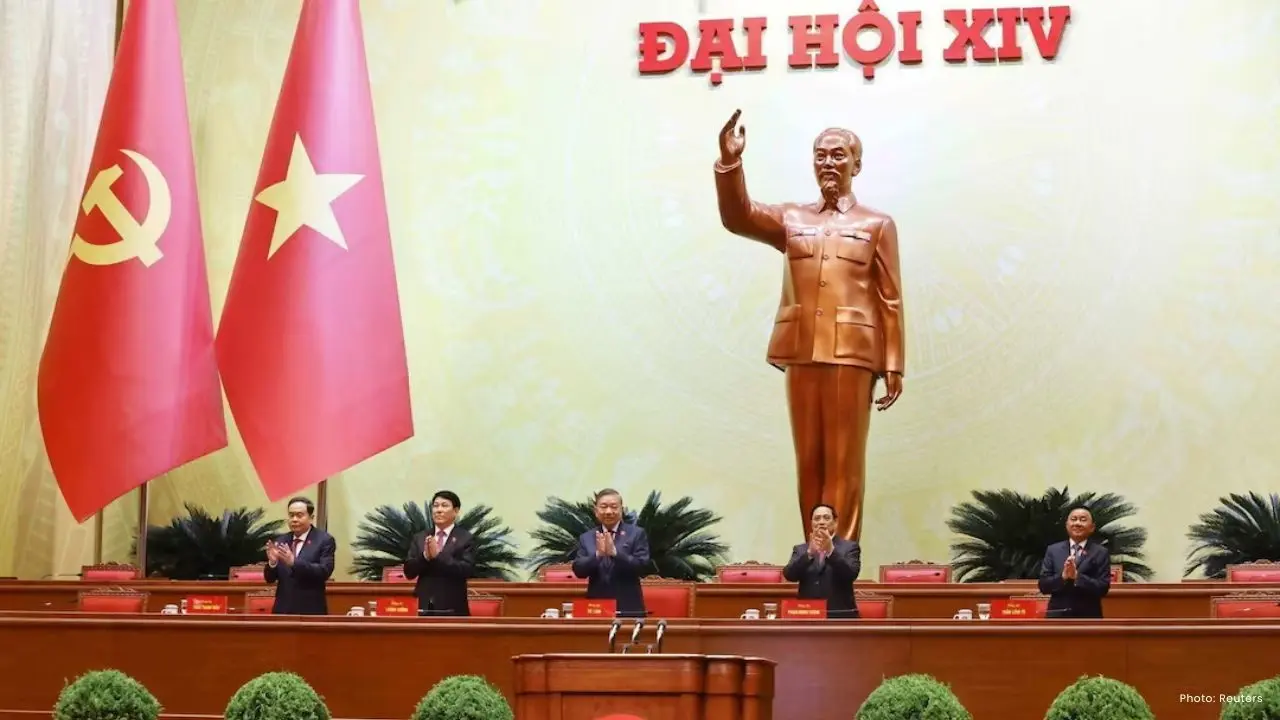
The opening sessions were held in an elegantly adorned hall featuring red carpets, with party leaders positioned on stage beneath a statue of Ho Chi Minh, the architect of modern Vietnam, flanked by portraits of Karl Marx and Vladimir Lenin, representing the ideological foundation of the party.
Journalists covering the congress are encountering their own set of restrictions; they cannot carry mobile phones while on duty. Although reporters can use their laptops, they are limited to the official congress network for connections. Clear guidelines for international media insist on preserving the image and reputation of Vietnam and its leaders during reporting.
Vietnam operates as a one-party state, with the Communist Party dominantly steering political authority and managing information vigilantly. The measures observed at this congress reflect an intensified effort to thwart the dissemination of leaks, rumors, or external pressures during this significant period.
The Vietnamese government prioritizes stability and unity. By curbing communication and limiting movement, party officials aim to assure that crucial decisions are deliberated privately while presented to the public cohesively. While advocates argue this fosters order and focus, critics contend such restrictions underscore the deficiency of transparency in Vietnam's political landscape.
As the congress progresses, its resolutions will mold Vietnam’s leadership and policies for years ahead. While the official outcomes will eventually be disclosed, the intricate deliberation process remains closely guarded, underscoring the party's firm control over political power and information.