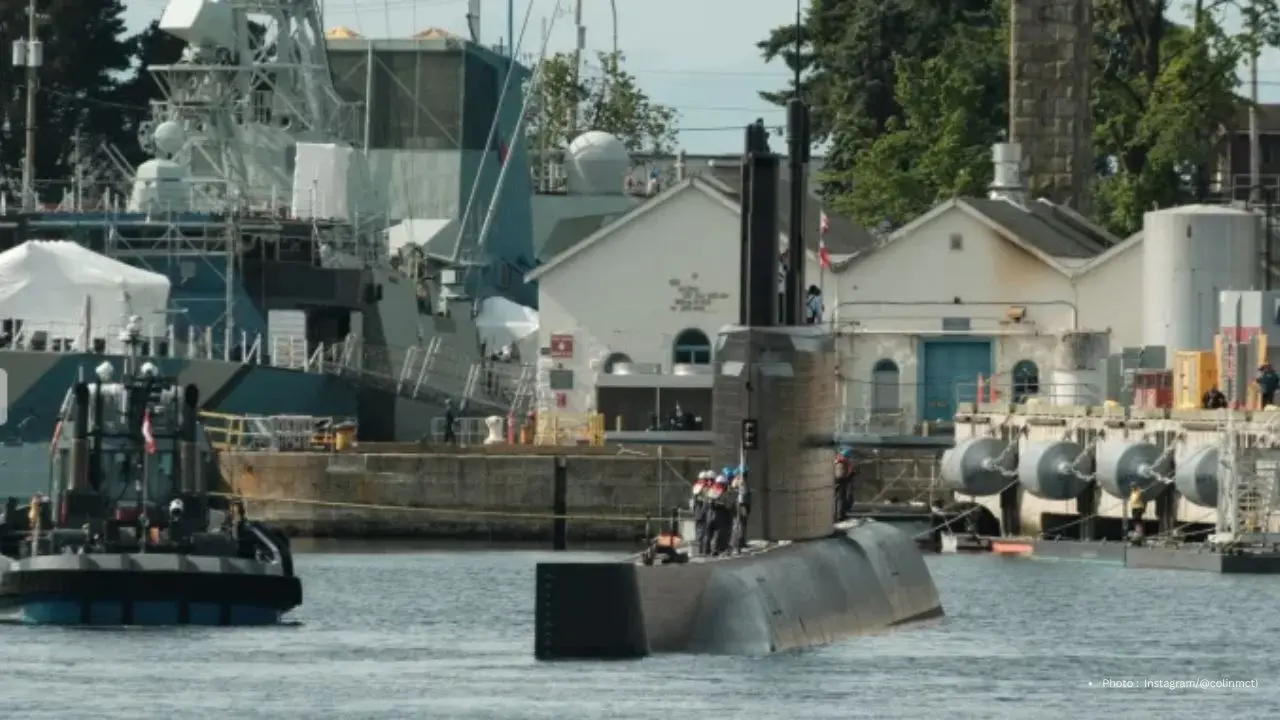
A South Korean navy submarine has arrived at Canadian Forces Base Esquimalt in British Columbia after completing a historic trans-Pacific journey that set a new record for South Korea’s submarine force. The submarine, known as the ROKS Dosan Ahn Changho, traveled more than 14,000 kilometers across the Pacific Ocean before reaching Canada, marking the first time a South Korean submarine has successfully completed such a voyage. The visit has attracted major international attention because it comes during an important period for Canada’s future naval defense plans.
The submarine arrived at CFB Esquimalt near Victoria alongside the South Korean frigate ROKS Daejeon after leaving South Korea in March. During the long deployment, the vessels reportedly stopped in Guam and Hawaii before continuing toward Canada. Military officials described the mission as one of the most significant operations ever carried out by the Republic of Korea Navy’s submarine fleet. The successful crossing demonstrated the vessel’s long-range operational capability and advanced underwater endurance systems.
The Dosan Ahn Changho is part of South Korea’s KSS-III submarine program, which represents the country’s first domestically designed large submarine class. The submarine is equipped with advanced lithium-ion battery technology and an air-independent propulsion system that allows it to remain underwater for long periods without surfacing. Defence experts say these features make the submarine highly suitable for long-distance patrol missions and modern naval warfare operations.
The timing of the submarine’s arrival is especially important because Canada is currently evaluating proposals to replace its aging Victoria-class submarine fleet. Ottawa plans to purchase up to 12 new submarines under the Canadian Patrol Submarine Project, a program expected to cost billions of dollars over the coming decades. South Korean defence company Hanwha Ocean is one of the major competitors in the project and is offering the KSS-III submarine design to the Royal Canadian Navy.
Military analysts believe the Pacific crossing was also a strategic demonstration aimed at proving the submarine’s reliability and operational range to Canadian officials. Canada requires submarines capable of operating across the Pacific, Atlantic, and Arctic regions for extended periods. Experts noted that the successful voyage directly showed the submarine’s ability to meet some of Canada’s demanding naval requirements.
Reports also stated that members of the Royal Canadian Navy joined the South Korean crew during part of the Pacific journey as part of a military exchange and cooperation program. The deployment allowed Canadian personnel to observe the submarine’s operations and technical systems closely during real-world conditions. Defence observers said this kind of cooperation could help strengthen military ties between Canada and South Korea in the future.
Following its arrival at CFB Esquimalt, the submarine is expected to participate in joint naval exercises with the Royal Canadian Navy before continuing toward the multinational RIMPAC 2026 military exercise in the Pacific region. South Korea is also reportedly sending additional advanced naval assets to the exercise, showing the country’s growing role in international maritime security operations.
The visit has generated significant interest among defence experts because Canada’s submarine replacement decision is considered one of the country’s most important military procurement projects in recent years. Alongside South Korea’s proposal, Germany’s ThyssenKrupp Marine Systems is also competing for the contract. Analysts believe the final decision could shape Canada’s naval strategy for decades while also influencing future defence partnerships in the Indo-Pacific region.