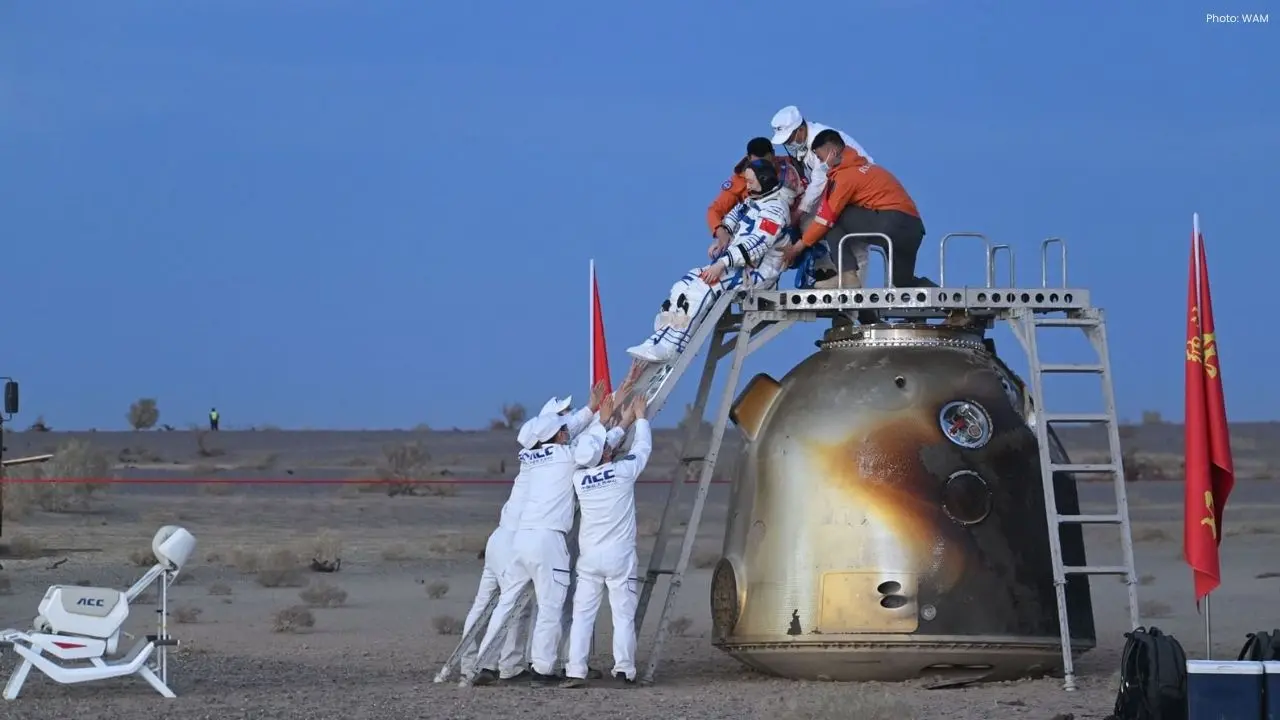
On Friday evening, China's Shenzhou-21 astronauts successfully landed back on Earth, culminating their remarkable 210-day journey aboard the Tiangong space station. This mission established a new record within China's space program for the longest single-crew duration in orbit, showcasing the nation's growing prowess in long-term human space travel.
The China Manned Space Agency (CMSA) reported that the return capsule, which housed astronauts Zhang Lu, Wu Fei, and Zhang Hongzhang, successfully touched down at the Dongfeng landing site in Inner Mongolia. Recovery teams swiftly reached the capsule and confirmed the well-being of all three astronauts following their space adventure.
Throughout their seven months in orbit, the crew conducted a variety of scientific experiments, maintenance tasks, and technological demonstrations. Their safe return marks the conclusion of the Shenzhou-21 mission, deemed a total success by Chinese authorities.
During their time in space, the astronauts completed three spacewalks, showcasing their capability to undertake complex operations outside the station. These activities included inspecting and photographing the viewport of the Shenzhou-20 return capsule, as well as installing protective shields intended to mitigate risks from space debris.
The crew also managed several cargo transfer tasks, transporting equipment and supplies to ensure the ongoing maintenance and research within the space station. These efforts have been deemed essential for the sustainable operation of China's permanent orbital outpost.
The Shenzhou-21 mission not only advances China’s ambitions in space exploration but also yields invaluable data on the long-term effects of space travel on astronauts. Insights from this mission will enhance future crewed missions and contribute to advanced scientific research and deeper space projects.
Completing the Shenzhou-21 mission marks yet another significant achievement for China’s human spaceflight program, which continues to extend its footprint in low-Earth orbit through consistent crew rotations, scientific initiatives, and technological growth aboard the Tiangong space station.