The 2026 QUAD Foreign Ministers Meeting (FMM) held in New Delhi became one of the most important diplomatic gatherings in the Indo-Pacific region this year. Foreign ministers from India, the United States, Japan, and Australia came together to discuss rising global tensions, regional security, economic cooperation, and supply chain challenges. The meeting showed that the four countries are increasing cooperation at a time when geopolitical competition and security concerns are growing rapidly across Asia and beyond.
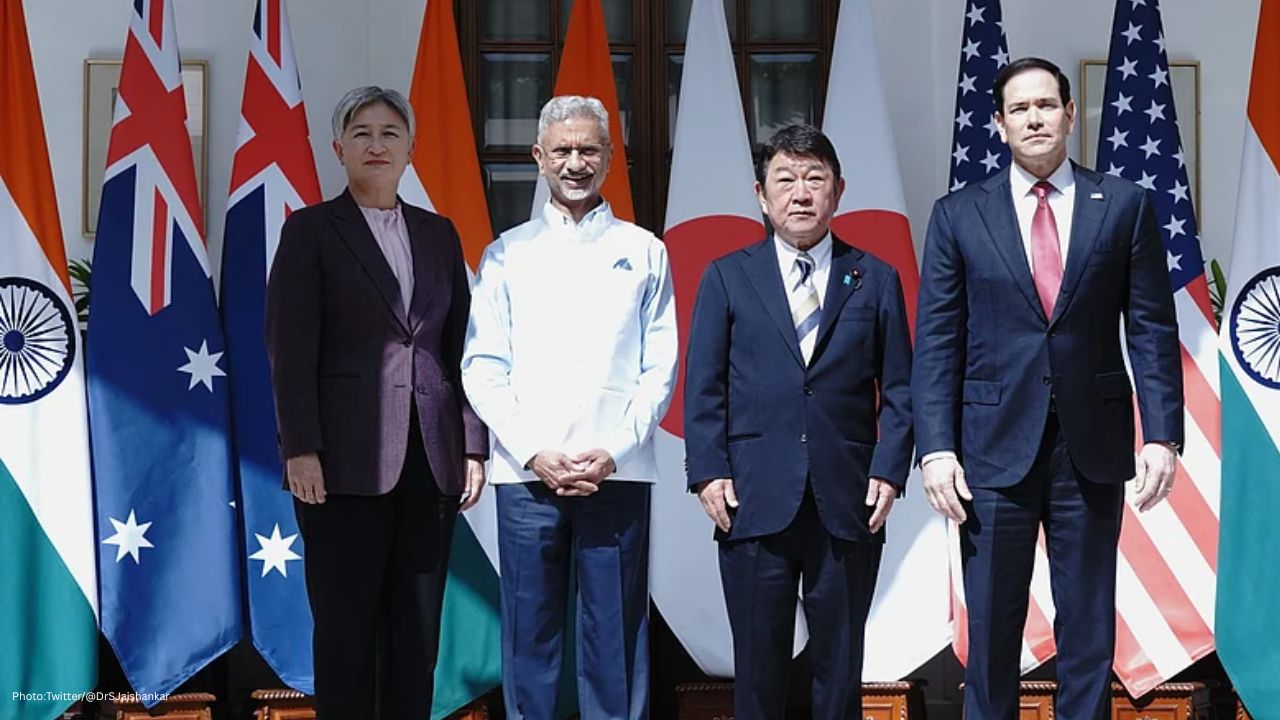
India hosted the meeting with External Affairs Minister S. Jaishankar welcoming US Secretary of State Marco Rubio, Japanese Foreign Minister Toshimitsu Motegi, and Australian Foreign Minister Penny Wong. The discussions mainly focused on maintaining a “Free and Open Indo-Pacific,” which has become the central goal of the QUAD partnership.
One of the biggest achievements of the meeting was the launch of the Indo-Pacific Maritime Surveillance Collaboration (IPMSC). This initiative will allow QUAD nations to coordinate maritime monitoring and improve information sharing across the Indo-Pacific region. Officials said the project is designed to improve maritime awareness, protect shipping routes, and strengthen regional stability. The move comes at a time when tensions in the South China Sea and nearby waters continue to increase.
The QUAD countries also announced a major agreement on critical minerals cooperation. The new framework aims to secure supply chains for minerals and rare earth elements that are essential for electric vehicles, semiconductors, batteries, and advanced technology industries. India and the United States signed a separate bilateral framework to deepen cooperation in mining, processing, recycling, and investment related to critical minerals. This step is being seen as an effort to reduce overdependence on China, which currently dominates much of the global rare earth supply chain.
Another major outcome was the launch of a new Indo-Pacific Energy Security Framework. The initiative was announced as global energy markets continue facing pressure due to instability in the Middle East and tensions around key shipping routes such as the Strait of Hormuz. QUAD members said they will work together to secure fuel supplies, improve emergency coordination, and protect energy trade routes. The countries also discussed creating stronger energy reserves and more reliable supply networks for the future.
The meeting also produced the QUAD’s first major joint infrastructure project — a plan to help build a port in Fiji. The project is aimed at improving connectivity and infrastructure in Pacific Island nations, where competition for influence between global powers has intensified in recent years. Officials said the port project will support trade, logistics, and economic growth in the region while also strengthening ties with Pacific nations.
Counterterrorism cooperation was another important topic during the meeting. QUAD members reviewed previous workshops on drone threats and emerging technologies used by terrorist groups. The countries also confirmed plans for a future counterterrorism exercise in Australia focused on state-sponsored threats and unmanned aerial systems. Officials believe closer intelligence sharing and joint preparedness are becoming increasingly important in today’s security environment.
The meeting carried strong strategic importance because it demonstrated unity among the four countries during a period of growing global uncertainty. Although the QUAD is not a formal military alliance like NATO, many analysts believe the group is becoming more influential in balancing power across the Indo-Pacific region. China reacted cautiously to the meeting and warned against “bloc confrontation,” while QUAD leaders insisted that the partnership is focused on regional peace, stability, and economic resilience.
Experts say the 2026 QUAD meeting matters because it moved beyond diplomatic discussions and delivered practical initiatives in security, technology, infrastructure, energy, and trade. The agreements announced in New Delhi show that the QUAD is evolving into a stronger strategic partnership with long-term regional goals. For India, the meeting also highlighted its growing role as a major diplomatic and strategic power in the Indo-Pacific region.