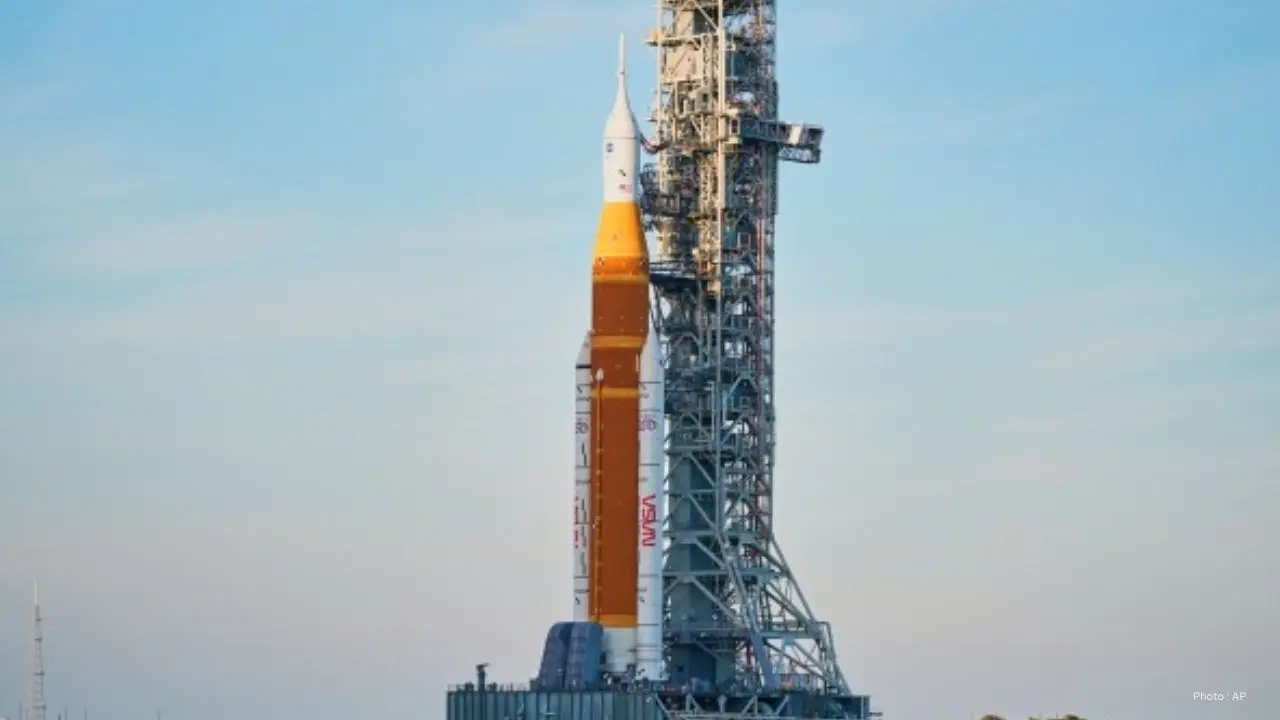
National Aeronautics and Space Administration has refined important flight details for the upcoming Artemis III mission as preparations continue for the agency’s planned return of astronauts to the Moon next year. The mission is expected to become one of the most significant milestones in modern space exploration because it aims to land humans on the lunar surface for the first time since the Apollo era.
NASA officials said updated mission planning includes adjustments to spacecraft operations, lunar landing timelines, orbital coordination, and astronaut training procedures. Engineers and mission planners are continuing to fine-tune technical systems to improve safety, efficiency, and coordination between multiple spacecraft involved in the complex mission.
Artemis III is expected to use NASA’s powerful Space Launch System rocket along with the Orion spacecraft to transport astronauts toward lunar orbit. A separate lunar landing system developed in partnership with private aerospace companies will then carry astronauts from orbit down to the Moon’s surface before returning them safely to the Orion capsule.
The mission is part of NASA’s broader Artemis program, which aims to establish a long-term human presence on and around the Moon while preparing for future missions to Mars. Officials say Artemis III will also include scientific experiments, surface exploration, and technology demonstrations designed to support future deep-space missions.
One of the mission’s major goals is to land astronauts near the Moon’s south polar region, an area scientists believe may contain frozen water inside permanently shadowed craters. Researchers say studying lunar ice could become extremely important for future space exploration because water can potentially be converted into drinking supplies, breathable oxygen, and rocket fuel.
NASA also confirmed that astronaut training activities are continuing intensively as crews prepare for lunar surface operations, emergency scenarios, spacecraft docking procedures, and long-duration mission tasks. Engineers are simultaneously testing spacesuits, communication systems, navigation technologies, and life-support equipment needed for the mission.
The Artemis program has faced delays and technical challenges over recent years, including concerns involving spacecraft readiness, testing schedules, and lunar landing systems. However, NASA officials say updated planning and additional testing are helping reduce mission risks ahead of launch preparations.
International partners and private space companies are also playing major roles in the Artemis program. NASA has expanded cooperation with commercial aerospace firms and allied space agencies to support lunar infrastructure, scientific research, cargo systems, and future exploration projects connected to the Moon.
Space analysts say Artemis III is being closely watched globally because it represents both a scientific milestone and part of a broader international competition in space exploration. Countries including China, Russia, India, and members of the European Space Agency are all increasing investments in lunar and deep-space programs.
If successful, Artemis III would mark the first human Moon landing in more than 50 years and the first time a woman and a person of color are expected to walk on the lunar surface. NASA says the mission could open a new chapter in human space exploration and lay the foundation for future long-term operations beyond Earth orbit.