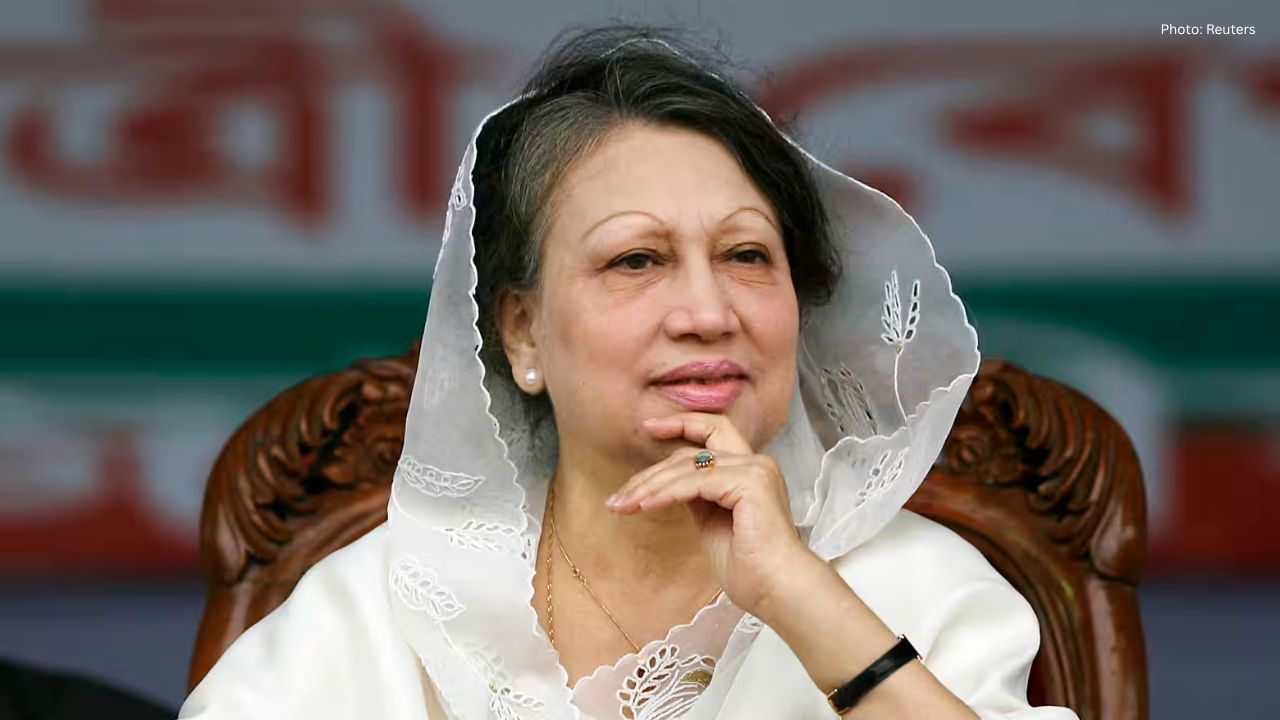
Khaleda Zia, who carved her place in history as Bangladesh’s first woman prime minister, died at the age of 80 on Tuesday after a prolonged illness. Her family party, the Bangladesh Nationalist Party (BNP), announced her passing, revealing that she had been grappling with various health issues, such as severe liver disease, diabetes, arthritis, and heart complications.
Earlier in 2025, she traveled to London for specialized medical care and remained there for several months before returning home. Despite not holding office since 2006, her enduring influence in the political arena and unwavering allegiance from her supporters remained palpable.
Khaleda Zia became a key public figure following a personal tragedy; she was primarily a homemaker until her husband, President Ziaur Rahman, was assassinated in a failed coup in 1981. Three years later, she assumed leadership of the BNP, the party her husband established, vowing to fulfill his vision of rescuing Bangladesh from poverty.
Throughout the late 1980s, she collaborated with Sheikh Hasina, the Awami League leader, to oppose the military dictatorship of Hossain Mohammad Ershad, jointly working to restore democracy in 1990. However, their partnership deteriorated, resulting in a fierce political rivalry, which defined the political landscape for over thirty years, earning them the nickname the “battling Begums.”
In 1991, she led the BNP to triumph in what is regarded as the nation’s first truly fair election, becoming Bangladesh’s first female prime minister. During her initial term, she reinstated the parliamentary system, curtailed presidential powers, liberalized the economy for foreign investment, and made primary education freely available.
She faced electoral defeat in 1996 but returned to power in 2001 with substantial support. However, her second term faced significant obstacles, including the emergence of militant groups and rampant corruption allegations. A grim grenade attack at a political rally in 2004 heightened political unrest, casting a long shadow on the country’s political climate.
The ensuing turbulence resulted in an army-backed interim government assuming control in 2006. Both Khaleda Zia and Sheikh Hasina were arrested on corruption allegations and spent nearly a year in custody. Although they were later freed, Khaleda never regained political command, as her party boycotted numerous elections and she spent years in detention due to ongoing legal disagreements.
In 2018, she was convicted in a corruption case related to an orphanage trust, a decision she labeled as politically motivated. As her health waned, she transitioned from prison to house arrest in 2020. She was eventually freed in August 2024 after significant protests led to Sheikh Hasina's resignation. Early in 2025, the Supreme Court exonerated her and her son, Tarique Rahman, from the corruption charges.
Even during her final years, Khaleda Zia’s impact persisted, with the BNP remaining a significant political entity. Her son, Tarique Rahman, is viewed as a formidable candidate as Bangladesh prepares for forthcoming parliamentary elections. Her demise arrives at a critical juncture, as the nation is currently managed by an interim government led by Nobel laureate Muhammad Yunus.
Khaleda Zia’s legacy is complex. To her advocates, she was a decisive leader symbolizing democracy and national dignity. To her detractors, she represented a divisive political era marred by unrest. Regardless, it's undeniable that she played a pivotal role in reshaping Bangladesh's political history and paving the way for women in leadership roles.