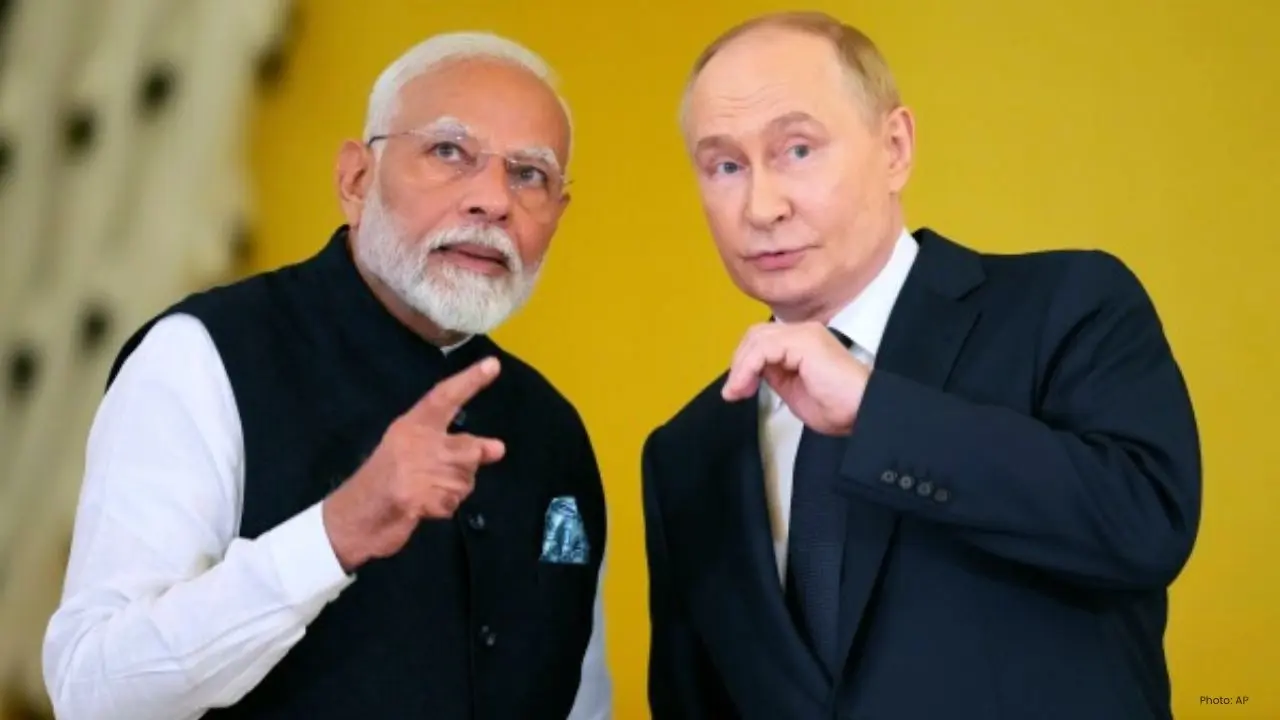
Russian President Vladimir Putin has arrived in New Delhi for a pivotal two-day state visit that could redefine the future of cooperation between India and Russia in areas such as energy, defence, and labour mobility. The timing is critical, as India’s relations with the US face turbulence, with Washington tightening its oversight on Russian oil imports amid ongoing geopolitical shifts due to the Ukraine conflict.
Upon his arrival, Putin received a formal welcome as he prepared for the annual bilateral summit with Prime Minister Narendra Modi—a longstanding tradition that cements their partnership. However, this year, the stakes have been raised significantly.
Historically, India and Russia have maintained a solid alliance since the Soviet era, but their relationship is now navigating through economic sanctions and strategic challenges. India’s rapidly-growing economy, expanding at over 8%, has made it a vital market for Russian exports, particularly discounted oil. Prior to the Ukraine invasion, Russian oil constituted merely 2.5% of India's imports, but surged to 35% when prices fell.
While this shift has benefited Indian refiners, it has strained India's relationship with Washington. The additional 25% tariff imposed by the Trump administration on Indian goods due to the continued purchase of Russian oil necessitated a scaling back of orders in recent months. Putin's visit aims to mitigate this slowdown as Russia seeks to lock in one of its key energy consumers.
Defence collaboration will also be a significant focus. Russia has been India’s leading military supplier for decades. Despite efforts to diversify, India still heavily depends on Russian technology for several platforms, including Sukhoi-30 jets and S-400 air defense systems. With Pakistan introducing Chinese fifth-generation fighters this year, India is expected to explore options including the Su-57 and the next-gen S-500 defense system. However, issues such as supply chain delays and sanctions could be topics of concern that Modi will likely address.
Moreover, trade disparities present another challenge. Bilateral trade has skyrocketed to over $68 billion, predominantly driven by Indian oil purchases, leading to significant trade imbalances in Russia's favor. New Delhi seeks greater access for Indian products in Russian markets, spanning electronics, seafood, and garments, where India's market share remains relatively minuscule.
Putin's visit also symbolizes a broader geopolitical strategy. For the Kremlin, aligning with Modi serves to counter Western efforts to isolate Russia. Conversely, hosting Putin requires India to maintain its delicate balance with the US and Europe, showcasing its diplomatic finesse. Both nations exhibit determination to preserve their longstanding ties amidst these complex dynamics.
As discussions commence, the summit is likely to prioritize practical cooperation—including oil, defence provisions, new trade routes, and labour exchanges—over broad political rhetoric. The outcomes of this visit could be pivotal in shaping India's approach to strategic autonomy in an increasingly volatile global landscape.