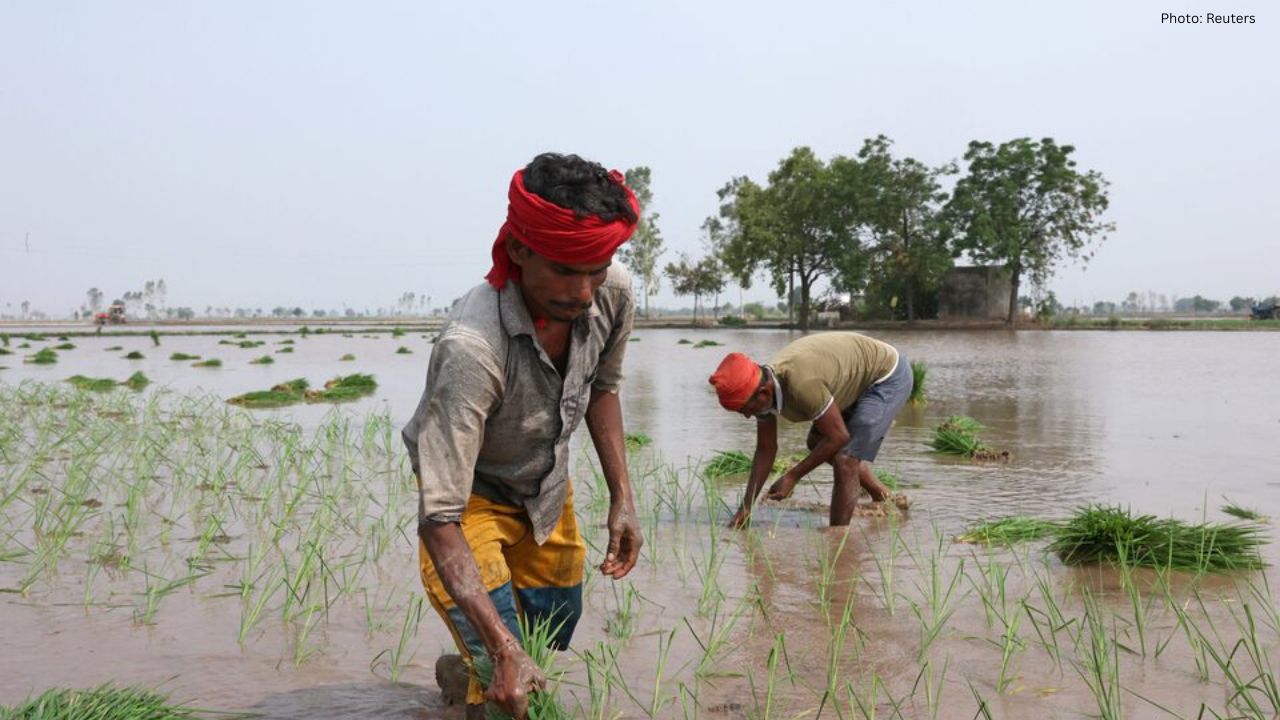
India has achieved the remarkable feat of becoming the world's leading rice producer and exporter, a development hailed by policymakers and agricultural experts alike. In the last decade, the nation has nearly doubled its rice exports, surpassing 20 million metric tons in the most recent financial year. This remarkable achievement has bolstered India's stature in international food markets. However, beneath this success story lies a critical situation that threatens both farmers and the future of water security in agriculture.
Water scarcity is at the core of the issue. Rice is notoriously water-intensive. In India, particularly in northern regions like Punjab and Haryana, rice farming heavily relies on groundwater sources. These provinces are already among the most water-deficient areas in the country. With an expansion in rice farming, groundwater levels are plummeting at alarming rates.
Farmers recount that ten years ago, water was accessible at depths around 30 feet. Today, borewells must frequently be drilled to depths of 80 to 200 feet to reach groundwater. Drilling deeper incurs additional costs, requiring investments in longer pipes, durable pumps, and increased electricity bills. Such financial burdens are becoming overwhelming for many.
Balkar Singh, a farmer from Haryana, notes that expenses escalate yearly. “Each year, the borewell has to go deeper,” he shares. “It's becoming too costly.” His predicament mirrors that of countless farmers facing similar challenges across the region.
Government interventions have significantly influenced the current scenario. For many years, India promoted rice cultivation to secure food supplies for its growing populace. Initiatives such as guaranteed minimum prices and generous subsidies on fertilizers and electricity were implemented. Although these measures have historically supported national food needs, they now inadvertently encourage rice farming in water-scarce regions.
Experts express grave concerns regarding the implications. As one of the most water-stressed nations globally, India incentivizes farmers to exploit groundwater at unprecedented rates. The production of a single kilogram of rice can use between 3,000 and 4,000 liters of water—substantially higher than the global average.
Government reports indicate that Punjab and Haryana extract more groundwater annually than can be naturally replenished. In some localized areas, the extraction rate exceeds natural recharge levels by 35% to 57%. Consequently, significant portions of these states now fall under the “over-exploited” or “critical” categories regarding groundwater usage.
This issue affects farmers unevenly. Larger landholders often weather the storm by investing in advanced borewells and taking advantage of subsidy schemes. In contrast, smallholder farmers feel the most substantial impact. Each spike in costs severely disrupts their already limited income, raising fears they may not sustain farming as water resources dwindle.
The global implications of this situation cannot be overlooked. As India accounts for roughly 40% of the world's rice exports, any significant shift in its production practices will ripple through international food markets. Experts are now questioning whether India should maintain extensive rice exports against such high environmental costs.
Some initial steps towards change are noticeable. Certain state governments are encouraging farmers to shift to less water-intensive crops such as millets. For instance, Haryana is offering financial incentives to those who pivot from rice. Given that millets require significantly less water, they are increasingly recognized as healthy alternatives.
Nonetheless, these initiatives have yet to gain wide traction. Currently, incentives are often short-lived, failing to persuade a significant number of farmers to adopt permanent changes. Experts emphasize the need for long-term assistance, reliable pricing structures, and guaranteed government purchases to empower farmers in transitioning crops.
Economists suggest that reallocating existing subsidies could prove beneficial, as funds currently directed towards rice production could support the cultivation of less water-intensive crops while sustaining farmer livelihoods and conserving groundwater.
Many farmers express a willingness to adapt. Gurmeet Singh, a rice grower from Punjab, states that with appropriate governmental support, they are amenable to diversifying their crops. “Our land is fertile,” he remarks. “We’re prepared to change if the government commits to fair pricing for our produce.”
Although India's rice production has nurtured a sense of national pride and global recognition, it concurrently reveals a pressing environmental concern. Without pivotal policy alterations and comprehensive strategies, the future of India's agricultural landscape is uncertain. Strike the right balance between food security, farmer support, and water conservation will emerge as one of India's paramount challenges moving forward.