Germany and Italy, the leading manufacturing powers within the European Union, have unveiled a collaborative effort designed to fortify European industry and enhance the region's competitive edge. This initiative signifies a growing alignment between Berlin and Rome, both of which are increasingly concerned about economic pressures stemming from China, the U.S., and stringent EU regulations.
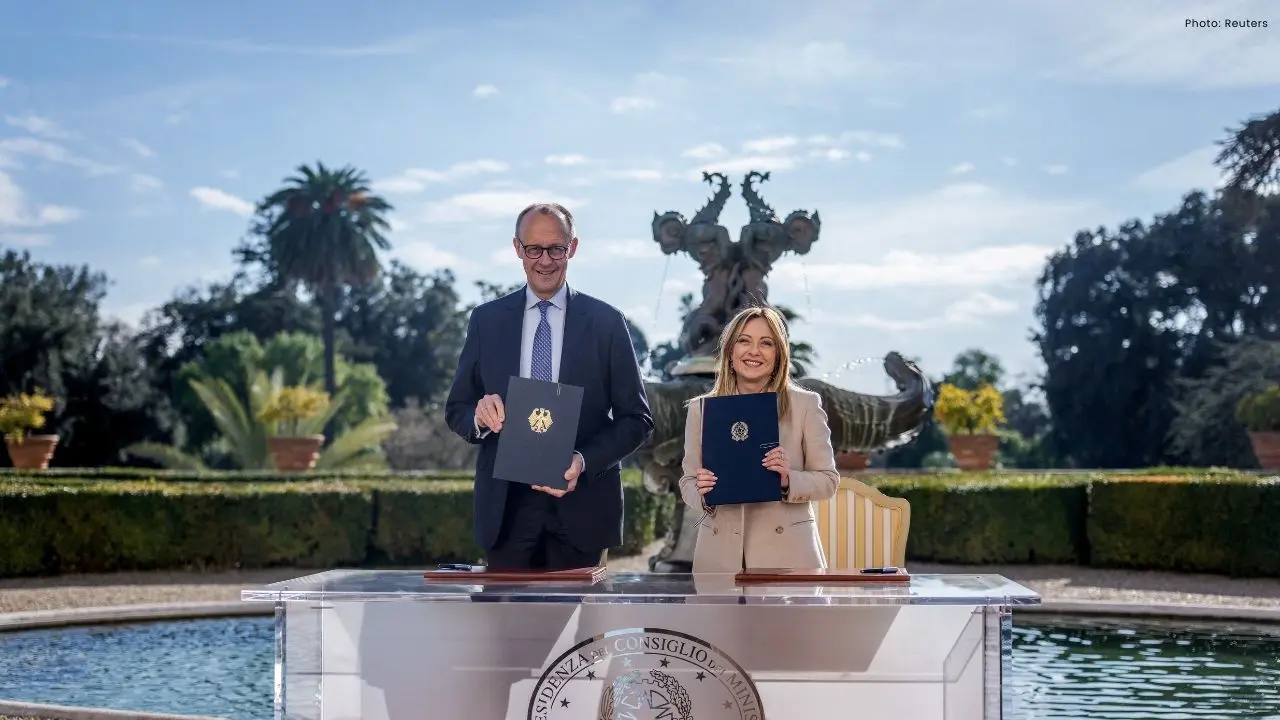
The partnership was announced in Rome during discussions between Italian Prime Minister Giorgia Meloni and German Chancellor Friedrich Merz. The two officials committed to collaborating within the EU to simplify regulatory frameworks, alleviate unnecessary constraints, and support vital industries. They also emphasized the need for enhanced cooperation in fields like energy, defence, security, and migration.
Both nations asserted the necessity for Europe to respond more swiftly and cohesively. They cautioned that sluggish decision-making and burdensome regulations are undermining Europe’s industrial foundation, particularly amidst the ongoing challenges posed by Russia’s invasion of Ukraine and global economic competition.
Meloni remarked that a common perspective is now shared between Italy and Germany on numerous critical issues. She criticized EU green transition policies for placing undue strain on industries, specifically automotive sectors, thereby granting a competitive advantage to China. Similarly, Germany has voiced concerns that EU regulations hinder manufacturers' ability to compete internationally.
This partnership further underscores existing divisions within the EU. While France has been advocating for a firmer approach towards the United States, Germany and Italy are adopting a more cautious stance. As significant exporters to the U.S., both nations prefer dialogue and cooperation over confrontation, especially in diplomatically sensitive moments.
The pair's comprehensive action plan calls for simplifying EU legislation and urges prudence regarding new regulation implementation. They assert that reducing bureaucratic barriers will facilitate business investment, growth, and job creation. Furthermore, they endorse advancing the EU’s single market integration, particularly in services, as a vital factor for future development.
Germany and Italy pinpointed crucial sectors needing support, like the automotive industry and energy-intensive manufacturing. They warned that without increased synergy, Europe risks lagging behind the U.S. and China in industrial and technological prowess.
The two governments also committed to collaborating on securing essential raw material supplies necessary for modern manufacturing. With China dominating much of this supply chain, Berlin and Rome highlighted the need for Europe to mitigate its dependencies and ensure equitable competition, especially in online retail.
Regarding trade, both countries advocated for expedited approval of EU trade agreements with nations in South and Central America and called for advancements on deals within the Indo-Pacific region. This stance diverges from France's emphasis on heightened protections for its agricultural sector.
Germany and Italy also formalized a defence collaboration agreement, reinforcing their commitment to joint initiatives across land, air, sea, and cyber systems. This development reflects their shared conviction that a robust industrial sector is integral to ensuring Europe’s security.
This new alliance represents a pivotal moment in EU governance, with Germany and Italy poised to play a leading role in directing the future trajectory of the bloc. As global competition escalates, their partnership could significantly influence Europe’s balance between economic advancement, regulation, and industrial integrity in the coming years.