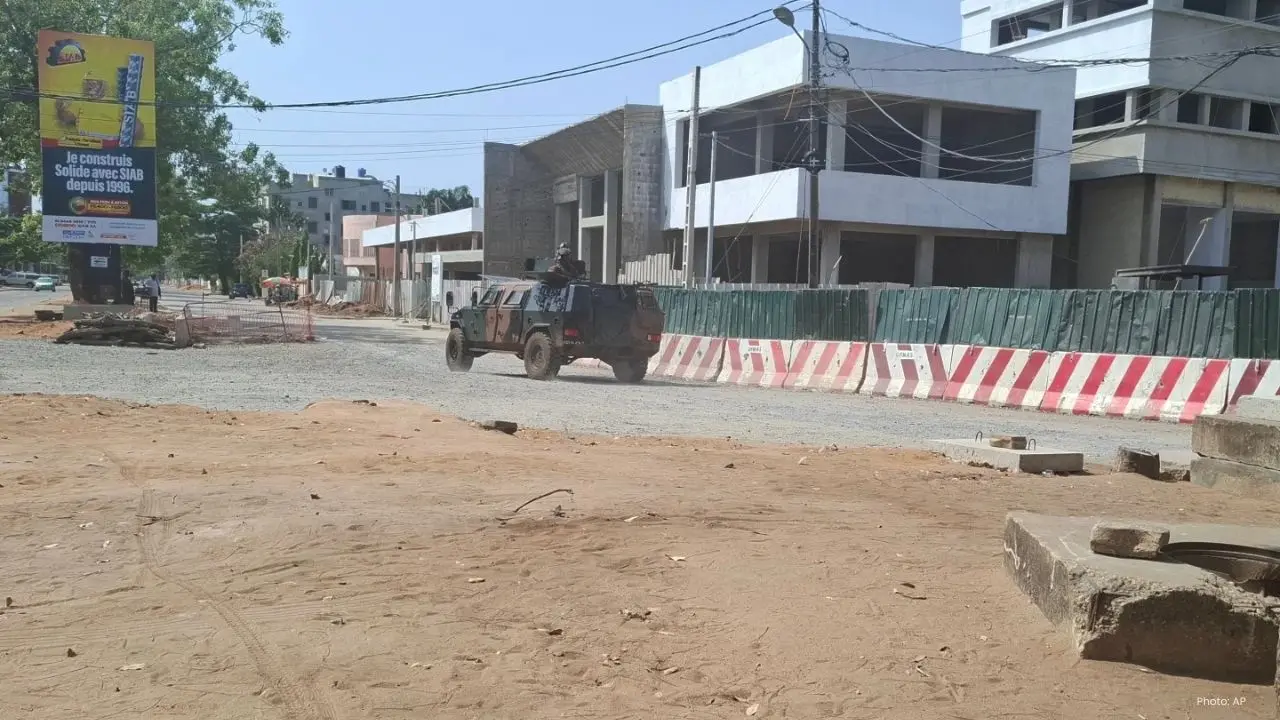
On a chaotic Sunday morning in Cotonou, Benin, a group of soldiers created disturbances by briefly taking over state television to announce a coup, calling themselves the Military Committee for Refoundation, and proclaiming the government's dissolution, alarming the West African region.
By the afternoon, Interior Minister Alassane Seidou declared the coup had been “foiled” through social media, though President Patrice Talon's whereabouts were not revealed until he addressed the nation on television. “I express my condolences to the victims of this senseless adventure and to those still held by fleeing mutineers,” Talon remarked, reassuring the public about ongoing efforts to ensure the safety of affected individuals.
This attempted mutiny adds to the growing trend of military unrest in the region; Guinea-Bissau experienced a successful coup just last month after contested elections, marking continued instability across West Africa.
Describing the sequence of events, Seidou shared that “in the early morning of December 7, a small faction of soldiers attempted to destabilize the state. The Beninese Armed Forces, dedicated to the republic, promptly intervened to restore order.” At least 13 soldiers have been apprehended, though the whereabouts of coup leader Lt. Col. Pascal Tigri are still unknown.
In response, ECOWAS (Economic Community of West African States) swiftly deployed troops from Nigeria, Sierra Leone, Ivory Coast, and Ghana to aid Benin's military in upholding constitutional integrity. Nigeria’s President Bola Tinubu commended the collaborative initiative, confirming that Benin had requested both air and ground assistance, successfully re-establishing control over the national television station.
Notwithstanding the turmoil, life in Cotonou has mostly normalized, with security patrols visible throughout the area. Since gaining independence from France in 1960, Benin has weathered military coups but has upheld relative political stability since the onset of democracy in 1991. Talon, who assumed office in 2016, is scheduled to step down next April, with his party's candidate Romuald Wadagni likely to take his place.
Political tensions remain a concern: last month, the legislature voted to extend presidential terms from five to seven years, while an opposition candidate faced disqualification from the electoral commission for the forthcoming election.
As Benin navigates past this notable coup attempt, the emphasis resides on fostering stability and preparing for a crucial transition of power in a region historically vulnerable to military uprisings.