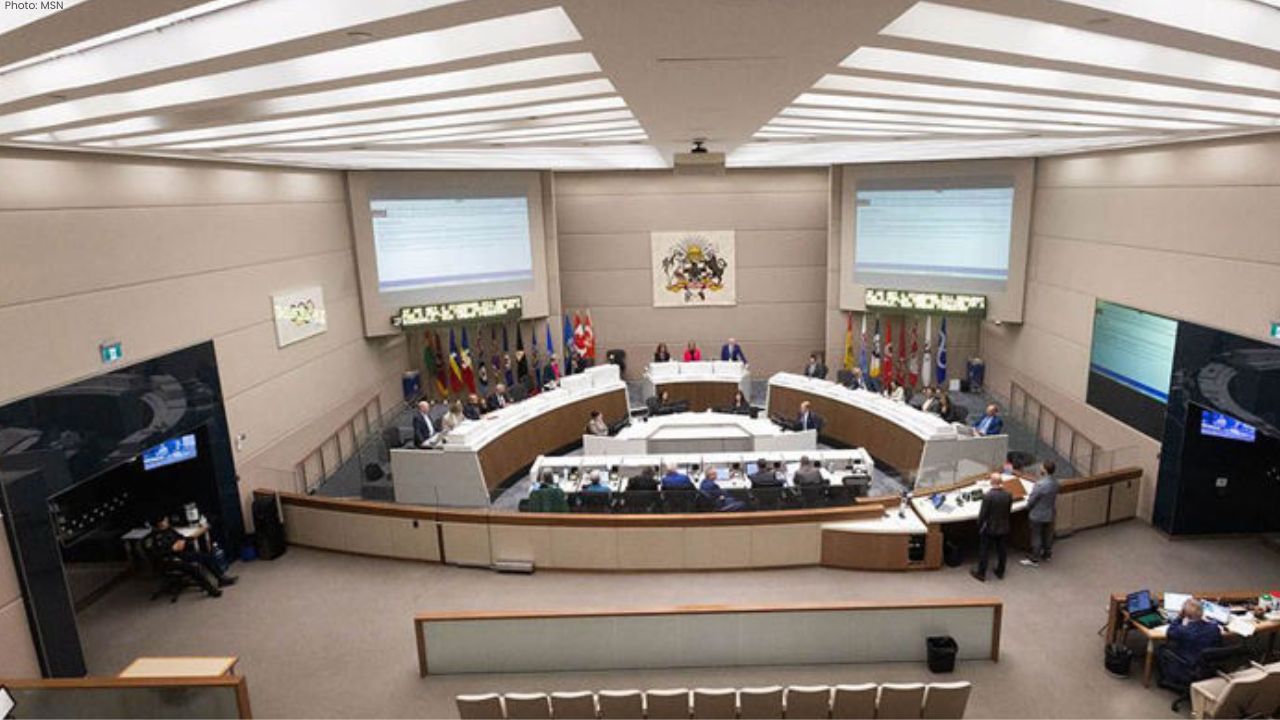
Calgary’s newly elected city council is preparing to tackle one of the most debated issues in recent municipal history: the citywide residential rezoning policy. Repealing the policy was a central campaign promise for many of the newly elected councillors and mayor-elect Jeromy Farkas, who has emphasized the need for a replacement strategy.
“We’re going to be starting those initial conversations about the mechanics of that with the incoming city council,” Farkas said at a press conference in front of city hall. “But it’s also very important to focus on the replacement approach.”
The rezoning policy, approved by council in May 2024 after the longest public hearing in Calgary’s history, changed the city’s default residential zoning to residential grade-oriented infill (R-CG). The public hearing featured more than 730 speakers, the majority of whom voiced opposition to the proposal.
Under R-CG zoning, a wider variety of housing types—including single-detached homes, semi-detached houses, duplexes, and rowhouses—became permitted across Calgary. The policy was part of a larger housing strategy aimed at increasing supply and improving housing affordability.
Groups opposing the rezoning, such as Calgarians for Thoughtful Growth, have expressed cautious optimism about the new council’s ability to address the issue. “If you ask any one of the elected councillors what issues they heard on the doorsteps, blanket rezoning was one of them,” said Robert Lehodey of the group. “Hopefully they’re prepared to find another way to work with communities to come up with solutions for intelligent, thoughtful densification.”
Most of the new council, including Farkas, campaigned on repealing the citywide rezoning. The Communities First Party secured four seats—Kim Tyres in Ward 1, Andre Chabot in Ward 10, Rob Ward in Ward 11, and Dan McLean in Ward 13—with the repeal included in their platform. The A Better Calgary Party also supported the repeal, electing Mike Jamieson in Ward 12. Independent councillors John Pantazopoulos (Ward 6) and Landon Johnston (Ward 14) also ran on the promise to reverse the policy.
“Almost everybody said they would repeal it or make drastic alterations to it,” said McLean. “That is still the first order of business to me — I want to see blanket rezoning repealed.”
However, not all councillors agree on a full repeal. Nathaniel Schmidt, representing Ward 8, prefers amending the current policy rather than discarding it entirely. “We have to start with listening to each other as a council and listening to our constituents and find a path forward that is mutually beneficial,” Schmidt said.
Industry stakeholders have warned of potential consequences if the policy is repealed. The Calgary Inner City Builders Association (CICBA) noted that the rezoning had reduced development timelines for townhomes by six months, saving approximately $90,000 per project. “Instead of repealing, why don’t we find solutions?” said CICBA chair Shameer Gaidhar. “Let’s get community officials and industry together to address the issues.”
Repealing the policy will not be immediate. The process requires an advertising period, public hearings, and council debate before approval. The new council is currently in orientation and will be officially sworn in on October 29.
As Calgary prepares for continued population growth, reaching an estimated two million residents in the coming years, the outcome of the rezoning debate will have significant implications for housing supply, affordability, and community planning across the city.