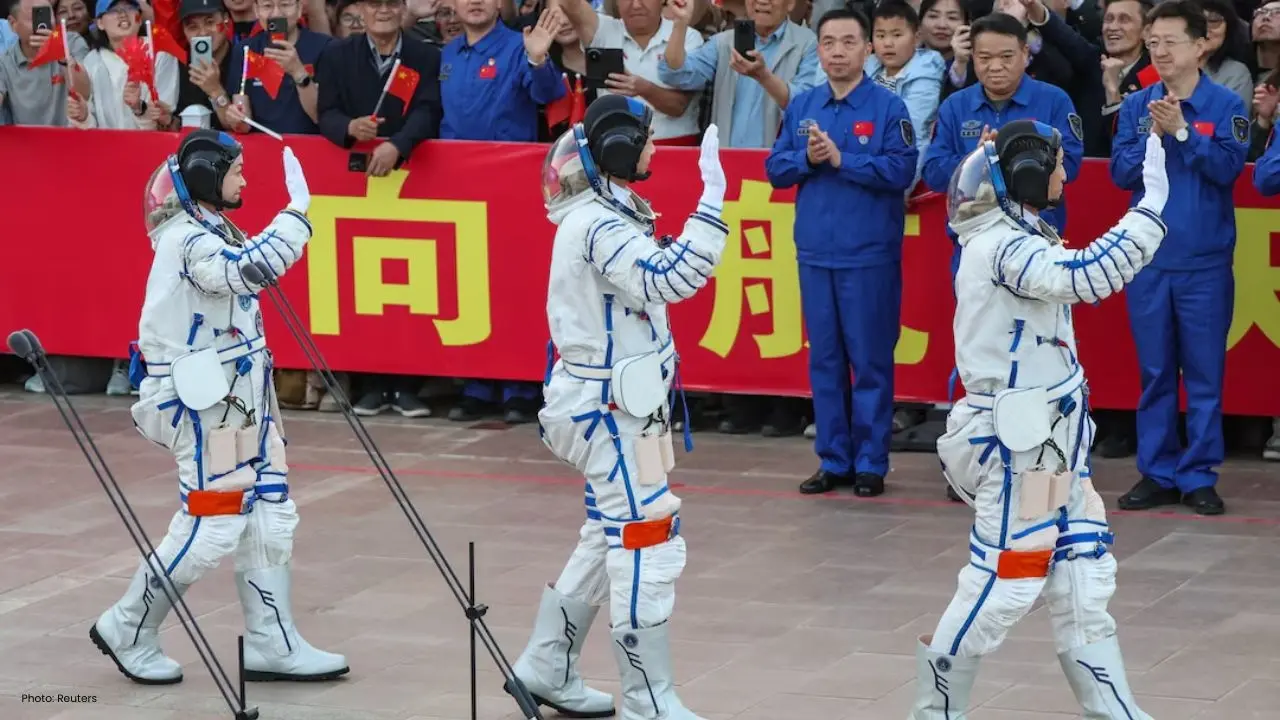
China has successfully launched the Shenzhou-23 crewed space mission from the Jiuquan Satellite Launch Center, marking a pivotal move in its ambitious endeavor to land astronauts on the moon by the year 2030. This mission features three astronauts who will spend an extended time aboard the Tiangong space station, including a member whose year-long stay represents China's longest human spaceflight to date.
The Shenzhou-23 spacecraft took off atop a Long March-2F Y23 rocket late Sunday night. The crew comprises commander Zhu Yangzhu, pilot Zhang Yuanzhi, and payload specialist Li Jiaying, notably the first astronaut from Hong Kong to join a Chinese space mission. Officials have marked this event as a significant milestone highlighting China's expanding space capabilities.
According to the China Manned Space Agency, this extended mission will allow scientists to investigate the long-term impacts of spaceflight on human physiology. Research will focus on various factors, including exposure to radiation, bone density changes, mental health, and other physiological effects faced during lengthy space missions. Experts believe these studies are essential for preparations for future lunar expeditions.
Over the last decade, China’s space program has drastically advanced as it seeks to compete with the United States within the new space race. The aim is to achieve a successful crewed moon landing before 2030 and collaborate with Russia to set up a permanent research facility on the moon by 2035. Officials indicate that the Shenzhou-23 mission will also trial sophisticated autonomous docking technologies crucial for upcoming lunar missions.
As the global space race intensifies, this mission arrives at a pivotal moment. The United States aims for a lunar landing by 2028 through NASA's Artemis program, while SpaceX is testing its next-gen Starship rockets for deeper space ventures. Chinese researchers argue that their expanding space resources and successful Tiangong missions build China’s capabilities as a formidable player in global space affairs.
China has already secured several historic achievements, including being the first to attain samples from the far side of the moon back in 2024. Since 2021, the nation has executed multiple long-term missions to the Tiangong station, enhancing life-support systems and astronaut training.
An intriguing aspect of the Shenzhou-23 mission is its cutting-edge research into human survival in space. Notably, scientists are experimenting with human stem cells and artificial embryos aboard the space station to explore future possibilities for human habitation and reproduction during prolonged space journeys.
Experts believe Shenzhou-23's success could bolster China's confidence as it prepares for lunar explorations ahead. As the world races towards lunar discovery, Beijing is increasingly solidifying its role as a leader in advanced space science and exploration.