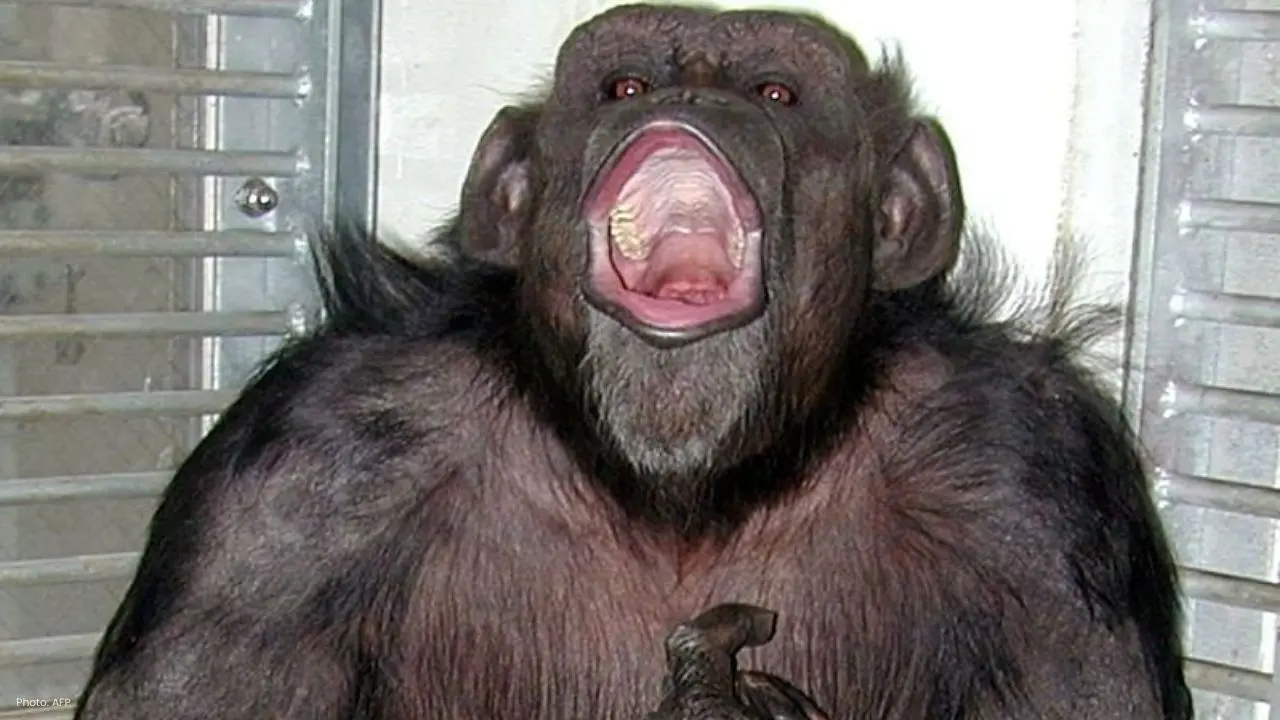
TOKYO — Ai, the renowned chimpanzee whose exceptional skills significantly advanced our understanding of primate cognition, has passed away at 49, as reported by Japanese researchers.
Known as "Ai," which translates to "love" in Japanese, she died on Friday due to multiple organ failure and age-related health issues, according to the Kyoto University Center for the Evolutionary Origins of Human Behavior. Ai spent her life at the university, where she emerged as a pivotal figure in contemporary primate research.
Throughout her life, Ai participated in groundbreaking research focusing on perception, learning, memory, and problem-solving. Her involvement not only highlighted the intelligence of chimpanzees but also facilitated critical insights into the cognitive similarities between humans and our closest relatives in the animal kingdom.
Researchers affirmed Ai's significant role in shaping modern experimental methodologies for studying chimpanzee cognition.
"Ai was extremely inquisitive and took part in these studies with enthusiasm, unveiling numerous aspects of the chimpanzee psyche for the first time," the center stated. "Her contributions laid a vital foundation for understanding the evolution of human cognition."
A Chimpanzee with Distinctive Talents
Ai was far from an ordinary chimpanzee. She garnered fame for her ability to recognize over 100 Chinese characters, the English alphabet, Arabic numbers, and at least 11 different colors, earning her the moniker "genius" in popular media and the focus of various academic studies and television features.
Primatologist Tetsuro Matsuzawa, who collaborated with Ai extensively, frequently praised her extraordinary learning capabilities. In a notable experiment, Ai was shown the Chinese character for pink alongside two-colored squares: one pink, one purple. She consistently chose the pink square, demonstrating genuine comprehension rather than mere guessing.
In another trial, Ai was presented with an apple and asked to select between a rectangle, a circle, and a small dot on a computer screen to represent a simple "virtual apple." This not only illustrated recognition but also showcased her capacity for abstract thinking.
Such experiments provided compelling evidence that chimpanzees can engage in complex thought processes and symbolic comprehension, abilities once thought to be exclusive to humans.
A Life Committed to Science
Ai arrived in Japan from West Africa in 1977, quickly becoming integral to Kyoto University's extensive studies on chimpanzee intelligence. Over the years, she featured in numerous scientific articles, including those in prestigious journals like Nature.
Her calm demeanor and enthusiasm for tasks made her an ideal subject for long-term research. Scientists noted that she showed genuine curiosity and engaged in testing, indicating active interest beyond mere training.
In 2000, Ai became a mother to a son named Ayumu, who also gained recognition for his remarkable memory abilities, particularly in recalling sequences of numbers after only brief exposure. His feats sparked new discussions on the transmission of skills and knowledge from parent to child in chimpanzees.
This dynamic duo provided researchers with a unique opportunity to investigate learning, memory, and development across generations.
A Enduring Legacy
Ai's impact on science transcends her impressive skill set. According to her research center, she laid the groundwork for a reliable system to study chimpanzee cognition, a framework still employed today for exploring primate learning, memory, and thought processes.
Most importantly, her life's work has altered perceptions of animals—they are not mere instinctual beings but are capable of solving problems, understanding symbols, and engaging in complex learning.
Although Ai has passed, her legacy will continue to resonate in laboratories, classrooms, and academic texts worldwide. For decades, she bridged the relationship between humans and animals, enhancing our understanding of our origins and kinship with primates.
As researchers in Japan and globally honor her memory, Ai will be recognized not merely as a study subject, but as a trailblazer who transformed our comprehension of intelligence itself.