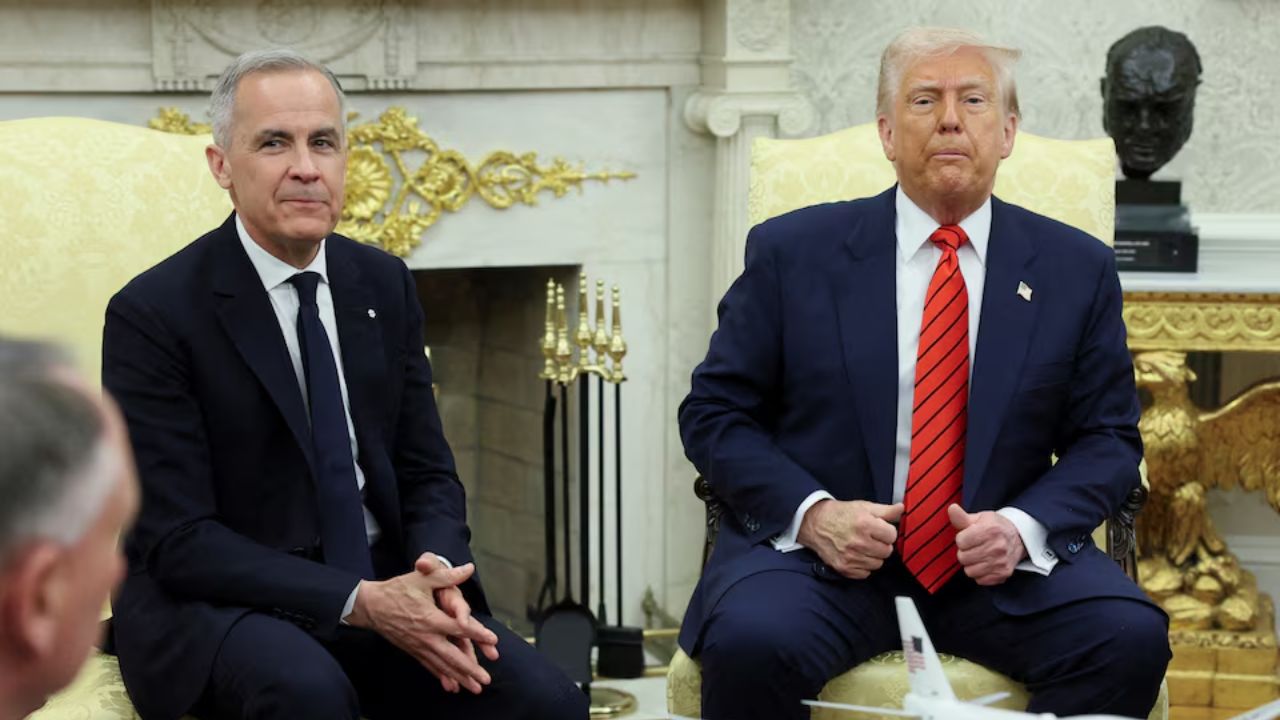
Photo:Reuters
Canadian Prime Minister Mark Carney and U.S. President Donald Trump held a phone call on Thursday, at a time when relations between the two countries are facing some of their most difficult moments in recent years. The call focused on trade disputes, economic opportunities, and shared global concerns such as the ongoing war in Ukraine.
The discussion was described by the Canadian government as “productive and wide-ranging,” suggesting that while tensions remain, both sides are still willing to keep lines of communication open.
A Call Amid Rising Tensions
The timing of this call was significant. Just hours earlier, Canada’s Foreign Affairs Minister Anita Anand was in Washington, D.C., meeting with U.S. Secretary of State Marco Rubio. This shows that Canada and the U.S. are working on multiple levels—both through direct leader-to-leader talks and through official diplomatic channels—to manage a difficult relationship.
According to the Prime Minister’s Office, Carney and Trump covered several key areas:
* Trade challenges: especially after the U.S. raised tariffs on Canadian goods.
* Opportunities for cooperation: looking at ways to strengthen economic ties.
* Security partnership: building a framework for closer defense and intelligence coordination.
* Ukraine conflict: discussing strategies to support Kyiv and maintain stability in Europe.
The Trade War at the Center
The biggest issue remains the escalating trade war. On August 1, President Trump’s executive order took effect, raising tariffs on Canadian goods to 35 percent. These tariffs hit a wide range of industries—steel, aluminum, lumber, and agricultural exports among them—making Canadian products much more expensive in the U.S.
The White House defended its decision by saying Canada had “failed to cooperate” in reducing the flow of fentanyl and other illegal drugs into the United States. U.S. officials also pointed to Canada’s retaliatory tariffs on American goods as a reason for further escalation.
From Canada’s side, Carney strongly criticized the move, calling it “disappointing and harmful” for both economies. He stressed that Canada remains fully committed to the Canada-United States-Mexico Agreement (CUSMA), the massive free trade deal that links the three countries. Carney reminded the public that CUSMA is the second-largest free trade agreement in the world by trade volume, and both Canada and the U.S. benefit from it enormously.
Beyond Trade: Global Security and Ukraine
The call wasn’t only about trade. The two leaders also spent time discussing Russia’s war in Ukraine. According to Carney’s office, they talked about “how to build on the President’s leadership to support long-term peace and security for Ukraine and Europe.”
Canada has been a strong supporter of Ukraine since the war began, providing weapons, humanitarian aid, and political backing. The U.S., under Trump’s leadership, has also provided military and financial assistance but has faced criticism for being inconsistent in its approach. Carney’s conversation with Trump suggests Canada is pushing for unity among Western allies to maintain pressure on Moscow and prevent further destabilization in Europe.
This part of the call highlights how Canada and the U.S. see themselves not just as trade partners, but also as strategic allies in global security.
Political and Economic Reactions
The tariff dispute has triggered strong reactions from business groups, workers, and politicians in both countries.
* In Canada, manufacturers and exporters warn that higher tariffs will damage industries already struggling with high costs. Farmers are particularly concerned, since many rely heavily on U.S. markets for selling wheat, canola, beef, and dairy.
* In the U.S., some manufacturers and farmers argue that Canada’s retaliatory tariffs are equally damaging, especially in states that depend on cross-border trade. Many are urging the White House to return to the negotiation table instead of escalating further.
* Among analysts, there is concern that this trade war could disrupt supply chains, raise consumer prices, and reduce competitiveness in global markets—especially as both Canada and the U.S. face economic challenges from inflation and slowing growth.
What This Means for Canada-U.S. Relations
The Canada-U.S. relationship is one of the closest in the world. The two countries share the world’s longest undefended border, billions of dollars in daily trade, and deep cultural ties. Yet, disagreements over trade have flared up repeatedly in history—whether it was disputes over softwood lumber, dairy, or automotive rules.
This latest clash, however, is one of the sharpest in recent memory. The decision by Trump to raise tariffs to 35 percent has been described by experts as “a major escalation.” It signals that the U.S. is ready to take a tougher stance against Canada, despite their long history of cooperation.
At the same time, Carney’s measured response—showing disappointment but not breaking off talks—demonstrates Canada’s strategy of staying calm and diplomatic, hoping to avoid a complete breakdown in relations.
What Comes Next
Carney and Trump agreed to “reconvene shortly,” meaning this is not the end of the story. More talks are expected in the coming weeks.
Observers believe the next steps could go in two directions:
1. Negotiation and compromise: If both sides soften their positions, a new trade agreement or reduced tariffs could be possible.
2. Further escalation: If neither side backs down, tariffs could rise even higher, leading to serious damage for businesses and workers in both countries.
For now, businesses across North America are watching closely, hoping that cooler heads will prevail.