Photo:AP
Introduction: Preserving a Modern Icon of Street Art and Social Commentary
Banksy’s ‘Migrant Child’ mural, painted in 2019 on the weathered walls of Palazzo San Pantalon in Venice, has become a landmark of modern street art as well as a potent symbol highlighting migration’s human cost. Known for his provocative and often temporary public artworks, Banksy captured global attention with this piece depicting a lifejacket-clad child clutching a pink smoke bomb—a haunting representation of migrant vulnerability and hope amid crisis.
Venice’s decision to remove this mural from its original urban canvas marks a significant moment in the complex dialogue surrounding street art preservation, cultural heritage, and the integrity of ephemeral works. The artwork’s removal aims not only to arrest further deterioration caused by environmental exposure but also to enable the mural to reach broader audiences via future exhibitions in controlled settings.
Background: The Birth of ‘Migrant Child’ and Its Powerful Message
Created during the height of the European migration crisis in May 2019, ‘Migrant Child’ was painted on the outer wall of the 17th-century Palazzo San Pantalon, located beside the Rio di San Pantalon canal. The mural’s subject—a shipwrecked child with a pink smoke flare—evokes the tragic perils migrants face while crossing the Mediterranean Sea in search of safety and a better life.
This image encapsulates themes of innocence, loss, desperation, and resilience. Banksy’s choice to blend raw street art with political activism brought renewed public attention to the plight of migrants and refugees, making it a symbol both in Venice and internationally. The mural served as a focal point during the Venice Biennale arts festival, drawing visitors and sparking conversations about humanitarian responsibility.
The Environmental Threat to the Mural’s Longevity
Despite its cultural resonance, ‘Migrant Child’ was never intended to endure Venice’s harsh climatic and urban conditions indefinitely. Over six years, the mural suffered progressive fading and flaking due to continuous exposure to humidity, salt carried by sea breezes, temperature fluctuations, and air pollution. Approximately one-third of the painting had become significantly damaged, threatening the legibility and artistic impact of the piece.
Conservation experts warned that without urgent preservation measures, irreversible loss was imminent. The artwork’s mural-type media and the building’s stone facade posed unique restoration challenges, necessitating delicate handling to avoid further damage.
The Decision to Remove and Restore the Mural
Faced with this risk, Banca Ifis—the Venetian bank owning Palazzo San Pantalon—commissioned a carefully planned rescue operation. The project’s objectives were to safeguard the mural’s remaining integrity and prepare it for eventual restoration and public display in a more suitable environment.
Leading the conservation effort was Federico Borgogni, a distinguished Venetian restorer with a track record in preserving historic artworks and architectural surfaces. Coordinating with individuals close to Banksy, the team sought a balance between respecting the artist’s ethos—in particular, the transient nature of street art—and preserving an important cultural artifact.
Restoration Procedures and Challenges
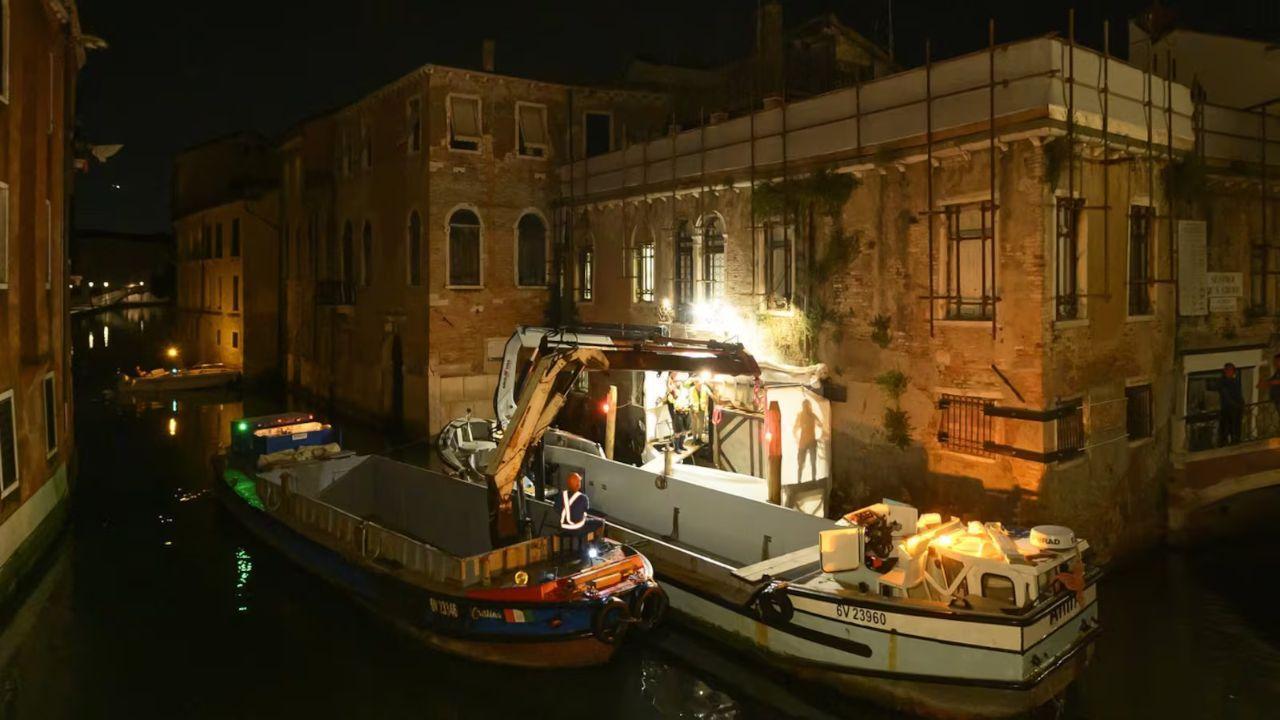
The detachment process, conducted overnight between July 23 and July 24, 2025, involved several critical steps:
-
Surface Cleaning:
Initial cleaning involved the removal of dust, grime, and superficial salts without harming the fragile paint layers.
-
Consolidation Treatments:
Specialized chemical consolidants were applied to stabilize flaking paint and adherence of pigment to the stone substrate.
-
Sectional Removal:
Rather than removing the entire wall or façade, a segment containing the artwork was carefully separated from the building’s exterior. This procedure required precise engineering and the use of advanced cutting and lifting equipment to transport the mural safely.
-
Temporary Housing for Restoration:
The removed wall segment was transported to a climate-controlled studio where further restoration processes will continue. This controlled environment allows conservators to carry out detailed cleaning, color retouching where appropriate, and protective coatings applications.
The delicate nature of the mural’s materials and damage meant every step required meticulous attention to ensure minimal loss of original substance and artistic intent.
Funding and Cultural Vision Behind the Project
Banca Ifis financed the entire operation, covering costs from planning and technical studies to the actual extraction and ongoing restoration work. The bank’s initiative reflects a broader commitment to Venice’s cultural heritage and urban identity, integrating the artwork into community access programs beyond its physical site.
Post-restoration, the batch intends to exhibit ‘Migrant Child’ in a series of free, publicly accessible cultural events and exhibitions. By doing so, Banca Ifis aims to extend the mural’s life cycle beyond the ephemeral street setting, providing space for reflection, education, and engagement with pressing social issues.
Although specific dates and venues for future displays have not yet been announced, the bank’s communications stress a desire to maintain the artwork’s activist spirit and message accessibility.
Dialogue on the Preservation of Ephemeral Street Art
This project has ignited widespread discussion among art experts, cultural commentators, and the general public. Prominent themes include:
-
Should Street Art Be Preserved?
Some argue that street art’s essence lies in its transitory nature—the work is a dialogue with the environment and momentary public space, meant to fade or be erased. Preserving such art in controlled environments may change its contextual meaning.
-
Value of Preserving Messages for Future Generations:
Others contend that powerful pieces like ‘Migrant Child’ transcend their street context, becoming valuable cultural testimonies warranting preservation to continue inspiring awareness on migration and humanitarian crises.
-
Impact on Venice’s Urban Identity:
Many Venetians view the mural as part of their city’s contemporary cultural fabric; its restoration symbolizes a commitment to protecting diverse historic and modern artistic expressions.
These complex debates illustrate the evolving role of street art in cultural heritage management and the difficulties in balancing authenticity, temporality, and preservation.
Public and Expert Reactions
Reactions have been mixed but largely respectful of the conservation effort:
-
Some local artists expressed concern about altering Banksy’s envisioned impermanence.
-
Cultural authorities and tourism officials generally supported preserving a work that had become emblematic for Venice visitors.
-
Human rights advocates applauded efforts that ensure the mural’s crucial social message is not lost due to natural decay.
International media coverage highlighted the operation as emblematic of Venice’s ongoing struggle to preserve its layered identities—historic and contemporary—in the face of environmental and tourist pressures.
The Future of ‘Migrant Child’: Moving Beyond the Wall
Once restoration is completed, the mural is expected to enter a new phase of life as an exhibit carefully curated to evoke its original power while offering enhanced interpretative frameworks. Possible venues include museums, public art roundtables, and cultural forums within Venice and beyond, potentially accompanied by multimedia materials contextualizing the migration crisis.
Such presentations may spark broader public discussions about refugees worldwide, the human stories behind migratory flows, and shared civic responsibilities.
Additionally, this restored work could serve as a model for preserving other endangered street art works, promoting innovative conservation strategies that respect both artistic spontaneity and heritage preservation.
Venice’s Ongoing Relationship with Street Art
Venice has a rich tapestry of historic art and architecture but has increasingly become a stage for contemporary street artists who bring immediacy and socio-political concerns into public view. The city’s balancing act involves welcoming these dynamic expressions without compromising the fragile urban fabric.
This case reiterates the complexities in managing urban artistic expressions—respecting the artistic freedom of public, often unauthorized works, while acknowledging their cultural influence and significance.
Technical and Conservation Innovations in the Project
The extraction and restoration process benefited from recent advances in restoration science:
-
Use of non-invasive cleaning agents tailored to salt- and humidity-affected stone surfaces.
-
Imaging and mapping technologies to document damage in microscopic detail.
-
Precision cutting tools to detach embedded murals without causing structural damage.
-
Environmental control systems replicating optimal humidity and temperature to stabilize pigments and substrates during restoration.
Such innovations highlight the growing toolbox available to conservators working at the intersection of contemporary art and architectural heritage.
Preserving a Beacon of Migration Awareness
The removal and restoration of Banksy’s ‘Migrant Child’ mural represent a rare fusion of street art activism and institutional preservation, reflecting broader societal shifts towards recognizing the importance of safeguarding artworks that address pressing global challenges.
While inherently ephemeral, this work’s symbolic power and enduring message about empathy for migrants and refugees have earned it a new chapter beyond its weathered canal wall in Venice.
As the mural embarks on its restoration journey, both Venetians and the global community await its rebirth, ensuring that Banksy’s evocative portrayal of vulnerable humanity continues to inspire awareness and dialogue for years to come.