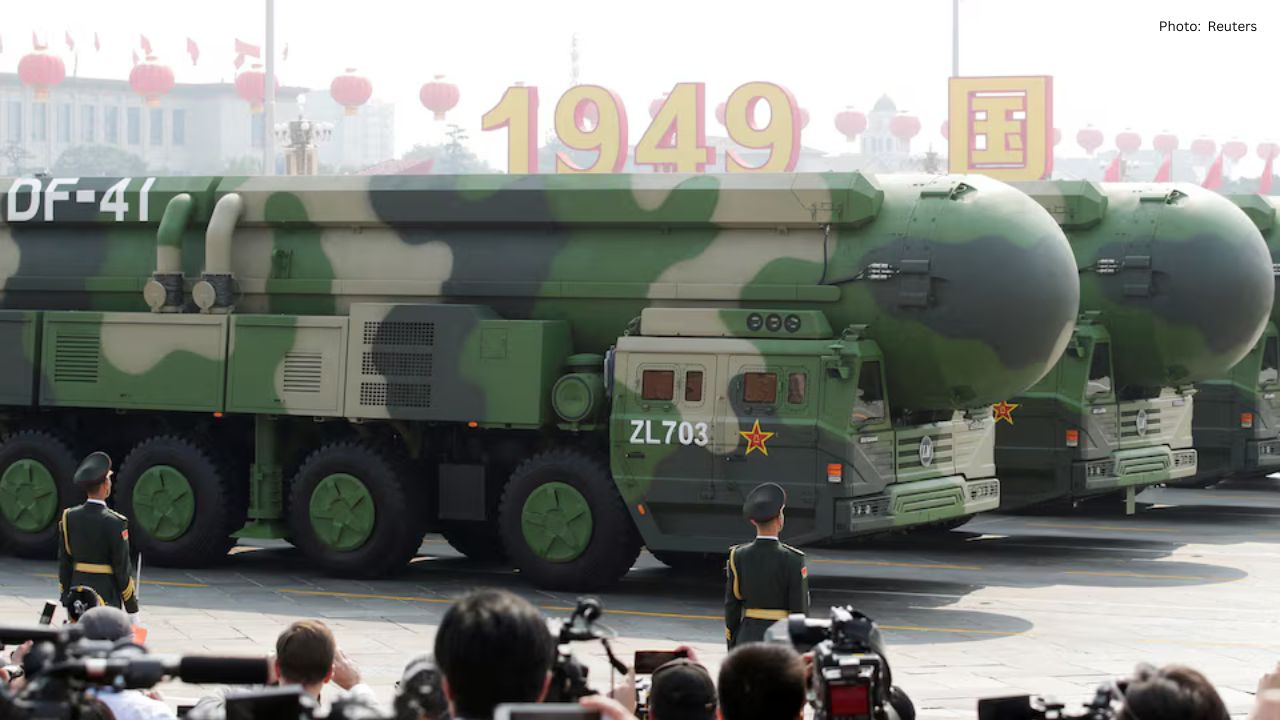
A draft report from the Pentagon reveals that China has likely loaded more than 100 intercontinental ballistic missiles (ICBMs) in newly established silo fields, marking a significant enhancement of its nuclear capabilities. The report also expresses concern over China’s reluctance to engage in arms control discussions, prompting worries about escalating military tensions in the Asia-Pacific area.
The report specifies that solid-fueled DF-31 missiles have been deployed in three silo fields situated near China's border with Mongolia. While the Pentagon had previously recognized the locations of these silos, the confirmation of the number of loaded missiles is a recent development. U.S. officials cautioned that this draft could undergo changes before being submitted to lawmakers.
Additionally, the report underscores China’s expansive military ambitions, stating that Beijing aims to be capable of successfully engaging in a conflict over Taiwan by 2027. The document forecasts potential military actions extending as far as 1,500-2,000 nautical miles from China, possibly challenging U.S. military assets in the region.
China’s nuclear warhead inventory is currently estimated to be in the low 600s by 2024, indicating a slower production pace than in earlier years. However, the Pentagon anticipates that this number could surpass 1,000 by 2030. Despite the increase in warheads, China asserts that it adheres to a defensive nuclear strategy and employs a no-first-use policy, intending to utilize nuclear arms solely in retaliation.
The report arrives at a time when the 2010 New START treaty, the last U.S.-Russia nuclear arms control pact, is nearing its expiration. Experts caution that the conclusion of this treaty may spark a tripartite nuclear arms race involving China, Russia, and the U.S. Daryl Kimball, the executive director of the Arms Control Association, stated, “More nuclear weapons and a lack of diplomacy will not enhance safety for anyone, including China, Russia, or the United States.”
China contests the Pentagon’s assertions of a military buildup, labeling such accounts as efforts to “slander and malign” the nation. The Chinese embassy in the U.S. emphasized that China upholds a defensive strategy, maintaining its nuclear forces at a minimum necessary for security.
The report also delves into internal shifts within China’s military framework. Under President Xi Jinping, there has been a sweeping anti-corruption initiative targeting the People’s Liberation Army (PLA) and the defense sector. While immediate readiness may be affected, the Pentagon posits that this could result in long-term benefits for the PLA's operational competence. Over the past year and a half, at least 26 senior officials in state-owned arms firms have faced investigation or dismissal, notably in the nuclear and naval construction fields.
This escalation of China's nuclear capabilities unfolds amid heightened tensions with the United States over Taiwan, the South China Sea, and additional regional disputes. While China underscores its commitment to self-defense and strategic moderation, the Pentagon's findings suggest that Washington perceives these actions as rapid military modernization, which could disrupt regional and global power dynamics.
As global attention intensifies, experts urge for proactive diplomacy to avert misunderstandings and mitigate the risks associated with nuclear confrontations. The forthcoming years will be critical in determining how China, the U.S., and other nuclear nations manage their arsenals and pursue arms control dialogue.