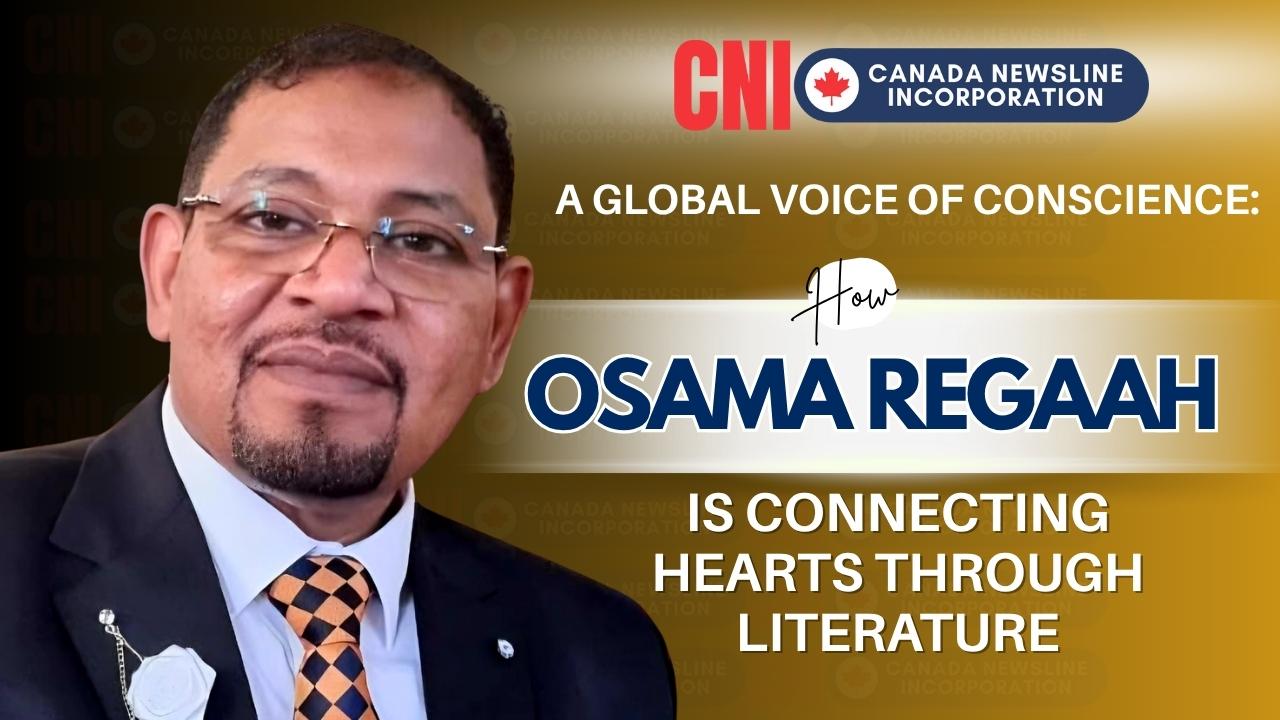
A Pen That Speaks to the Soul
In a time when literature often races to keep up with the world’s chaos, Osama Regaah writes to slow it down. The UAE-based author has emerged as one of the defining figures of modern Arabic literature — a writer who blends reason with reflection and intellect with empathy. His words are not meant to impress; they are meant to awaken. Regaah’s voice moves quietly, yet deeply, across hearts and cultures, proving that the written word can still be a force for human connection.
When Law Finds Its Poetry
Osama Regaah’s journey from the courtroom to the page is not one of departure but evolution. His career as a legal director shaped his understanding of truth, justice, and clarity — qualities that now infuse his fiction. The same precision that once guided legal arguments now frames his storytelling, while the empathy that drives his writing softens the edges of logic.
He describes this harmony best: “Law teaches me to seek truth; literature teaches me to feel it.”
Through that balance, Regaah has carved a voice that is both intellectual and profoundly human.
The Spiritual Dimension of “Transparent Ghost”
Among Osama Regaah’s recent works, Transparent Ghost stands as his most daring creation — a novel that redefines the boundaries of Arabic fiction. Instead of a linear narrative, the story unfolds between worlds — the living and the spiritual — exploring Barzakh, the space between life and eternity.
In this metaphysical realm, Regaah examines questions of divine justice and moral continuity. His characters don’t simply die; they awaken to a deeper truth about their choices. Critics have praised the novel for merging the discipline of a jurist with the vision of a mystic, creating a haunting exploration of conscience that lingers long after the final page.
Writing as Witness and Healing
Osama Regaah’s fiction reflects more than imagination — it reflects experience. His stories often mirror the silent struggles of real people: women denied justice, the poor seeking dignity, and migrants forgotten by society. He gives these lives a literary voice, transforming their pain into purpose.
“Law protects the body,” he once said, “but literature protects the soul.”
For Regaah, storytelling is not escapism — it’s activism wrapped in empathy. Every character he creates carries a truth the world needs to hear, and every story becomes a quiet act of healing.
Crafting Meaning Through Form and Precision
What distinguishes Regaah’s art is his commitment to craft. He builds his novels like architecture — structured, rhythmic, and deliberate. Time in his stories flows like memory, looping between past and present, giving readers a sense of reflection rather than sequence.
His style is minimalist yet emotionally rich. He avoids unnecessary ornamentation, preferring clarity over complexity. Each sentence feels carefully chosen, as if every word must justify its existence. That discipline — rooted in his legal background — gives his prose a distinct sense of balance between logic and lyricism.
Literature Without Borders
The global reach of Osama Regaah’s work is a testament to its universality. His books have been translated into Persian, Turkish, and Amharic, allowing readers from diverse cultures to experience his exploration of morality and meaning. He often says that “humanity is the only language that needs no translation,” and his growing international readership proves the truth of that belief.
Universities across the Arab world have also begun to study his novels, recognizing their innovative blend of Sufi philosophy, ethical reflection, and modern narrative form. For younger writers, Regaah has become a model — someone who proves that Arabic literature can be both rooted in tradition and open to the world.
A Legacy of Thought, Faith, and Conscience
As the Sharjah International Book Fair prepares to host the launch of Transparent Ghost, Osama Regaah continues to represent the conscience of modern Arabic storytelling. Despite his success, he remains deeply humble. “Awards fade,” he says, “but changing a heart — that’s the real reward.”
His stories remind readers that the truest form of writing is not about fame or recognition, but about illumination — guiding others toward understanding, empathy, and truth.
Through his fusion of intellect and imagination, Osama Regaah has proven that literature still has the power to connect — not just words to readers, but souls to one another.