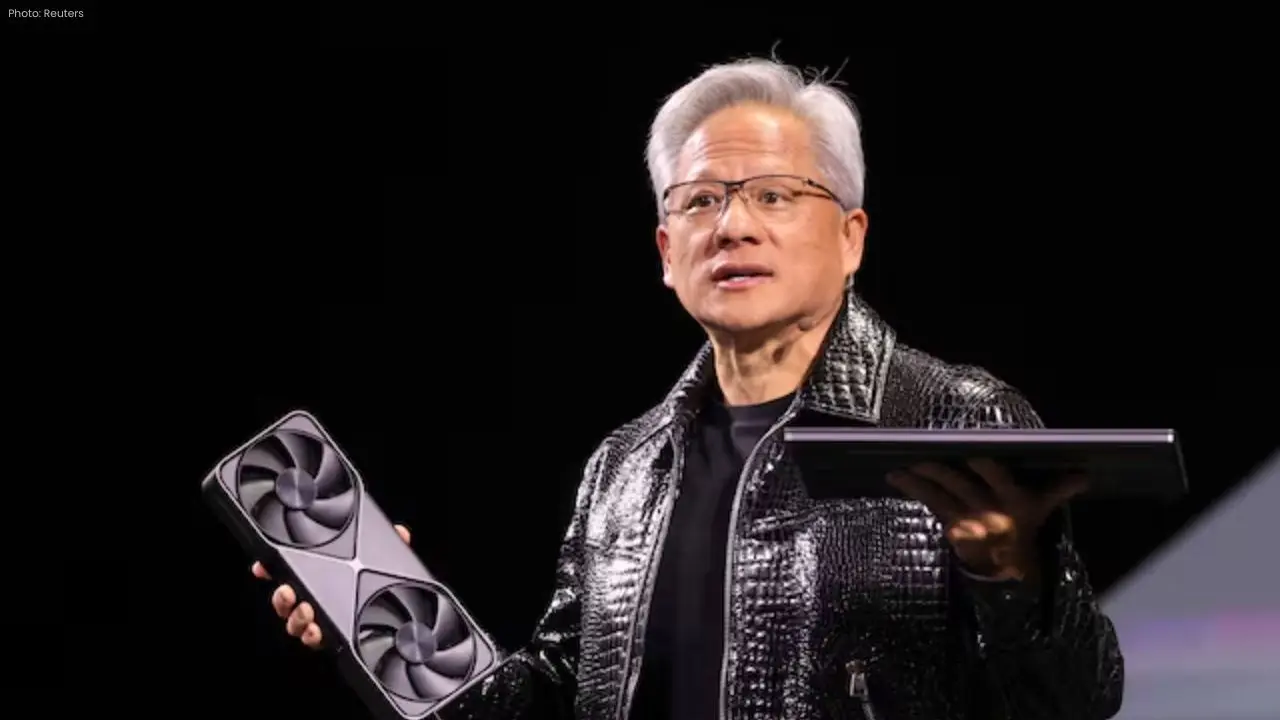
Nvidia CEO Jensen Huang announced that the company’s next-generation artificial intelligence chips have entered full production, signaling a significant advancement in AI computing capabilities. Speaking at the Consumer Electronics Show (CES) in Las Vegas, Huang said the new chips are capable of delivering up to five times more AI performance than Nvidia’s previous generation, particularly for applications such as chatbots and large-scale AI systems.
The new platform, called Vera Rubin, represents Nvidia’s latest high-performance computing architecture. It integrates multiple advanced chips into powerful server systems designed to handle complex AI workloads. According to the company, these servers can be interconnected into massive clusters containing thousands of chips, dramatically improving speed, efficiency, and the ability to generate AI outputs such as text, images, and other data-driven responses.
Huang explained that the substantial performance improvement is driven by a combination of a new proprietary data format and an upgraded chip architecture. This advancement allows Nvidia to achieve major efficiency gains even though the increase in the number of transistors is relatively limited. The company believes this approach could set a new industry standard if adopted more widely.
In addition to processing power, Nvidia is introducing new memory and networking technologies aimed at improving AI responsiveness. One of the key innovations focuses on reducing delays during long conversations with chatbots, making interactions faster and more reliable. The company also unveiled new networking switches designed to support large-scale data centers by enabling faster and more efficient connections between thousands of machines.
Nvidia said several major cloud service providers, including Microsoft, Amazon, Google, and Oracle, are expected to adopt the Vera Rubin systems. AI-focused infrastructure company CoreWeave is expected to be among the first customers to deploy the new platform.
Beyond hardware, Nvidia also highlighted advancements in software, particularly for autonomous vehicles. The company announced wider availability of new open-source software that helps self-driving cars make decisions while maintaining detailed records of how those decisions were reached. This approach is intended to improve transparency and trust, allowing automakers to better evaluate and refine AI behavior.
Despite increasing competition from traditional chipmakers and custom AI chips developed by major technology companies, Nvidia expressed confidence that its latest innovations will strengthen its leadership position in the rapidly evolving global AI market.