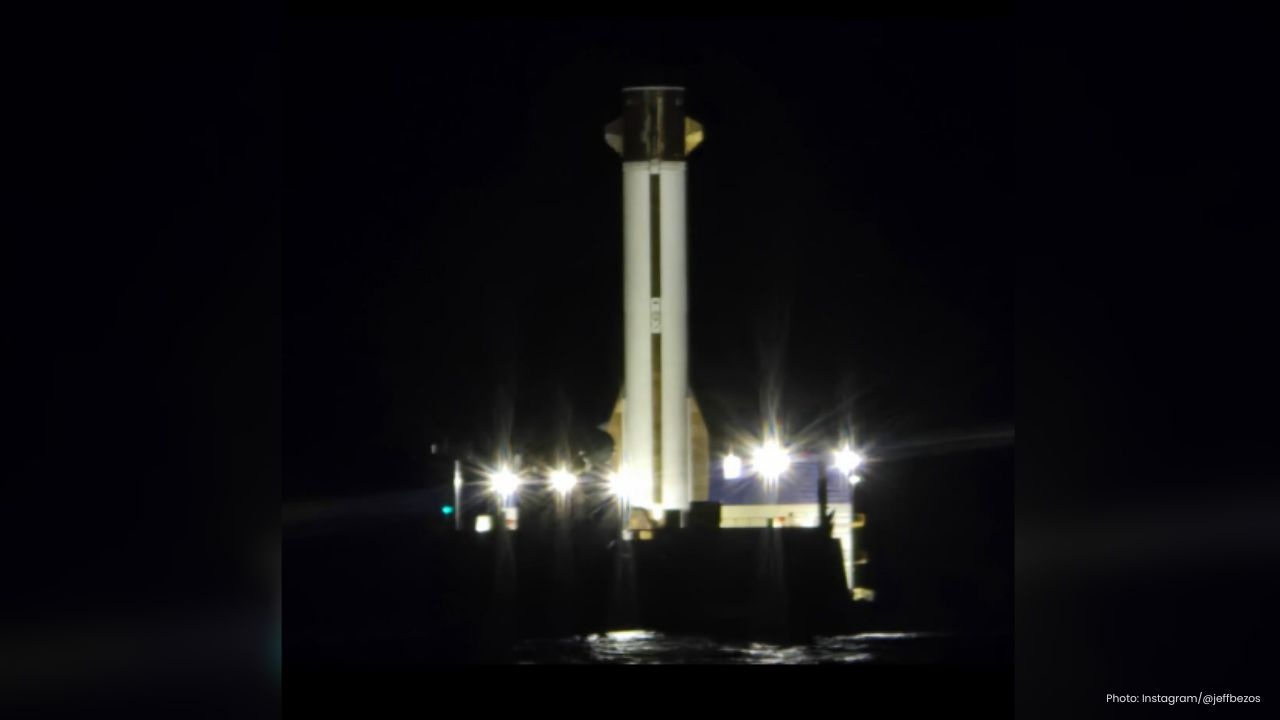
In a landmark event for space exploration, Blue Origin's New Glenn rocket ascended into the clouds on Thursday, successfully launching two NASA satellites on their way to Mars. The mission culminated in an impeccable booster landing—a feat previously associated with SpaceX.
The towering 320-foot rocket lifted off at 3:55 p.m. New York time after experiencing two delays, overcoming challenges with determination. Moments later, while the upper stage embarked on its journey, the lower booster executed a flawless landing onto a barge in the Atlantic Ocean, prompting cheers from mission control as it touched down with precision.
Jeff Bezos, attending the launch alongside Blue Origin CEO Dave Limp, celebrated this pivotal achievement with the team. During the broadcast, commentator Tabitha Lipkin remarked, “We’re competitive, we have a reusable booster, and this is just the start.” Bezos later took to social media to underscore the significance of the booster’s landing and praised the team's efforts.
After the successful landing, Blue Origin confirmed the deployment of the Mars-bound probes crafted by Rocket Lab. The spacecraft will stabilize in orbit before embarking on their journey to Mars in the upcoming year, taking advantage of the favorable alignment between Earth and the Red Planet.
This flight marks New Glenn’s second mission, and its inaugural venture for NASA, indicating a significant shift for Blue Origin's aspirations in orbital travel beyond suborbital tourism. Although lagging behind in the schedule, the company aims to compete more seriously with SpaceX, which has long led the market with its Falcon 9 rocket. The partial reusability of New Glenn is set to bolster Blue Origin’s launch frequency and address its $10 billion worth of satellite contracts.
With its enhanced payload capabilities, New Glenn plays a vital role in Blue Origin’s objectives for deep space missions, including NASA’s Artemis V lunar initiative. By executing a successful booster landing while deploying Mars-bound spacecraft, the company takes a significant stride toward challenging competitors like ULA's Vulcan and ESA's Ariane 6 in the heavy-lift rocket market.
The accomplishments of Thursday lay the groundwork for Blue Origin and the broader space race steered by billionaires, showcasing the company’s promise to transform orbital launch capabilities in the years ahead.