A New Era in Arabic Storytelling
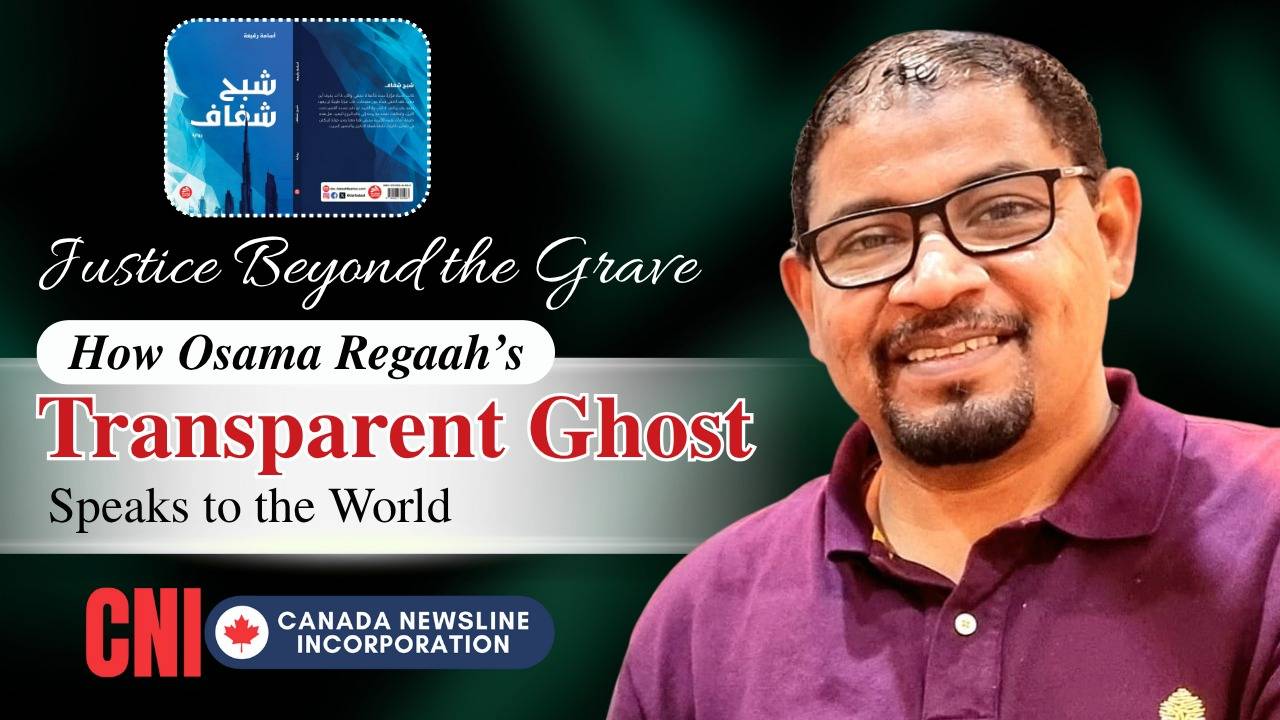
In today’s literary landscape, where realism and tradition often define Arabic fiction, Transparent Ghost by Osama Regaah arrives as a bold departure, a profound dialogue between life, death, and divine justice. Set to be unveiled at the Sharjah International Book Fair this November, the novel has already become a subject of anticipation across Gulf literary circles for its rare blend of mystery, faith, and moral reflection.
For Regaah, Transparent Ghost is not merely a story; it is a spiritual meditation. He describes writing it as an act of awakening, a journey through conscience as much as through imagination. Every chapter encourages readers to look inward, questioning their own sense of right, wrong, and the unspoken ties between justice and destiny.
The Question That Haunts Humanity
At the heart of the novel lies a question that transcends religion, geography, and time: What if justice does not end with life?
Osama Regaah begins his story in a familiar, modern world filled with ambition, competition, and hidden truths. But soon, the plot dissolves into a metaphysical dimension where the living and the dead share one moral universe. Here, souls observe their earthly lives, confronting the consequences of choices once justified by power or desire.
Drawing on the Islamic concept of Barzakh, the realm between life and the afterlife, Regaah transforms death into a mirror of divine accountability. The afterlife becomes a courtroom of conscience, where truth is no longer argued but revealed. The dead, far from silent, continue to think, feel, and remember, offering readers an unflinching view of the moral weight every human action carries.
A Time That Moves in Circles
One of the novel’s most distinctive qualities is its nonlinear narrative structure. Regaah describes it as a spiral of time, where the past, present, and afterlife coexist. Moments loop and overlap, mimicking the rhythms of memory and guilt.
The story is told through multiple voices, including the living, the departed, and unseen narrators, each revealing fragments of a larger truth. The reader becomes an investigator of morality, assembling meaning through reflection rather than sequence. This structure mirrors how real-life truth unfolds, gradually, painfully, and sometimes too late.
Through this inventive form, Regaah transforms reading into a moral experience. The audience becomes part of the trial, standing witness to their own inner courtroom where justice and mercy constantly collide.
Between Faith, Memory, and Conscience
Regaah’s prose flows with both clarity and poetry. His imagery, such as the sea as destiny, the green tree as redemption, and the hidden well as guilt, adds visual depth to his themes. While spiritual in tone, the novel is grounded in real societal concerns: corruption, ambition, betrayal, and the loss of integrity in the modern world.
By linking the corporate realm with the metaphysical, Regaah bridges the human and divine concepts of justice. His dual identity as a legal thinker and storyteller allows him to merge reason with compassion, showing that law and morality, logic and faith, are not opposites but reflections of one another.
Echoes of Heritage and Humanity
Deeply rooted in Gulf culture and Sufi philosophy, Transparent Ghost draws on regional myths, legends, and symbols while speaking to universal human emotions. The sea, a recurring image in Regaah’s work, becomes a metaphor for eternity, where every action leaves a ripple that endures beyond the body.
In doing so, Regaah revitalizes Gulf identity not as nostalgia but as a living philosophy. His writing affirms that tradition and modernity, faith and reason, can coexist, and that storytelling remains a sacred bridge between them.
A Landmark in Contemporary Arabic Fiction
Transparent Ghost is more than a novel; it is a literary experiment that unites mystery, spirituality, and philosophy under one vision. Critics regard it as one of the most significant contributions to contemporary Arabic literature, a book that redefines what it means to seek justice not in courtrooms, but in the soul.
As anticipation builds ahead of its Sharjah debut, Regaah remains grounded in purpose rather than fame. He says, I want my words to be read long after I am gone, as if I were still breathing between them.
This sentiment captures the spirit of Transparent Ghost: a story that transcends mortality to remind readers that words, like souls, never truly die. Through his work, Osama Regaah revives the belief that literature is not just an art form; it is a form of truth that speaks when the world falls silent.