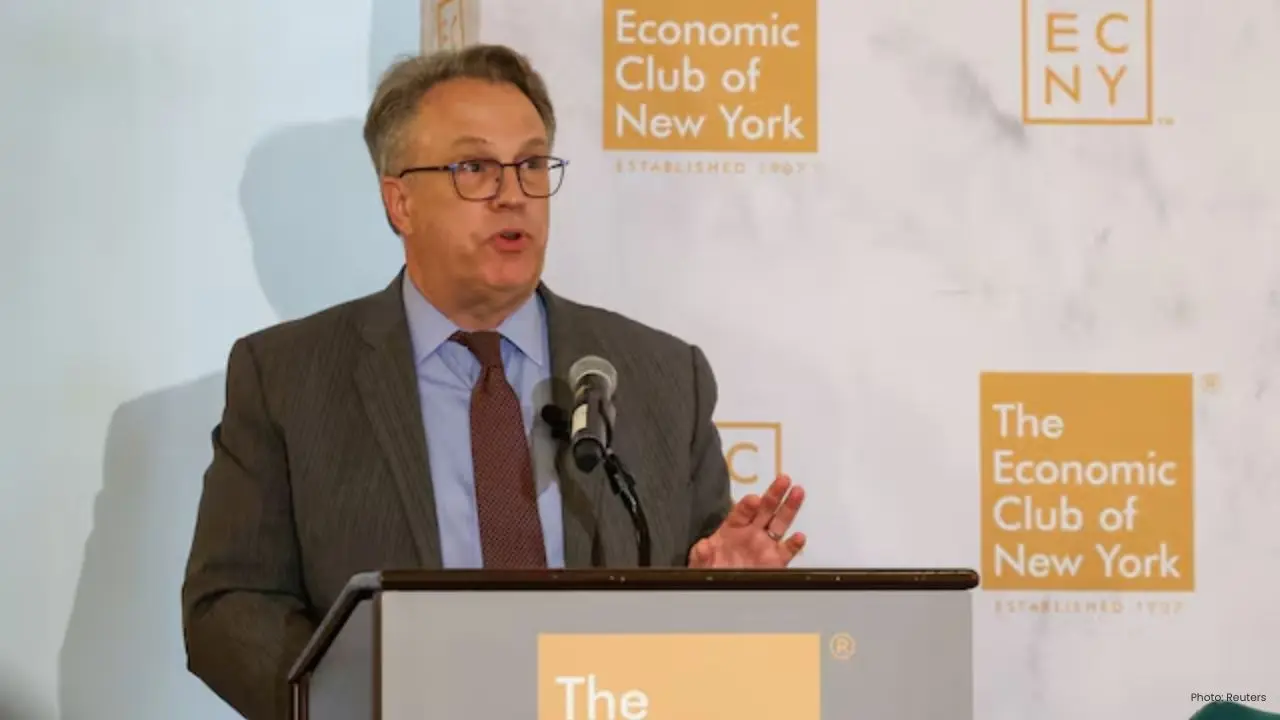
The discussion regarding the U.S. Federal Reserve's future decisions gained momentum on Friday as New York Fed President John Williams indicated that interest rates might be lowered “in the near term,” leading to a shift in market sentiment towards a December reduction.
While speaking at an event in Chile, Williams characterized current monetary policy as “modestly restrictive,” suggesting room for adjustments toward a more neutral federal funds rate. His influential position is underscored by his role as a permanent voter on the Federal Open Market Committee.
These insights were enough to prompt a swift reaction from traders. Market odds, which had previously leaned towards maintaining rates, swung back to reflect nearly a 60% probability of a quarter-point cut at the Fed's meeting set for December 9–10. Until now, ongoing inflation concerns had kept expectations muted.
Despite this shift, the situation remains complex. Williams observed that inflation progress had “temporarily stalled,” with prices still hovering above the Fed’s 2% goal. He mentioned that pressures related to tariffs should ease, and recent labor data reveals a cooling labor market, including an uptick in the unemployment rate to 4.4%, reminiscent of pre-pandemic levels.
Not all officials within the Fed are aligned on the idea of a rate cut. Boston Fed President Susan Collins expressed her “hesitation” towards further easing. She regards the current rate range of 3.75%–4% as effective in controlling inflation, particularly given the economy's robustness. Her viewpoint has contributed to shifting market expectations away from immediate rate cuts.
Also echoing caution was Dallas Fed President Lorie Logan, who reiterated in Zurich her belief that the October cut was premature. She advised that the Fed maintain current rates “for a time” to better evaluate the extent of the policy's restrictiveness. Logan will gain voting privileges next year, which adds future relevance to her stance.
The split among Fed policymakers arises as the central bank is without some key economic data due to delays from the recent U.S. government shutdown. With crucial inflation metrics and job reports pending, uncertainty shrouds the December decision.
As we approach the next meeting, the divide among policymakers—those advocating for adjustment versus those favoring a wait-and-see approach—has set the stage for one of the year's most scrutinized policy decisions.