China has officially launched its third aircraft carrier, named Fujian, marking a crucial step in the country’s naval modernization agenda. This milestone cements China’s position as a formidable maritime power, now boasting the second-largest fleet of aircraft carriers globally, just trailing the United States.
The commissioning event, which featured President Xi Jinping, highlighted China’s aspirations to assert itself as a leading naval force within the Asia-Pacific region. Named after a southeastern coastal province, the Fujian exemplifies premier naval design and advanced military tech.
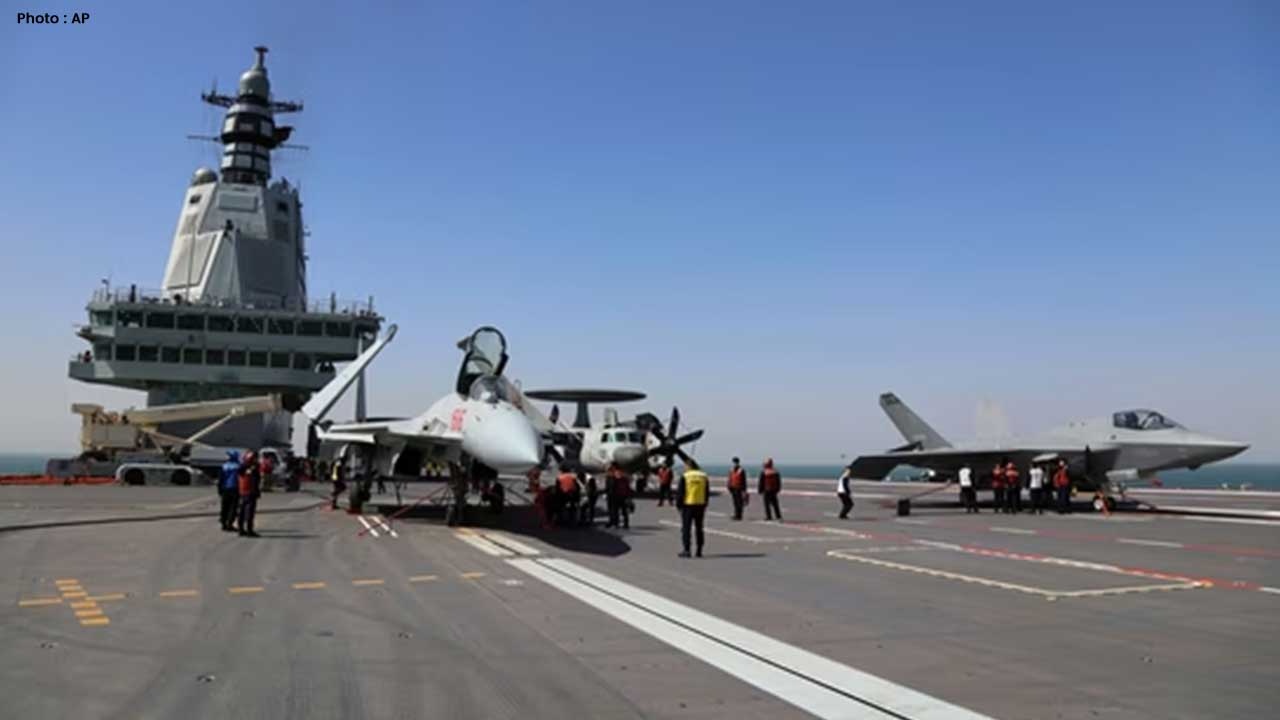
Unlike its predecessors, the Liaoning and Shandong, the Fujian is the first carrier in the Chinese fleet equipped with an electromagnetic catapult launch system. This cutting-edge technology enhances the carrier’s operational range and strike capabilities by allowing for the launch of heavier, fully armed aircraft. The Fujian can deploy sophisticated aircraft, including the KJ-600 early-warning plane, the stealth J-35 fighter, and the J-15T heavy fighter.
Significantly, the Fujian is China’s first domestically designed aircraft carrier, distinguishing it from the Liaoning, which was initially an incomplete Soviet ship obtained from Ukraine, and the Shandong, built locally but based on the Liaoning’s blueprint. With this new addition, China surpasses countries like India, the UK, and Italy, each operating two carriers.
Technologically, the Fujian stands as the world’s second aircraft carrier utilizing an electromagnetic catapult system—an advancement previously exclusive to the U.S. Navy’s USS Gerald R. Ford. This innovative system substitutes traditional steam-powered catapults, enabling smoother and more efficient aircraft launches while minimizing mechanical wear on both the vessel and the planes.
Despite its impressive full-load displacement of over 80,000 tons, the Fujian is smaller than its American counterparts, which can reach 100,000 tons. The Chinese carrier can hold between 40 to 60 aircraft, while U.S. carriers typically accommodate 60 to 70 planes.
A notable limitation of the Fujian is that it is conventionally powered, capping its range at about 8,000–10,000 nautical miles, whereas U.S. carriers operate on nuclear power, granting them virtually unlimited range.
Experts speculate that China is working on developing nuclear-powered carriers as part of its next naval advancement phase. Military analysts assert that the Fujian’s design and capabilities represent a significant leap toward that objective, positioning China to broaden its influence into the Pacific Ocean and vital regions like the South China Sea, East China Sea, and Taiwan Strait.
Equipped with three electromagnetic catapults, two aircraft elevators, and a streamlined flight deck, the Fujian is among the most sophisticated vessels in China’s arsenal. While it has one less launch system than the USS Ford, the Fujian illustrates China’s advancements in naval warfare technology.
As China proceeds with the expansion and modernization of its navy, the Fujian’s commissioning signals its serious maritime goals. This carrier not only bolsters China’s defense capabilities but also extends its strategic reach well beyond regional confines, reshaping the global naval power equilibrium.