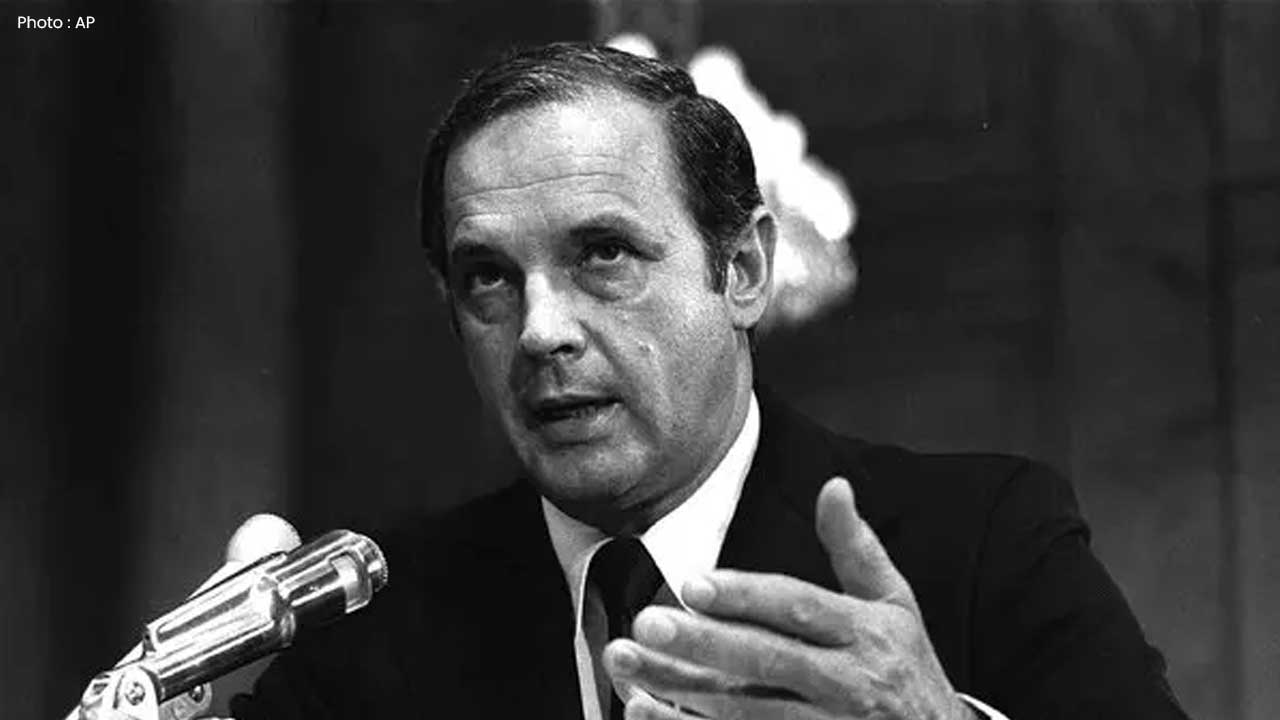
Alexander Butterfield, the former White House aide who exposed President Richard Nixon’s secret recording system during the Watergate scandal, has died at the age of 99. His death, confirmed by his wife Kim, occurred a month before he would have celebrated his 100th birthday at his home in La Jolla, San Diego. No cause of death was mentioned.
Butterfield served as deputy assistant to President Nixon from 1969 to 1973. He was the man who revealed the existence of Nixon’s audio taping system, which secretly recorded conversations and meetings in the Oval Office, Nixon’s office in the Executive Office Building, the Cabinet room, and four White House telephones. This revelation became a pivotal moment in American history and led to the discovery of the “smoking gun” tape that ultimately forced Nixon to resign.
A native of Pensacola, Florida, Butterfield grew up in California and attended UCLA before joining the US Air Force in 1948. He served as a combat pilot during the Vietnam War, leading a squadron of tactical reconnaissance aircraft. Later, he worked as a military assistant to a senior Pentagon official, gaining valuable experience that led him to the White House.
Butterfield joined the Nixon administration as a deputy to Chief of Staff H.R. Haldeman, a longtime friend from UCLA. Among his duties was maintaining a historical record of the presidency, which included overseeing the installation of the secret voice-activated taping system. By the time the Watergate break-in at Democratic headquarters on June 17, 1972, became a major political issue, Butterfield had already left the White House to become the head of the Federal Aviation Administration.
When called to testify before the Senate Watergate Committee in 1973, Butterfield disclosed the recording system. In a nationally televised hearing, he confirmed that listening devices had recorded conversations in key areas of the White House. This news stunned the nation, providing investigators with undeniable evidence of Nixon’s knowledge of the cover-up.
Butterfield later explained that President Nixon had often forgotten about the recorders and had ignored advice to destroy the tapes, never expecting the scandal to reach the point where he would have to surrender them. The tapes ultimately revealed Nixon agreeing to halt the investigation into the break-in, which led to his political downfall. The Supreme Court rejected Nixon’s claims of executive privilege, forcing him to release the tapes, and he resigned on August 9, 1974, avoiding impeachment.
Despite his central role in uncovering the tapes, Butterfield was never implicated in the break-in or the cover-up. Several of Nixon’s other aides, including Haldeman, went to prison for their involvement. Butterfield later provided extensive documents and interviews to journalist Bob Woodward, contributing to the 2015 book The Last of the President’s Men, which described the inner workings of the Nixon administration.
Butterfield remained involved in public life, advising filmmaker Oliver Stone for the 1995 movie Nixon, in which he also appeared briefly as a White House staffer. Over the years, he expressed mixed feelings about his role in Watergate, acknowledging the historical significance of his revelation while noting that he never sought personal fame for it.
Alexander Butterfield’s death marks the passing of a figure who played a key role in one of America’s most important political events. His courage in disclosing the secret White House tapes helped uphold accountability and transparency in government, leaving a lasting legacy in US history