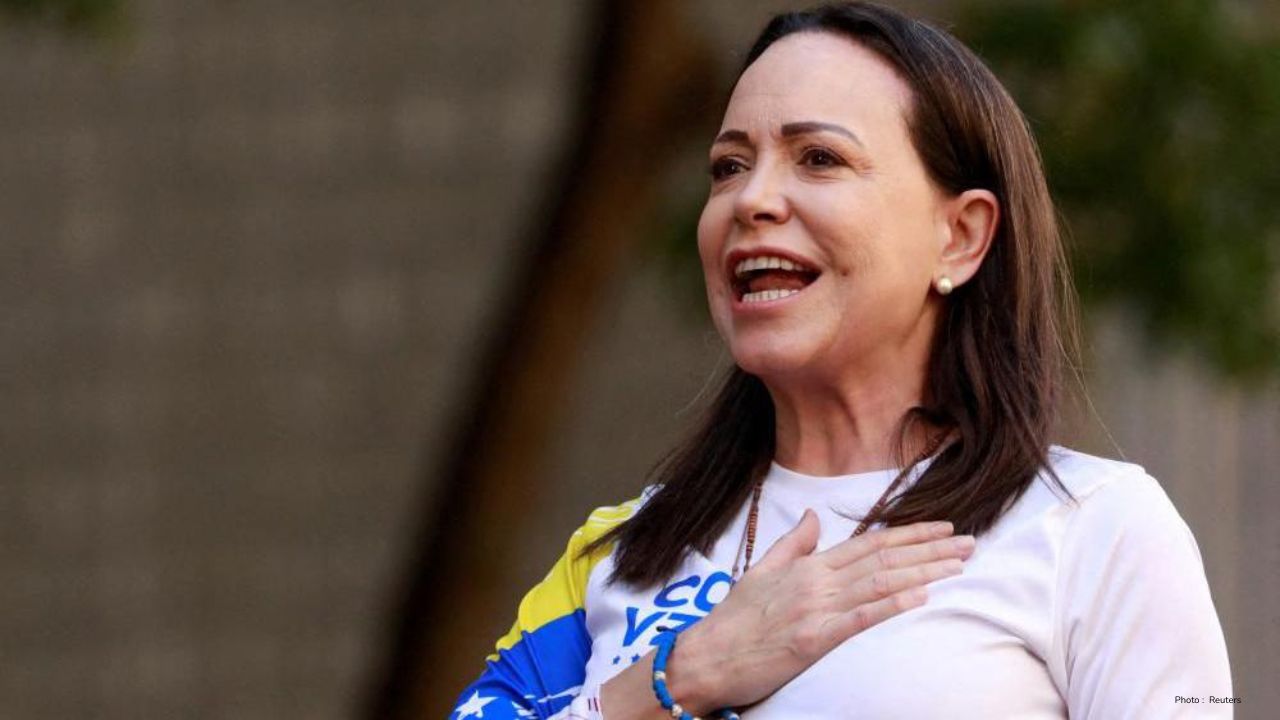
In a historic announcement on October 10, 2025, the Norwegian Nobel Committee awarded the Nobel Peace Prize to Maria Corina Machado, the Venezuelan opposition leader, recognizing her courageous fight against dictatorship in her country. Machado, 58, has lived in hiding for years to avoid persecution by the government of President Nicolas Maduro. This award has captured global attention and sparked both praise and controversy.
Machado, an industrial engineer and a leading voice against authoritarian rule in Venezuela, was blocked by Venezuela’s courts in 2024 from running for president. This decision prevented her from challenging President Maduro, who has been in power since 2013. Despite these obstacles, Machado continued to lead peaceful campaigns for democracy and freedom in Venezuela. The Nobel Committee praised her for standing up to oppressive power and defending human rights under extremely challenging conditions.
“Oh my God … I have no words,” Machado said during a phone call with Kristian Berg Harpviken, secretary of the Nobel award body. She added, “I thank you so much, but I hope you understand this is a movement, this is an achievement of a whole society. I am just one person. I certainly do not deserve it.” Her words reflect both humility and the collective effort of many Venezuelans working for democracy and social justice.
The White House criticized the decision, calling it “political.” A spokesperson, Steven Cheung, wrote on X (formerly Twitter) that President Donald Trump has been working on peace deals globally, including efforts to reduce conflict in Gaza, and suggested that the Nobel Committee prioritized politics over peace. Despite this criticism, the Nobel Committee emphasized that the award celebrates individuals who show courage against authoritarianism and defend freedom.
President Nicolas Maduro, in power for 12 years, has presided over a period of deep economic and social crises in Venezuela. His government faced international pressure and disputes during the 2025 elections. Machado’s recognition highlights the global importance of peaceful resistance and democratic movements, even when leaders face strong political opposition and personal danger.
It remains uncertain whether Machado will be able to attend the Nobel Peace Prize ceremony in Oslo on December 10, 2025. Many laureates throughout history have been unable to attend due to political restrictions or personal safety concerns. This includes Soviet dissident Andrei Sakharov in 1975, Poland’s Lech Walesa in 1983, and Myanmar’s Aung San Suu Kyi in 1991. If Machado cannot travel to Norway, she will join this list of laureates recognized from afar, underlining the risks she continues to face in Venezuela.
The Nobel Committee stated that awarding Machado the Peace Prize serves as recognition not only of her personal courage but also of the wider struggle of Venezuelans fighting for freedom and democracy. Her award sends a strong message that the international community is watching and supporting efforts to challenge oppressive governments through nonviolent action.
Machado’s achievement has sparked celebrations among Venezuelan citizens and opposition supporters around the world. It highlights the importance of standing firm for human rights and the role of peaceful activism in bringing hope to countries facing political and social turmoil.
In conclusion, Maria Corina Machado’s Nobel Peace Prize is a historic moment for Venezuela and a recognition of the ongoing struggle for democracy and human rights in countries facing authoritarian rule. While controversy surrounds the award, it shines a spotlight on the courage, resilience, and determination of those who fight for freedom against great odds. Machado’s award reminds the world that individual bravery, combined with collective effort, can inspire change even in the most difficult circumstances.