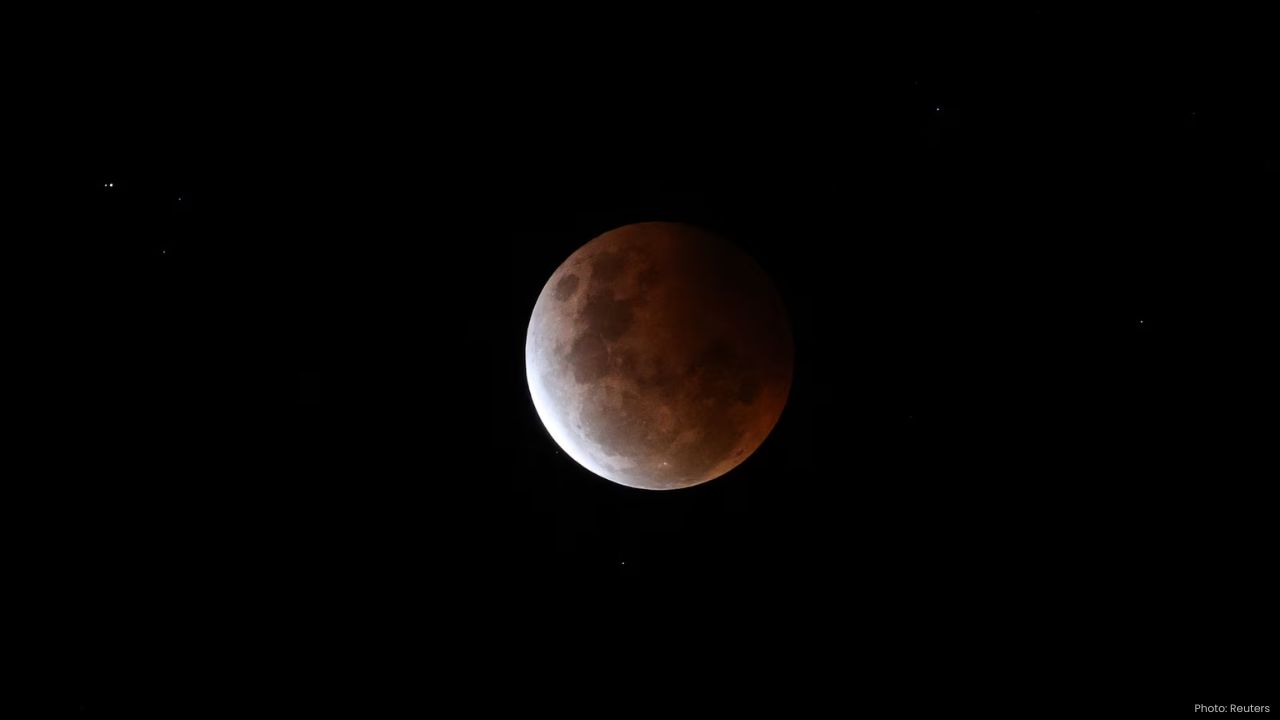
Millions of people across India and around the world turned their eyes to the night sky on Sunday to witness a rare and mesmerizing celestial event — the total lunar eclipse, popularly known as the “Blood Moon.” During this phenomenon, the Moon appeared in a deep, reddish shade, creating a spectacle that left both scientists and casual sky-watchers in awe. This was the first Blood Moon visible in India since 2018, making the event even more special.
What is a Lunar Eclipse?
A lunar eclipse is a natural astronomical event that occurs when the Moon passes through the Earth’s shadow. This happens only when the Sun, Earth, and Moon are almost perfectly aligned in a straight line. During a total lunar eclipse, the Earth blocks the Sun’s light from directly reaching the Moon. This is why the Moon seems darkened during the event.
Lunar eclipses occur during a full moon when the Moon is near one of its two points of orbit called “lunar nodes,” which are the points where the Moon’s orbit crosses the plane of the Earth’s orbit around the Sun. These events can happen roughly twice a year, but total lunar eclipses visible from a specific location are rarer.
The type of lunar eclipse — whether partial, total, or penumbral — and its length depend on how closely the Moon passes to the lunar node. The longer the Moon stays in Earth’s shadow, the longer the eclipse lasts, creating an extended viewing experience for sky-watchers.
Why Does the Moon Turn Red?
The stunning red hue of the Moon during a total lunar eclipse is the reason it is popularly called a “Blood Moon.” This crimson color occurs because of the way sunlight interacts with the Earth’s atmosphere.
Ryan Milligan, an astrophysicist at Queen’s University Belfast, explained: “The Moon appears red during lunar eclipses because the only sunlight reaching it is reflected and scattered through the Earth’s atmosphere. Blue light is scattered more easily than red, leaving the Moon with its iconic ‘bloody glow.’”
In simpler terms, the Earth’s atmosphere acts like a filter. Sunlight passes through the atmosphere and bends toward the Moon. As it does so, shorter wavelengths of light, like blue and green, scatter away, while longer wavelengths, like red and orange, pass through and reach the Moon. This creates the eerie, fiery glow that captivates millions of observers.
How Long Did Sunday’s Eclipse Last?
The total lunar eclipse began at 8:58 pm across India and continued until 2:25 am the next day, making it a long and spectacular event for anyone who stayed awake to watch. This eclipse was also notable for being the second Blood Moon of 2025, the first having occurred in March.
Astronomers pointed out that this eclipse was the longest such event since 2022, offering a rare opportunity for detailed observation. It gave scientists, students, and amateur astronomers alike a chance to study the Moon, the Earth’s shadow, and the way light interacts with our planet’s atmosphere.
When Can India See the Next Blood Moon?
For those who missed Sunday night’s eclipse, there is no need to worry. India will next witness a total lunar eclipse on December 31, 2028. This gives astronomy enthusiasts another opportunity to marvel at one of nature’s most beautiful and rare spectacles.
The Significance of Blood Moons
Blood Moons have fascinated humans for centuries. In many cultures, these events were considered omens or significant signs. Today, while we understand the science behind the red glow, the beauty and rarity of the Blood Moon continue to inspire awe and curiosity.
Eclipses like these also play a role in scientific research. Studying the Moon during an eclipse can help scientists learn more about its surface and how sunlight and Earth's atmosphere interact. Observing lunar eclipses can also provide clues about the Earth’s atmosphere, climate changes, and even the conditions that might exist on other planets.
Observing the Night Sky
Events like the Blood Moon encourage people to look up and connect with the universe. Families, students, and amateur astronomers often gather in open fields, on rooftops, and at observatories to witness the Moon turning red. The spectacle is not only educational but also deeply inspiring, creating memories that last a lifetime.
Experts recommend using telescopes or binoculars to get a closer view, though the Moon is bright enough to be seen clearly with the naked eye. Many photography enthusiasts also take the opportunity to capture stunning images of the Moon during its fiery glow, sharing them with friends, family, and the wider community online.
How to Enjoy Future Eclipses Safely
Unlike solar eclipses, total lunar eclipses are completely safe to observe without any special equipment. This is because the Moon reflects sunlight and does not emit its own light. People of all ages can enjoy watching a Blood Moon without risking their eyesight.
To make the experience more engaging, some schools, science clubs, and astronomy organizations host viewing events, offering telescopes, guidance from experts, and educational talks about the Moon, planets, and stars. This turns a simple sky-watching experience into a fun and educational activity for students and families alike.
Sunday night’s Blood Moon reminded millions of people across India and the world of the incredible wonders of the universe. The red Moon, glowing in the night sky, was a spectacular sight that combined beauty, science, and history in one unforgettable event. As we look forward to the next total lunar eclipse in 2028, Sunday’s celestial show will remain a cherished memory for everyone who witnessed it.
Whether you are a scientist, a student, or someone who enjoys looking at the night sky, events like the Blood Moon encourage curiosity, learning, and appreciation for the cosmos. Observing the Moon in its crimson hue is a reminder that even in our everyday lives, the universe holds moments of breathtaking beauty waiting to be discovered.