Australia and the European Union have officially signed a major free trade agreement after nearly eight years of negotiations. The deal, valued at around A$10 billion, is being seen as an important step to strengthen economic ties during a time of global uncertainty and shifting trade dynamics.
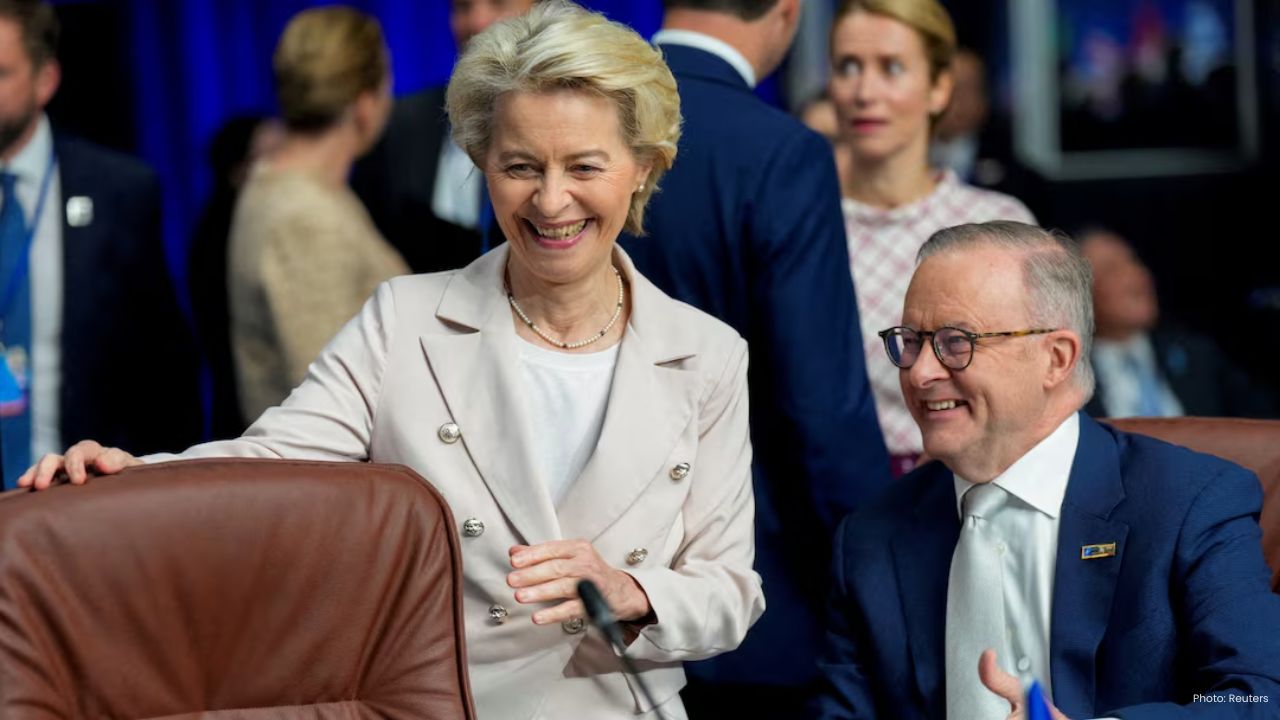
The agreement was signed by Australian Prime Minister Anthony Albanese and European Commission President Ursula von der Leyen, both of whom described it as a “win-win” for both sides. Leaders highlighted that the deal is not only about trade but also about building long-term trust and cooperation in a rapidly changing global environment.
One of the key features of the agreement is the removal of almost all tariffs on goods traded between the two regions. This will make it easier for Australian businesses to export products such as wine, seafood, dairy, fruits, vegetables, wheat, and barley to Europe. At the same time, consumers in Australia are expected to benefit from lower prices on European goods like chocolates, pasta, biscuits, wines, and spirits.
The deal is particularly important for Australia’s wine industry, which is expected to save millions of dollars due to reduced export costs. However, there are also some compromises. For example, Australian producers will be allowed to continue using certain European product names like “parmesan,” while others such as “feta” will be gradually phased out under agreed timelines. Interestingly, Australia has secured special permission to continue using the name “prosecco” for domestic sales, although export use will be limited over time.
While many sectors welcomed the agreement, some concerns have been raised. Representatives from Australia’s meat industry said the deal does not fully meet their expectations, especially regarding export quotas for red meat. Although quotas have increased, industry leaders believe the final numbers fall short of what was needed for significant growth.
Beyond trade, the agreement also includes stronger cooperation in defence, security, and critical minerals. Both sides have agreed to work together on areas such as counter-terrorism, maritime security, space collaboration, and supply chains for important resources like lithium and tungsten. These materials are essential for modern technologies and energy systems, making them strategically important.
European Commission President von der Leyen emphasized that the deal reflects a shared vision of “collective resilience,” especially at a time when global powers are increasingly using trade policies as tools of influence. The agreement also signals a move by both partners to reduce dependency on uncertain supply chains and strengthen reliable partnerships.
Overall, the Australia-EU trade deal is seen as a major milestone that could reshape economic relations between the two regions. While some challenges and concerns remain, the agreement is expected to create new opportunities for businesses, improve market access, and support long-term economic stability for both sides.